
5 Genius Ways Walmart Used Psychology to Become the World’s Biggest Retailer
(It’s why their shopping carts are so big…)
Walmart is a monster. It’s the world’s biggest retailer, raking in 514 billion dollars in 2019 alone. It employs 2.2 million people — that makes it the world’s second largest employer. It’s behind only the U.S. Department of Defense and ahead of the People’s Liberation Army in China.
You might have some feelings about the way Walmart does business, but you can’t deny that they really know how to sell. And you may not know it, but there are psychological secrets behind why they’re so good at getting us to buy.
In this article, I’m going to talk about five genius ways that Walmart used psychology to become the world’s biggest retailer.
Prefer to watch these principles? Check out the video on YouTube:
1. Giant shopping carts make it easy to buy more
In 1962, SamWalton started the first Walmart in Bentonville, Arkansas.
He would eventually become America’s richest man, but back then, nobody knew who Sam Walton was — and they didn’t know anything about Walmart.
Walton knew that to get customers into the store and keep them coming back, he had to do something drastic. He needed to offer prices that no one else could match.
The problem was, low prices meant you had to sell lots of products.
Let’s say you’re buying apples. At the local Mom and Pop store, they might cost $1.00 a piece. But at Walmart they cost 50 cents.
If customers see that your apples are half the price, they’re more likely to visit you. BUT it also means you have to sell 2 apples to make the same amount of money.
The upside is lots more people will buy two apples.
Some may even buy 5 or 10. If you’re selling 10 apples now instead of 1, you’re making 5 dollars at Walmart while your competitor is still only making a dollar.
It’s sales volume that keeps you in business when your products are really cheap. Walmart eventually figured out an easy way to up their sales — give customers bigger carts.
Walmart eventually figured out an easy way to up their sales — give customers BIGGER carts.
A study led by researcher Martin Lindstrom found that when the size of a shopping cart was doubled, customers bought 40% more items.
What’s driving those sales? One possibility is the Priming Effect. That’s when our brains call on unconscious connections in response to a stimulus — also called a prime. In other words, what we’re exposed to now changes our behavior later.
When Walmart customers see those huge carts, they’re primed to throw a few more things in the basket, because they want to fill up the empty space. And that helps Walmart get the sales volume that they need to keep their prices so low.
2. “Action Alley” grabs your attention
Walmart are masters at grabbing customers’ attention. They believe in that old retail saying: “If they see it, we sell it.”
Since the earliest days of Walmart, Action Alley has been a signature part of the store layout. It’s basically a square aisle with small shelves or bins that contain low priced products or sales — like 5 dollar DVDs — and it sits right in the middle of the main shopping aisles.


By sticking Action Alley right in the middle of an aisle — even though this interrupts customers — Walmart guarantees that people will see and probably act on the deals.
But not everyone was a fan of Action Alley — in the early 2000’s a store redesign initiative called Project Impact removed Action Alley.
Customers were complaining that Action Alley cluttered up the aisles and got in their way. But less than a year later, sales had suffered so much that Action Alley was brought right back.
Why is Action Alley so effective? It’s down to a behavioral science principle called Salience Bias.
Salience describes how good an item is at getting your attention. If the product seems to jump out at you, it’s salient. If it blends into the background and takes a while to find, it’s not.
By sticking Action Alley in everyone’s way, Walmart’s making sure these deals are super salient. Even if they’re annoying their customers.
3. Sales aren’t just sales… they’re Rollbacks
When you think of sales, do you think of Walmart? Not if they can help it. Because of their focus on Everyday Low Prices, Walmart doesn’t do many clearance prices or regular sales. Instead they have something called Rollback offers.
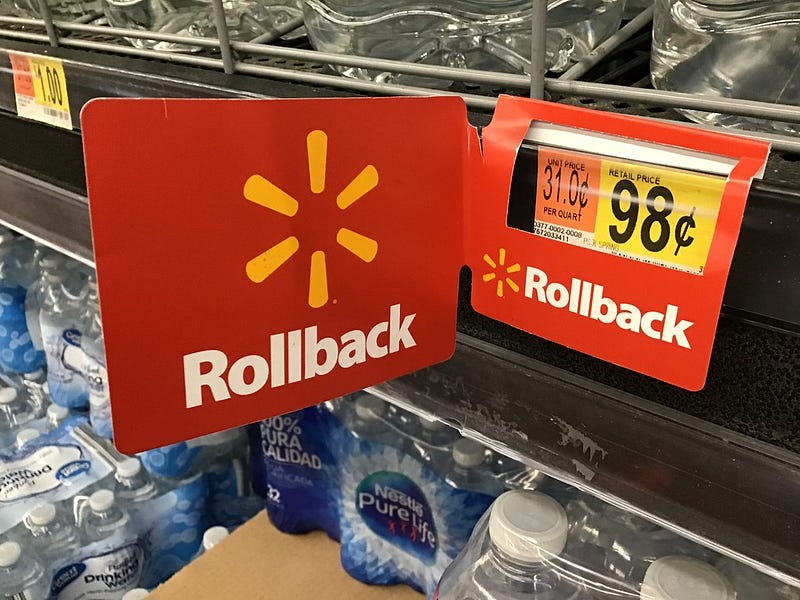
Walmart does something interesting with these Rollback offers — they always show the original price in big bold numbers on the Rollback sign. So if green beans were 64 cents and are now rolled back to 50 cents a can, the sign will have two prices — the old one, 64 cents and the new one, 50 cents.
Why do they do that? Because people don’t know how much most things should cost in isolation. Without something to compare it to, you don’t really know if 50 cents is a good deal on green beans. You assume it is, because that’s what the sign says.
It’s down to a psychology principle known as Anchoring. It says that our decisions are influenced by the first information we see. We’ll mentally grab on to this information without being consciously aware that we’re doing it.
Professor Dan Ariely illustrated anchoring in an experimental auction he ran with his class at the Massachusetts Institute of Technology (MIT). First, he showed students random objects, like a bottle of wine or a textbook.
Ariely then asked students to write down a fake price for each item using the last two digits of their Social Security number.
For example, if my Social is 123–45–6789, the price of a bottle of wine would be $89. After students wrote down the fake price of each item, they bid on it in an auction. Students who had high Social Security numbers paid up to 346% more than students with low numbers — for the same items.
Students who had high Social Security numbers paid up to 346% more than students with low numbers — for the same items.
Why? Because the first number they saw — even though it was completely unrelated — influenced how much they decided to bid.
The students mentally anchored to that number. The higher the Social Security number, the higher the bid. Walmart knows that when customers anchor to the original price, the Rollback price always looks good in comparison.
That’s why anchoring can get customers to potentially pay more… but always feel like they got a good deal.
4. The sneaky way Walmart stocks its shelves
Walmart might be the world’s biggest retailer today, but during its rise to power there were definitely some bumps in the road.
They might be focused on their Everyday Low Prices, but on more expensive products they found that a low price alone — can backfire.
Let’s take TVs for example.

When Walmart focused strictly on low-priced TVs, they weren’t stocking brands that people knew and loved.
And when people couldn’t find the brands they trusted, they weren’t willing to spend a few hundred dollars on a TV, even if it was the cheapest TV, when it wasn’t a brand they recognized.
Walmart found that to drive sales they had to have brand names that people knew and loved, not just a low price.
Why? Research has found that customers perceive value as price plus quality. If your price is low, but your quality is too low too, customers think your product has low value. But if your price is low and your quality is high, then your product has high value.
Customers perceive value as price plus quality.
One way that customers perceive quality is by leaning on the reputation of a well-known brand name. As Stephen Quinn, former Chief Marketing Officer at Walmart told the New York Times,
“Customers really need the assurance of brands… In the past we were focused on low price.
But low price on what?”
So Walmart began stocking lower-priced models from brands like Sony, Samsung, and Magnavox. When they did, sales started to pick up.
Why? It’s down to something called the Authority Principle.
The Authority Principle states that people are more easily persuaded by authority figures. That could include police, government leaders, professors, and perceived experts.
Or, in the case of electronics, a well-known brand.
5. Greeters have an outsized impact

Walmart stores have had Greeters at its doors for decades. Saying hello and goodbye to customers, handing out smiley face stickers, and generally being a nice friendly face at the beginning and end of your Walmart shopping experience.
Even though Walmart found Greeters made their customers feel more welcomed, they’re also adding a new position in some stores — Customer Hosts. Hosts are kind of like Greeters on steroids — they greet, but they also make cart runs, clean spills, and lift heavy items for customers.
Greeters and Hosts perform a critical role in Walmart’s customer experience — their smiling faces and helping hands help lift customers’ spirits and generate some warm, fuzzy feelings for the retail giant.
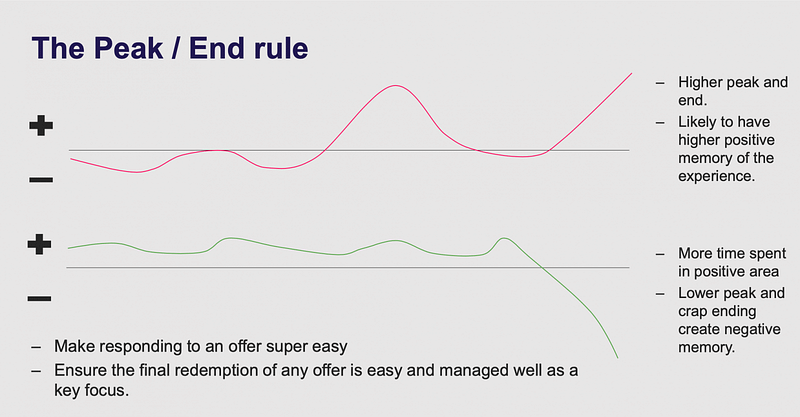
According to the psychological Peak-end Rule, the emotional peaks and ends of any experience punch above their weight.
The Peak-end Rule says that people judge an entire experience by only two points — how they felt at its peak and its end. Not the average of every moment of the experience.
Who discovered Peak end? Nobel laureate Daniel Kahneman and a research team explored this subject in a study about how people remember pain. He asked men to rate their discomfort during a colonoscopy procedure.
Kahneman’s team then compared the patients’ “remembered” pain experiences with data recorded during the procedure. To their surprise, the team found people rated the pain of the entire experience based on only two points: The intensity of pain at its worst point, and the pain at the end of the procedure.
Kahneman discovered that our brains can’t remember everything, so they use mental shortcuts (called heuristics) to pick out what’s important. One of the most important heuristics is emotion — the more intense and more recent the feelings, the more memorable the experience.
These findings are the foundation of the psychology principle known as the Peak-end Rule, which whether it knows it or not Walmart’s greeters apply to perfection.
The Bottom Line
Although Walmart is the biggest company on the planet, they never stop evolving their stores. The brand devotes an entire division to behavioral science-based experimentation.
As Om Marwah, former Head of Behavioral Science at Walmart put it:
“We as behavioral scientists at Walmart believe that if you are creating amazing, delightful, high-utility experiences by understanding people’s needs…you’re gonna lead to long-term behavior change and long-term engagement.
And that’s what ultimately creates value for a business.”
If you want to apply these principles like Walmart has, ask yourself:
- Salience: Are there moments in our experience where we can (ethically) interrupt behavioral scripts to deliver value?
- Anchoring Effect: What context do we give customers during moments of decision, especially when it comes to pricing?
- Authority Principle: What are the levers of authority in our experience? In which moments would they create the most impact for people who are making decisions or weighing their options?
Interested in learning more about behavioral science and psychology applied to business? Why not check out:
- My most popular behavioral science course: Behavioral Science and Psychology 101 for Marketers.
- Listen to the free weekly Choice Hacking podcast.
- Get a free chapter of my bestselling book, Choice Hacking: How to apply psychology and behavioral science to create an experience that sings.