5 Essentials Java Multithreading Questions-Q1
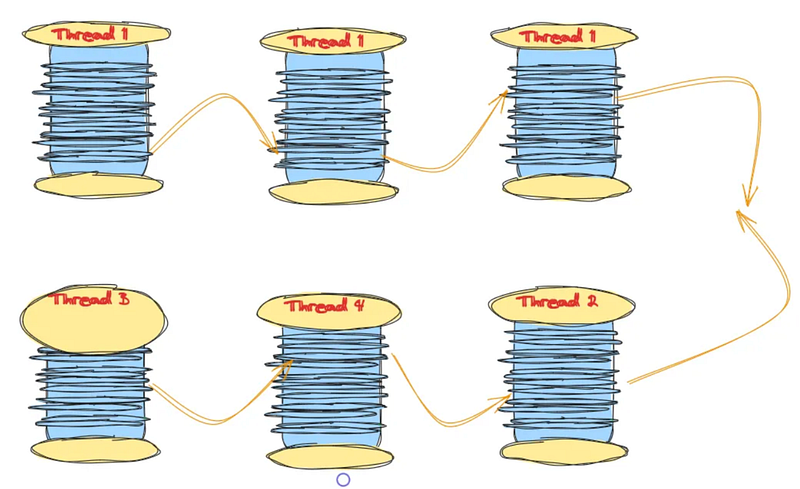
Can you explain Thread.yield() in Java?
The yield() method in Java is a mechanism for indicating that the current thread is willing to yield its current use of a processor.
This method is a hint to the thread scheduler that the current thread is willing to "step back" and allow other threads to execute. It's part of the Thread class in Java.
Key Aspects of yield():
- Voluntary: It’s important to note that calling yield() is merely a suggestion to the thread scheduler. It's up to the scheduler to decide what to do with this suggestion.
- The scheduler may choose to ignore it, especially if there are no other threads of the same priority that need CPU time.
- Scheduling: If there are other threads of the same priority that are waiting to execute, the scheduler might choose to pause the current thread and give other threads CPU time. However, the exact behavior and the decision to switch tasks are dependent on the thread scheduler, which varies by operating system.
- Priority Consideration: The effect of yield() is most noticeable in environments where threads have the same priority. In systems where thread priorities are considered,
yield()will make the thread scheduler more likely to switch to higher priority threads. - Usage: The
yield()method can be used to improve the efficiency of thread usage by allowing other threads of the same priority to run when a thread is not doing something critically important. It's often used in scenarios where threads are performing repetitive or CPU-intensive tasks and fairness or responsiveness is desired.
The considerations and impacts of yield.
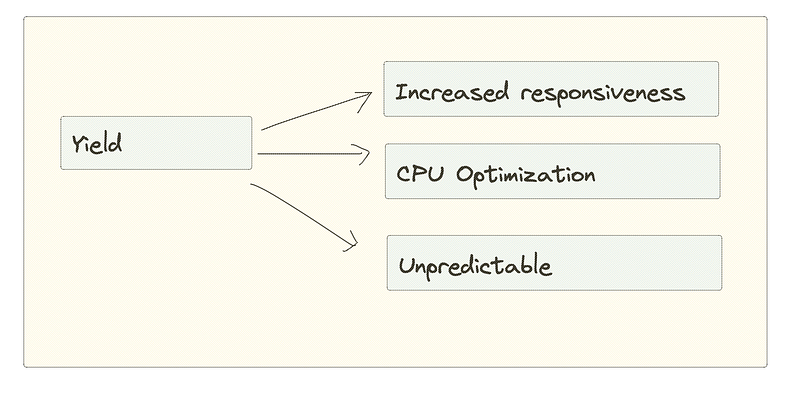
- Reduced CPU Wastage: By yielding, a thread can reduce wasted CPU cycles, especially in busy-wait loops.
- Improved Responsiveness: In applications with multiple threads of similar priority, using
yield()can help improve the system's overall responsiveness and fairness. - No Guarantee: Since
yield()is advisory, there's no guarantee that it will lead to a context switch or affect the application's behavior in a predictable way. Its effectiveness and behavior might vary across different JVM implementations and operating systems.
public class YieldExample extends Thread {
    public void run() {
        for (int i = 0; i < 5; i++) {
            System.out.println(Thread.currentThread().getName() + " running, iteration: " + i);
            // Hint to the scheduler that the current thread is willing to yield
            Thread.yield();
        }
    }

    public static void main(String[] args) {
        YieldExample t1 = new YieldExample();
        YieldExample t2 = new YieldExample();
        // Start the threads
        t1.start();
        t2.start();
    }
}
In this example, two threads are performing a simple loop.
By calling yield() within the loop, each thread gives a hint to the thread scheduler that it's willing to allow other threads to run, potentially leading to a more evenly distributed CPU usage among the threads.
I hope these examples will help you to understand the concepts in greater details. I hope you would like my content. Thanks for clapping and sharing.
Please consider supporting me here if you like my content.