
5 Essential Tools You Need In Your Toolbox to Build and Scale Your Consulting Side-Hustle
Build your toolbox so you have everything you need to build a successful consulting practice

Everyone needs tools. No exceptions.
Architects require pen, paper, and 3D visualization software. Software engineers need a sandbox to test their codes. Entrepreneurs obsessed with their startups need platforms to test the feasibility of their ideas.
You need tools if you aspire to become a consultant on the side. However, it is not always clear what consultants need to get their work going.
I will share 5 essential tools in my toolbox I take with me wherever I go. And maybe, this will help you visualize what you need to build your consulting practice at a minimum.
Setting the Stage: What You Need in Your Consultant’s Toolbox
Your market niche drives the tools you need in the toolbox.
You need tools to get and scale the consulting practice. These tools may include wearables, software, books, and intangible assets.
“It’s best to have your tools with you. If you don’t, you’re apt to find something you didn’t expect and get discouraged.”
― Stephen King, On Writing: A Memoir of the Craft
Tool # 1: Wearables that Allow You to Connect and Get Client Profile Information Fast
I use Popl.
Popl is a wearable designed for a speedy exchange of information during networking sessions. This use case is uniquely mine, and it is strong enough for me to purchase it.
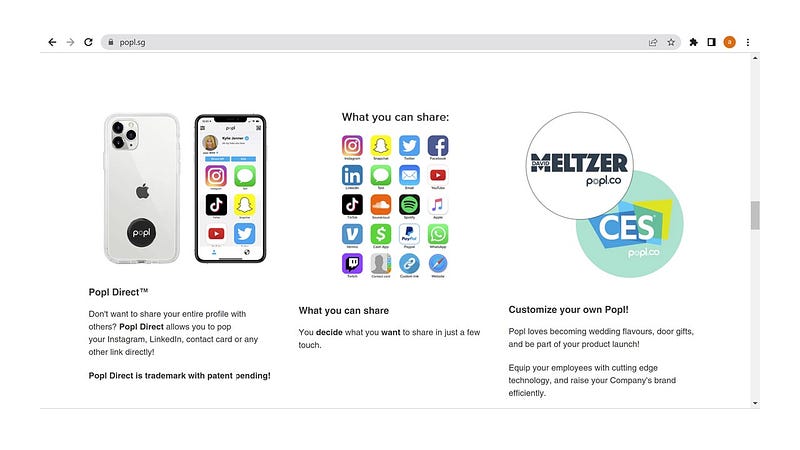
Popl allows you to share your professional profile information and platforms where you host your content assets. You get to configure your YouTube channel, LinkedIn account, Calendly, and Website URL into the profile page and share it across with a finger tap.
You can regard it as a dynamic version of Linktree.
Price range: Between $18–$25.
Tool # 2: Software for Instant Appointment Booking
If you want to be a consultant on the side, you need to think and operate like a doctor. You need appointments. Lots and lots of them.
Calendly is a great help to my consulting practice. My peers endorse this software as well. However, many of them use it passively.
They would tell their clients to book their appointments after their coffee chat. Not me. I know that clients forget all that when they leave the discussion table.
I would use it during the discovery conversation to show them that I have limited slots left for the week. It works as a nudge.
Interested parties will book their appointments with me (during our conversation) if they have decided to move to the next stage of the sales cycle.
Price range: From free to $12 per month for individuals.
Tool # 3: Self-Authored Books to Generate Client Interest
One of my peers does this.
Jonathon would bring along 10 copies of paperback he authored and give them away at networking events. He displays them for sale at a discount when he is giving a talk at professional institutions.
Book sales is not his goal. Jonathon understands that the root word of Authority is Author. It builds his credentials as the Go-To person in his space.
Jonathan gets 15% — 20% of his consulting revenue from readers. They wanted to know how his consulting practice realizes value from his ideas in the book.
Sales conversion happens after.
Cost to publish a book: You can reference it here.
Tool # 4: Research, Insights, Cutting Edge Knowledge.
You need to demonstrate that you are ahead of the curve.
Therefore, you need to read voraciously. The reason is simple. You will never know what the person in front of you is interested in.
Let us assume that you provide consulting services for technology adoption. That is a broad topic. You may need to be articulate in Agile practices, Big Data, Blockchain, Hadoop, Python, Enterprise Resource Planning, Smart coffee machine, Smart television, Smart this, Smart that.
Your client may be interested in integrating his Smart coffee machine into his laptop, even though you are talking about Industrial Internet-of-Things on stage.
Be prepared for all topics coming your way.
I suggest subscribing to and actively consuming content from Harvard Business Review and MIT Sloan Management Review. These materials are written by practitioners, so you will not go wrong.
Price Range: Monthly subscription between $17.50 — $25.83 (Harvard Business Review).
Price Range: Annual subscription of $69 for the digital option and $89 for print and digital (MIT Sloan Management Review).
Tool # 5: Outbound Marketing
This is not about social media platforms. Nope.
You need to market yourself to get business. Of course, this applies to all side-hustles. But I argue that it is mission-critical for consultants to build a successful practice from Day 1 to Year 5.
Why so? Because our greatest asset is our knowledge and know-how. Those are intangible assets. It resides in our minds.
We need to continuously tell people what we know, what we are good at, so they know. And we need to do that even when we are busy.
I recommend Hubspot for this purpose. It allows you to schedule email campaigns, targeted social media posts, and analyze the profile of your leads.
You can also study relevant metrics. Do you create newsletters? You can analyze your open rates, click rates, and bounce rates if you do.
I automated the entire outbound marketing process 3 months back, so it works without my presence. I get a monthly report in terms of engagement metrics. The feedback captured allows me to finetune the outbound marketing efforts moving forward.
Price Range: Between $63 — $630 monthly for individuals.
Summary
All consultants need tools.
We need tools to network, capture information, share content assets, secure appointments, and disseminate what we know. What you need in your toolbox is dependent on your targeted niche and business model.
You may realize one thing.
It does not cost a bomb to start your consulting practice. This is a low-cost, low upfront capital outlay business.
You can build and scale your consulting practice with minimum cost. And that, to me, is brilliant.
Other Stories To Help You Grow Your Consultant Side-Hustle:
On starting your Consulting Practice.
On building credentials.
On finding ideal clients.
On becoming the Go-To Consultant in your district.
As a content contributor, I write my observations from daily life and my business exposure. Because our life experience is the bedrock of our unique perspectives.


