
5 Enzymatic Bioremediation that helps to lessen the toxicity of Ops
Biological fight against the environment pollutants

Organophosphate compounds (ops)are widely used worldwide on agriculture land in the form of insecticides and mediation and nerve agents. These ops are highly toxic to our environment because they show environment persistence, accumulation, and intoxication of soil and water.
ops show intoxication to the enzyme acetylcholinesterase(an enzyme that is present in the neuromuscular junction of human beings body) inhibiting AChE(Acetylcholinesterase Activity) by the build-up of Acetylcholine body. Ops binding with enzyme is irreversible. The acetylcholinesterase enzyme helps control nerve signals of the body.
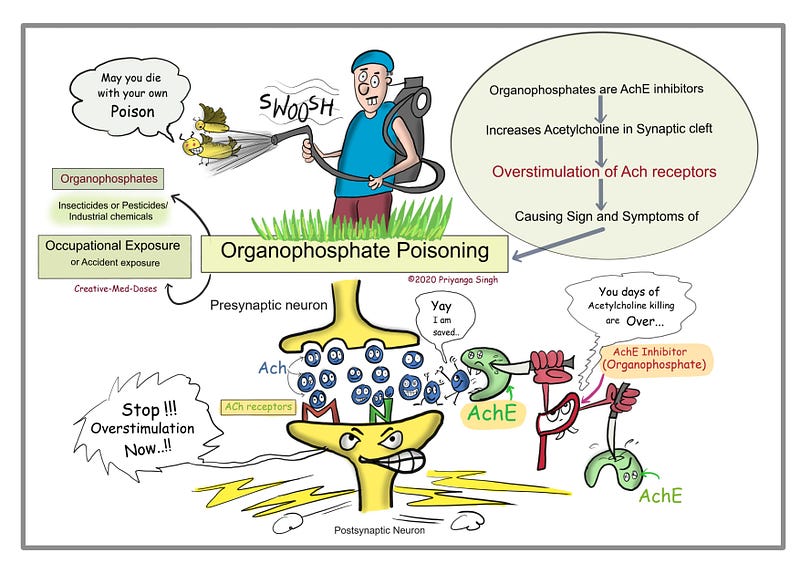
There is a classification of Ops compounds used in Agriculture and industrial-scale are:
Insecticide: Malathion, parathion, diazinon, fenthion, dichlorvos, chlorpyrifos, ethion.
Nerve gases: Soman, Sarin, Tabun, VX
Ophthalmic agents: Echothiophate, isofluorphate
Antihelmintics: Trichlorfon
Herbicides: Tribufos (DEF), Merphos
(Source: emedicine.medscape.com)
Bioremediation means use of natural biological system to degrade or consume environmental pollutants via its “Biological friendly strategy” to eliminate many harmful contaminants from our environment.Enzymatic bioremediation means naturally occuring enzymes in living organisms that helps to degrade the toxic and harmful compounds from our environment .
Five Enzyme that helps in Enzymatic Bioremediation to clean our environment from Ops are:
- Diisopropylfluorophosphatase (DFPase)
- Paraoxonase(PON1)
- Organophosphate degrading enzyme(Opd A)
- Phosphotriesterase (PTE)
- Organophosphate Acid Anhydrolase ( OPAA)
Above mentioned these enzymes can hydrolase a variety of Op pesticides containing Ops and helps to enzymatic degradation of OP compounds. These are environment friendly, non-flammable, non-corrosive, and dispersed safely and easily by nature.
Diisopropylfluorophosphatase(DFPase)
The enzyme is isolated from the European Squid Loligo Vulgaris. This enzyme property catalyzes the hydrolysis of OP compounds such as DFP ( Diisopropylfluorophosphate), number of G-type nerve agents including Sarin ( GB), Soman (GD), Cyclosarin ( GF), and Tabun (G A).
Paraoxonase (PON1)
An enzyme is produced in the human liver. It is a calcium-dependent enzyme able to hydrolyze aryl esters, lactones, and Ops. It is anti-inflammatory, anti-oxidative, anti-atherogenic, anti-microbial, anti-diabetic and op- detoxifying properties. Its enzymatic activity is also involved to hydrolyze the Ops compounds.
Organophosphate degrading Enzyme ( Opd A)
It is hydrolyzed organophosphate Ops and helps to remove Op residue from our environment. Opd A isolated from Agrobacterium radiobacter.It helps to decontaminate the contamination from the environment at a significant scale.
Phosphotriesterase (PTE)
Phosphotriesterase is known as Organophosphate hydrolase (OPH). It mainly hydrolyzes the pesticide parathion. Act as a catalytic bio scavenger.
Organophosphate Acid Anhydrolase (OPAA)
It is a bacterial prolidases isolated from several species of Alteromonas bacteria. It is mainly show activity against a wide range of compound cleavage at P-F, P-O, P-CN, and P-S bonds.
Enzymatic bioremediation is a rapid method. It helps to retard the pesticide effect from our environment and fight against environmental pollutants.
Reference:
Cheng,T.C., DeFrank , J.J. , and Rastogi , V.K. (1999).Alteromonas prolidase for organophosphorus G-agen decontamination .Chem,Biol.int.119–120,455–462.doi:101016150009–2797(99)00058–7
De Frank, J.J., and Cheng, T.C-(1991)Purification and properties of an organophosphorus aid anhydrase from a halophilic isolate.J.Bacteriol .173,1938–1943.doi:10.1128/jb.173.6.1938–1943–1991
Dumas D.P., Caldwell S.R., Wild J.R., Rausel F.M.(1989). Purification and properties of the phosphotriesterase from Pseudomonas diminuta.J.Biol.chem.264,19659–19665. Dumas D.P., Wild, J.R., Raushel F.M.(1989).Diisopropylfuolophosphate hydrolysis by a phosphotriesterase from Pseudomonas diminuta. Biotechnol.Appl.Biochem.11,235–243.
Heartleib j., Ruterjans H.(2001).High yield expression, Purification, and characterization of the recombinant diisopropylfluorophosphatase from Loligo Vulgaris Protein Expr.Purif.21,210–219.10.1006/prep.2000.1360
Horn I., Sutherland T.D., Harcourt R.L., Russell R.J., Oakeshott J.G. (2002).Identification of an old (Organophosphate degradation ) gene in Agrobacterium isolates.Appl.Environ Microbiol.68,3371–3376.10.1128|AEM.687.3371–3376.2002
Rajkovic M.G., Rumora L., Barisic K. (2011).The paraoxonases 1,2 and 3 in humans.Biochem.Med.21,122–130.10.11613/B M. 2011.020.