
5 Effective Spartan Habits to Improve Your Mental Strength
Use these ancient Spartan tactics to boost your resilience
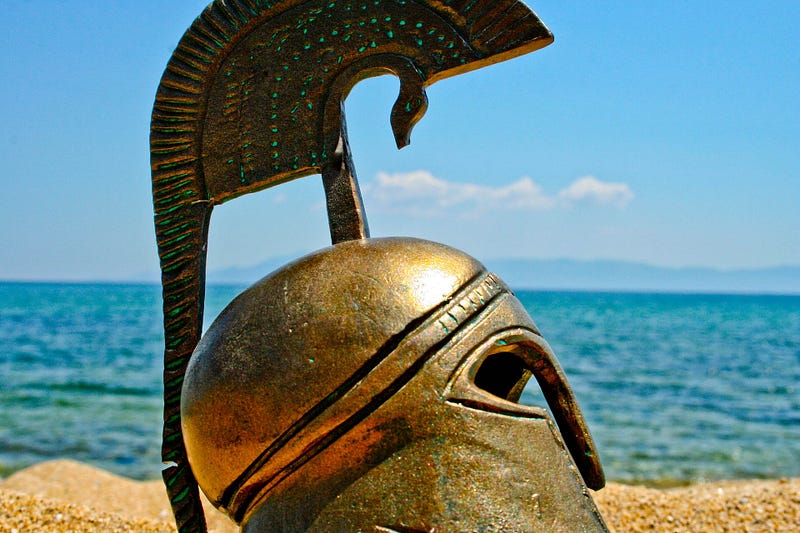
We all know the legendary story of Leonidas, the Spartan king who held back a mighty Persian army with a mere 300 warriors.
The movie naturally stretches the facts, but the depiction of courage, resilience, and unbreakable willpower is an authentic reflection of Spartan values.
Sparta was a Greek city-state famed for its warrior cult, independent women, and military dominance.
The city reached its peak between 431 and 271 BC when it won battle after battle against neighboring rivals.
Spartan discipline, loyalty to the state, and boldness were second to none.
In this context, the English language uses the word “spartan” to describe austere, no-nonsense locations. Not many societies valued discipline and mental toughness quite like the Spartans.
Not all Spartan activities, however, revolved around fighting.
Some daily Spartan habits are surprisingly mundane and easy to implement. That’s where we can use Spartan principles to boost our mental resilience today.
Spartan habits to improve your mental strength
The following are five Spartan habits that can boost your mental toughness. The Spartans didn’t invent these activities but they used them to instill a warrior mentality into their citizens.
Physical exercise and weight lifting
Although historians know little about specific Spartan exercises, it’s clear that Spartan children began training at age 7.
They were taken from their parents and enrolled in a military program called the “agoge.” This state-sponsored training included running, scholastics, spear throwing, and sword fighting.
From the age of 12, Spartan “youths” had to walk barefoot to harden up their feet.
According to modern sources, the kids had to learn how to survive in the wild, and the teachers encouraged pupils to wrestle and fight among each other.
Today, we naturally don’t have to fight neighboring city-states and throw spears at Persians.
Nevertheless, if you want to build a Spartan physique as well as Spartan resilience, take a leaf out of the agoge training book.
The famous Spartan training method combines physical exercise with resistance to discomfort and endurance.
In our modern world, a Spartan routine would start with weight lifting.
The second part would include endurance exercises like running, biking, and mountain climbing.
Finally, a modern Spartan routine would be incomplete without activities that build up resistance such as walking barefoot in the snow or hiking through muddy, rainy terrain.
Take cold showers in the morning
If you want to build Spartanesque mental toughness, resisting to uncomfortable sensations is essential. And cold showers are the best way to create these uncomfortable sensations.
In this context, fitness aficionados frequently highlight the benefits of cold showers. I couldn’t agree more.
A couple of years ago, I started incorporating cold showers into my morning routine. The effects were profound.
Freezing showers, especially during winter months, are hard to endure but also highly rewarding.
After a while, your body adapts to the uncomfortable sensation of icy water dripping down your skin.
Consequently, you build up resistance. And this resistance gradually makes cold showers less uncomfortable.
As such, cold showers are an excellent habit to train your resistance to discomfort. The simple act of building resistance to cold water can help your brain withstand other arduous situations.
You subconsciously know that forced endurance to uncomfortable sensations will lead to a higher tolerance in the long run.
Learn about your fears
The Spartans detested cowardice. There was no shame in losing a battle as long as every soldier lay dead on the ground.
Boys who were afraid of dogs had to sleep in dog staples until their fear was gone. And every soldier who feared death was put into near-death situations with two choices: die or confront the fear.
This might sound ridiculously brutal, but there’s one major lesson to consider.
The Spartans never let their fears grow in the background. They always had to confront them. And this confrontation secured their courage and mental strength.
Instead of letting our fears roam free, we need to learn about them and eventually face them.
As an example, you might be afraid of talking to your superiors about a pay-rise. As long as you refrain from talking to them, the fear will grow in the background.
Before long, the opportunity for a pay-rise will evaporate. The fear will have undermined your goals and plans.
That’s why you need to confront your fears before they start overriding other thoughts.
Getting back to our example, you can start with baby steps. You might not immediately want to mention the pay-rise, but you can start a banal conversation with your boss.
Slowly but steadily, you cut slices off your fear, and soon it will disappear altogether.
Proper dieting
Fasting is a major part of various cultures and the Spartans were no different.
Unlike Christian fasting or Muslim Ramadan, however, Spartan fasting had military objectives.
In their military academies, young soldiers couldn’t eat for days and rations were always small. The goal was to build endurance for hunger.
They also worshipped muscles. Defined physiques were the norm, not the exception.
Soldiers would compare themselves in front of the mirror for hours and identify areas to improve. Sounds familiar, doesn’t it?
The Spartans even publicly ridiculed overweight citizens. They were also the only Greek city-state where drunkenness was not commonplace.
Again, the Spartans took the concept of dieting and fitness to the extreme, but the general idea works well in the modern world.
The Spartans understood that mental and physical strength are strongly interdependent.
In this regard, intermittent fasting as well as a simple diet of whole foods, lots of water, and an abundance of veggies work well as a modern equivalent to the traditional Spartan lifestyle.
Accept defeat, but never surrender
Finally, the most effective Spartan habit to improve your mental strength is the Spartan concept of defeat.
The Spartans always accepted defeat, but they never surrendered.
That might sound contradictory, but it’s a straightforward rule.
Spartan soldiers could only lose if they were dead. They accepted their death as a tribute to the state and every fallen soldier received proper honors.
Surrender, however, was a different story. No matter the odds, Spartan soldiers were not expected to surrender as long as they were alive.
Famous ancient historians like Herodotus even mention the unwritten rule of committing suicide if you surrender in battle.
How can this outrageous Spartan line of thought further our mental strength today?
The major point is not to give up just because the odds are against you.
Almost every entrepreneur fights an uphill battle to make a name for himself.
I started my freelance writing career with no experience. I entered a saturated market full of competition and shrinking opportunities.
After one year, my blog was finally getting some traction, but I was still making less than 500 dollars a month.
This could have been the end — a moment to surrender.
Spoiler alert, it wasn’t. I had lost a battle, but I wasn’t dead.
I accepted defeat — the fact that I made a few mistakes in the first year — but I didn’t surrender. I soldiered on and eventually succeeded.
If you enjoyed this article, join my email list to stay in touch.


