
5 Effective Habits New Writers Should Cultivate to Boost Productivity

I’ve heard success stories about writers who climbed the financial ladder from a few cents in revenue to earning a six figure income. Perhaps you’re motivated to achieve similar success or simply want to earn money from your expert how-to-articles or your candid views on events. You may wonder if you have what it takes to enter the world of top-notch writers.
How do these mogul writers accomplish first-class success?
Is their tenacity any different from the firm grip you have in your writing career?
What is their secret sauce?
The 16th century welsh poet, George Herbet penned a long lasting proverb — slightly modified and convenient for a writer’s quote box, including for the novice — where there’s a will there’s a way.
Perhaps the secret sauce is mixed with herbs of willpower and spices of determination to create a potent base readers can’t resist. Novice writers too can create a firm foundation and thrive in a land of giants — that is, until they become giants themselves.
Be determined, consistent and resourceful and you should make fine strides with your writing goals. There are few common ingredients I believe every novice can add to the writers’ pot to produce more and to produce quality pieces. To kick start your career and boost productivity you should seek to cultivate these five effective habits.
1. Get Acquainted with the Bubble Method

If you’ve been out of the writing loop for sometime it may not be as easy to jump back into the game. Some new writers may spend hours in front of the blank page in search for that perfect idea, only to later ditch their efforts in frustration. Other writers may get stumped as they try to sort and organize their ideas.
If you’re the kind of person who has a mental smorgasbord of points, but and struggle to select a topic or angle — a key point you’ll write about — the Bubble Method is a great remedy for you and will produce a great output.
The Bubble Method is like an excavator that will help you dig deeper for new ideas and synthesize broader topics into bite size appetizers. This method encompasses a wide range of areas — many professionals from other fields use it effectively. The Bubble Method helps writers brainstorm, organize and select ideas for writing.
What is the Bubble Method and how do you use it?
Plain and simple, the method is a way for you to brainstorm and generate ideas for writing. The process is simple enough.
Get a sheet of paper and draw a bubble — a circle or oval will suffice — in the middle of your sheet. Think of that bubble in the middle as the anchor for all other ideas. Write your main topic in this circle.
Next, draw a line at a time that connects from the anchor — the middle bubble upward, downward or to the side. You will connect a new bubble to the end of each new line. This is where you’ll write a new idea related to your topic. A google or YouTube search will provide you with exemplars on what your final product may look like. Just type in the Bubble Method.
For the writer who desperately struggles to move beyond that blank page challenge yourself to generate three bubbles and ideas for your topic.
Once you’ve mastered three move onto brainstorming for five bubbles.
Do you have five? If so, great! Five is not that far away from eight ideas so keep going.
Alas! Try to create ten bubbles. The bubbles should give you a sufficient amount of ideas to start or even complete your written piece.
If you’re technology savvy and itching to brainstorm on the computer, the method is easy to recreate with shapes and lines using Microsoft Word, PowerPoint or some other applications. Once you’ve recreated the format then simply type out your ideas into each bubble.
There are articles and YouTube tutorials that can guide you with step-by-step instructions on how to create and optimize the Bubble Method experience for best results. For the novice writers, using the method will help you get more of your ideas down on paper and faster— eventually this may help you to get more done in your day, effectively and efficiently.
This universal system of brainstorming may help you fast forward your thinking process to a new dimension. A chef can propose 10 fine dining meals, detectives can suggest theories for a crime, a sports broadcaster can narrow the top 10 greatest dunkers, quarterbacks or athletes of all time all with the bubble method. It’s a one stop shop for everyone — including the novice writer.
2. Create an Outline

Even top-notch lawyers who analyze and scrutinize long, complex and critical arguments may use commercial outlines for discussion points. The writer’s outline is an extension of the brainstorming process and another essential resource.
An outline includes writing those ideas you’ll want to cover from beginning to end in proper sequence. Here you’ll be able to extract points from the bubble method and include a summary of details or examples you’ll want to use to enhance each part of your piece.
If you’ve taken an English language or essay writing class, you may recall the mechanics of essay writing and the stages of working from the thesis to your main points and supporting details. You’ll recall that you brought everything neatly together and ended your writing with a succinct conclusion that reinforced your thesis.
The outline provides you with a snapshot of your written piece from beginning to end, however, less formal depending on what you plan to write, unless you write an essay.
For novice writers, the outline can be your golden ticket to productivity. Some writers may find it extremely helpful to have the outline of everything that they will want to address in their written piece before taking on the arduous task of writing.
Thanks to the bubble method, a selection of points is already waiting for you to choose from and conveniently insert to create the beginning, middle and end of your outline. As you create the rough sequence of your outline, it may be helpful to ask the following questions:
How will your piece catch readers attention in the first few sentences?
Jot it down.
What point will you first introduce to your readers in the beginning? middle? end?
Jot it down.
What examples can you provide to support each of your points?
Jot it down.
In the outline, you’ll create a basic framework for your written piece from beginning to end and consider ways to immediately grab and sustain your readers attention throughout. Focus on the beginning, what information you’ll capitalize on in the middle and how you’ll conveniently conclude your piece.
Outlines don’t have to be complicated. There are several writing templates you can follow or you can create your own. Here’s an outline I created quickly on 5 Easy Ways To Practice Any Language.
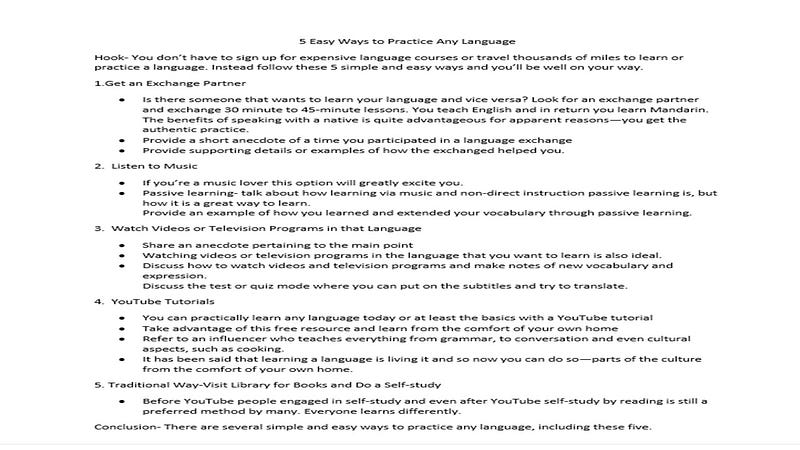
The outline should get the ball rolling and help you write efficient pieces. As you develop the habit of using an outline, you may find you’ll expand and organize your ideas quicker than without an outline.
The more outlines you write, you may find the process moving quickly for you and pretty soon you’ll be a step closer to the final product. The outline will set those ideas in the bubble method free and organize them until you’re ready to turn the outline into the rough draft.
3. Write a Draft

Get into the habit of creating a draft for each of your written pieces. Use your newly structured outline expand on those ideas, give details or examples and you’ll have a draft.
The draft is the rough copy of your writing — essentially a raw copy of the entire piece. Expound in detail on the subtopics and examples in your outline. Then go back, revise and check if there’s anything else you would like to add to spice up your writing.
Everything is there for you all in your draft. You may decide to add new ideas or delete some later on and that’s okay. Writing is exploration. However, when writers have a completed draft, they have something to refer to and further build on rather than just writing from the top of their head. You will surely cut down on time as you work from a draft than without one. The more time you save yourself as a writer in one phase of the writing process, you’ll be able to distribute it for something else.
For the novice writer, I recommend getting into the habit of making a draft so you can see the progression of your ideas on paper. The final polished copy may look very different from the draft, but at least you’ll have a starting point with all your thoughts written down until you’re ready to attack and polish them. A draft is confirmation that you're closer to the end.
The more drafts you can get through, the more light you’ll see at the end of the tunnel — there’s satisfaction and encouragement just knowing that your piece is almost done and you’ve come too far to give up or abandon the piece — you have no choice, but to finish.
4. Re-read

Not all writers prefer to read-aloud. If you belong to the group of silent readers or prefer to deconstruct words in your head, don’t worry. For the more vocal who prefer the audible version of their piece read aloud by themselves or the computer — the read the text aloud function— you are not alone. There’s no right or wrong way to reread. It’s whatever works for you — to each his own.
The most important idea is that you reread your work before you render that piece submission or post worthy. Writers have their own system of rereading, however if you’re a novice writer and don’t have a system yet, I’ll suggest the following pattern that works for me:
The first time read for overall content value to assess that you’ve included all the necessary information, points pf discussion and examples that you wanted to cover.
The second time read for syntax and grammar. You’ll want to ensure that your sentences are clear and coherent and that the piece is comprehensible.
The third time read for enjoyment. Reflect and consider if you met your purpose for writing. Did you leave your readers with something memorable to take away?
5. Share your written piece for Feedback

How well do you handle constructive criticism? If the answer is not well, you’ll have to develop the habit of getting used to it.
Feedback is part of the writer’s paradise, especially if you plan to write for publications. Editors may ask you to make anything from minor to extensive changes on a piece you’ve written. Before you submit to a publication, ask your family or a friend to read your work and to give honest feedback.
You’ll most likely get an unbiased view of what others think about your piece— as long as its not that friend or relative who loves everything.
If you receive the same feedback from different people, you may want to consider editing that part of the piece. For example, if more than one reader thinks your hook isn’t juicy enough, do not panic. Return to the drawing board to play around with new hooks. Explore ways to re-work your piece and exchange buzzwords to best grab your readers attention.
Feedback and constructive criticism may be the catalyst some writers need to produce more. You can’t keep your faithful readers or those that comment “great job can’t wait to read the next one,” waiting for months before you write the next piece.
Some writers may also use the feedback or constructive criticism as a motivational tool to write more this time around incorporating the feedback from critics for a powerful piece. Feedback has a way of motivating the reluctant writer to produce more.
What writer doesn't like a great challenge?
As a novice writer, it’s easy to feel overwhelmed with everything you need to learn about freelance writing — niches, queries and other concepts that float in the freelance writer’s world.
Don’t be intimidated by the pinnacle of success other writers attain. Focus on what you love to write and write it well — every writer is unique.
Picasso didn’t become a distinguished painter over night and neither do six figure writers reach those six figures in a few hours. All writers start from somewhere and so must you.
The more you can learn the tricks of the trade to speed up the writing process, without compromising quality, the more productive you may be. If you cultivate these five habits you may find you’ll produce more and waste less time.
These five habits apply to all writers, but especially for those novice writers who haven’t a clue where or how to start. Get into the habit of brainstorming with the bubble method, writing outlines and drafts and rereading and soliciting feedback from family and friends. If you cultivate these habits, you’ll kick start your career and may find a boost in productivity — after that everything else should fall into place — in the land of giants.
If you like this article, you’ll probably like this one too: