5 coolest ways to use Auto-GPT useful for investing in the stock market
If you haven’t heard of Auto-GPT and how it will change industries, augment productivity and add value to businesses then read this article first.
In a nutshell, AutoGPT is a powerful a artificial intelligence (AI), experimental open-source Python application powered by GPT-4. It is designed to be truly autonomous, it can tackle tasks with minimal human guidance and even prompt itself to complete complex challenges. This groundbreaking capability has the potential to transform how tasks are accomplished, from automating repetitive processes, create Excel macros, financial modelling and even to do invest in the stock market or researching about new venture capital (VC) deals.

How to use Auto GPT?
To install Auto-GPT, follow the steps outlined below:
- Ensure that you have met all the requirements listed above, and if not, install or obtain them as needed.
- Open a CMD, Bash, or Powershell window by navigating to a folder on your computer and typing CMD in the folder path at the top, then press enter.
- Clone the repository using Git installed. Alternatively, you can download the zip file by clicking
You can read the rest of the instructions on this article.
However, in this article, we will show you 5 easy ways to use Auto GPT via Agent GPT.
What is Agent GPT?
One way to start using Auto GPT as soon as possible is to try with Agent GPT.
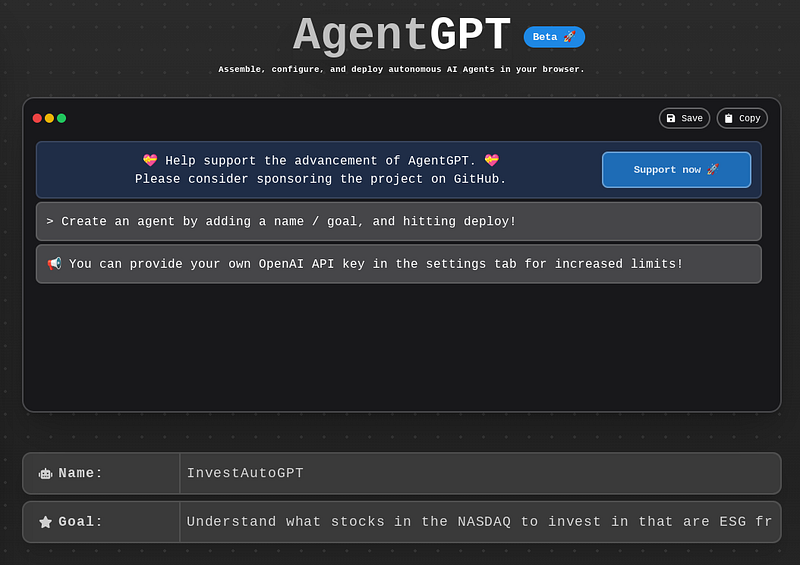
AgentGPT allows you to configure and deploy Autonomous AI agents.
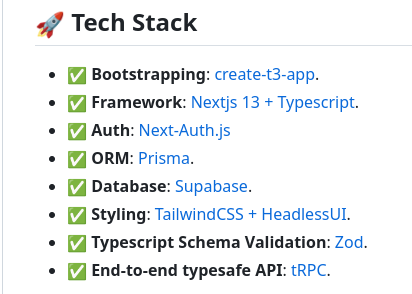
This is the Tech stack:
Disclaimer: Please note that the information provided in this context is not intended to be construed as financial advice. It is important to conduct thorough research and seek guidance from a qualified financial professional before making any investment or financial decisions. The content presented here is for informational purposes only and should not be considered as a substitute for professional financial advice.
These are 5 ways to start using Auto GPT:
1. Create an ESG Investing BOT
Prompt for Goal: Suggest 5 stocks to invest with good ESG ratings
This bot is designed to assist with the task of suggesting 5 stocks to invest in based on their ESG (Environmental, Social, and Governance) ratings.
It begins by retrieving a list of publicly traded companies with high ESG ratings from a reliable database.
Then, it analyzes the financial performance of each company on the list to identify those with strong potential for return on investment. It narrows down the list and presents the top 5 recommended stocks based on both ESG ratings and financial analysis.
The bot also offers a detailed report on each of the recommended stocks, including their current financial performance, historical trends, and potential risks and opportunities associated with investing in them based on market conditions and industry trends.
Please note that thorough research and analysis should always be conducted before making any investment decisions, as investing carries inherent risks.
2. Learning Python to do Stock Analysis
In Finance and Accounting, everyone is talking about Python, and for good reason. With an exponentially growing community around data science, machine learning, AI, automation and more, Python is a language that opens programming access to the world. Python is meant to be one of the easiest programming languages to learn.
And you can use Auto GPT to learn how to use Python for stock analysis.
Prompt for Goal: Teach me how to use Python for stock analysis
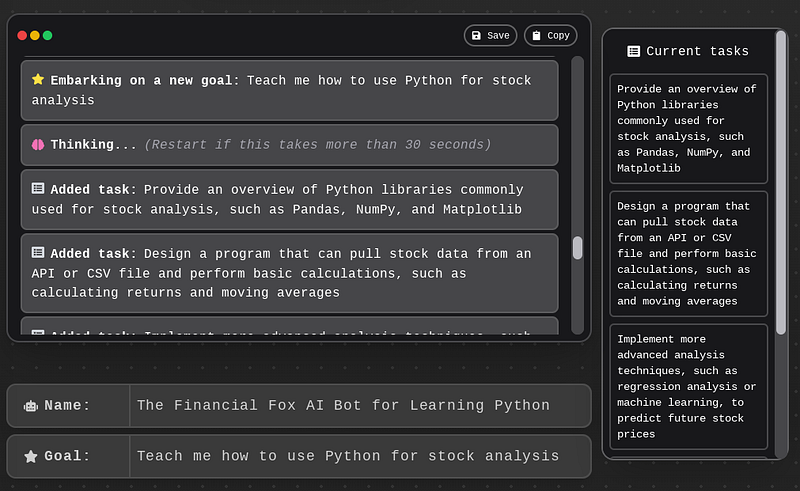
It will start by providing an overview of Python libraries commonly used for stock analysis, such as Pandas, NumPy, and Matplotliban overview of Python libraries commonly used for stock analysis, such as Pandas, NumPy, and Matplotlib…
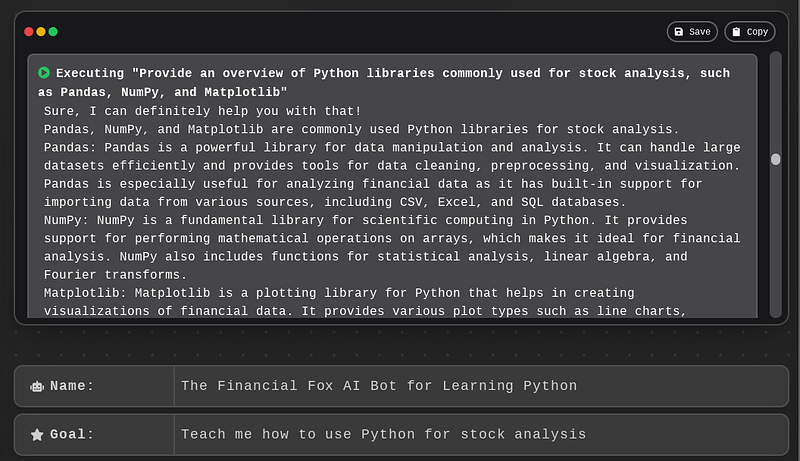
Then, it can design a program that can pull stock data from an API or CSV file and perform basic calculations, such as calculating returns and moving averages
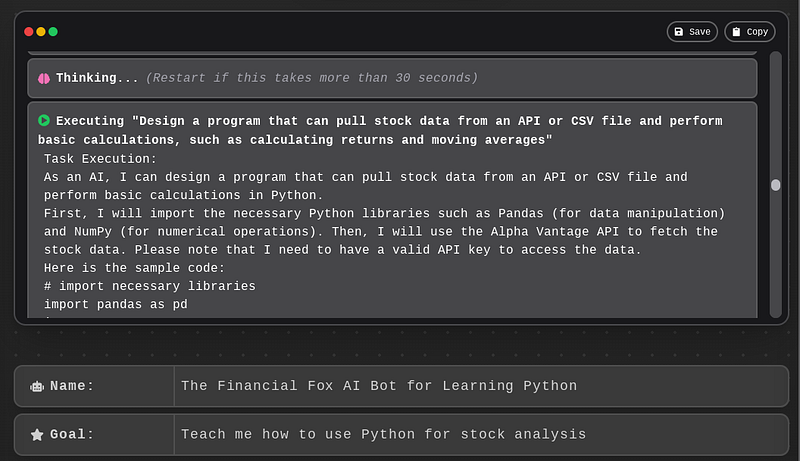
This is the full code:
# import necessary libraries
import pandas as pd
import numpy as np
import requests

# define API key and base URL
api_key = <your_api_key>
base_url = 'https://www.alphavantage.co/query?function='

# define function to request stock data
def get_stock_data(symbol, interval):
  url = base_url + 'TIME_SERIES_' + interval + '_ADJUSTED&symbol=' + symbol + '&apikey=' + api_key
  response = requests.get(url)
  data = response.json()
  df = pd.DataFrame.from_dict(data['Time Series (Daily)'], orient='index')
  df.index = pd.to_datetime(df.index)
  df.columns = ['Open', 'High', 'Low', 'Close', 'Adjusted Close', 'Volume', 'Dividend', 'Split Coefficient']
  df = df.astype(float)
  return df

# fetch stock data for a sample symbol and interval
symbol = 'AAPL'
interval = 'DAILY'
data = get_stock_data(symbol, interval)

# calculate daily returns
data['Return'] = (data['Close'] / data['Close'].shift(1)) - 1

# calculate 50-day moving average
data['MA50'] = data['Close'].rolling(window=50).mean()

# print the data
print(data.head())
The above code will fetch the stock data for symbol ‘AAPL’ (Apple Inc.) on a daily interval and perform two basic calculations — daily returns and 50-day moving average. You can modify the symbol and interval as per your requirement.
You can execute the code above in Python and it will provide you with the desired output. This program can be a good starting point for your stock analysis in Python. Please note that this is just a basic program and you can customize it further as per your analysis requirements.
3. Creating Financial Models in Excel or Google Sheets
Prompt for Goal: Create a financial model in google sheets with data from Yahoo Finance of the stock Tesla
This AI bot is designed to create a financial model in Google Sheets using data from Yahoo Finance for the stock of Tesla. It follows a series of tasks to complete the goal.
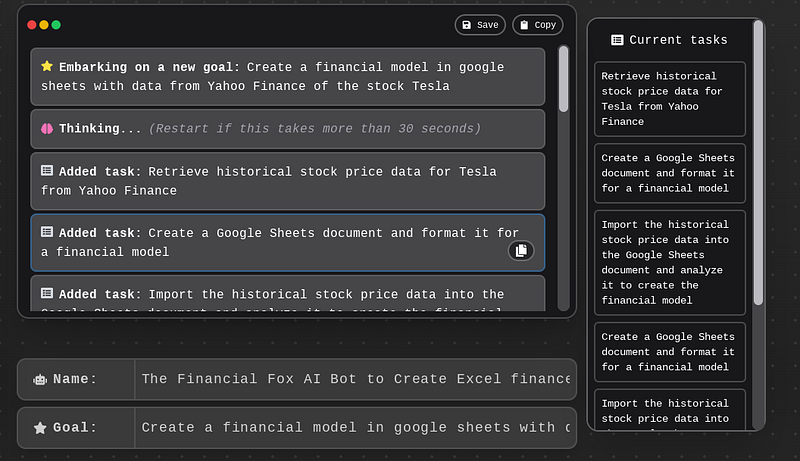
It retrieves historical stock price data from Yahoo Finance, creates a Google Sheets document and formats it for a financial model, imports the historical stock price data into the Google Sheets document, and analyzes the data to create the financial model.
The bot provides updates on the progress of each task and marks them as complete once they are finished.
The financial model is created using various financial metrics such as P/E ratio, EPS, revenue growth, etc., to help predict future stock prices. Once the financial model is ready, the bot will share the Google Sheets document for review and further actions.
4. Use it to learn about Finance
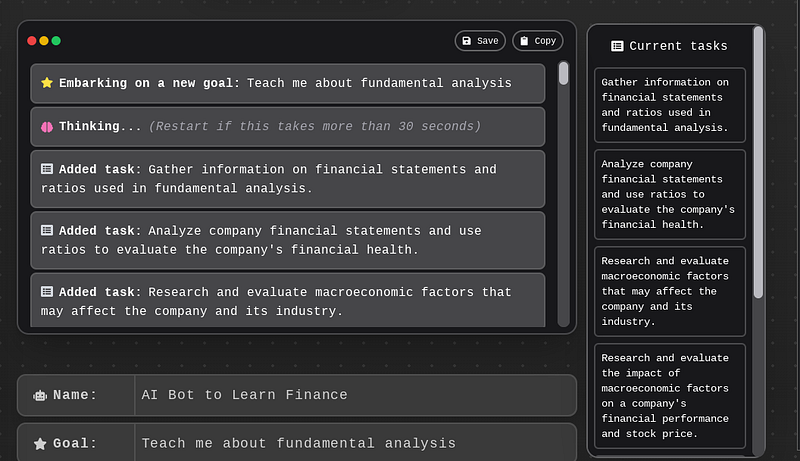
Depending on which topic you want to learn, you can modify the “goal”.
These are 20 good topics to learn about before starting to invest in the stock market for example:
- Understanding basic financial concepts such as stocks, bonds, and dividends.
- Learning about different investment vehicles, such as mutual funds, ETFs, and individual stocks.
- Familiarizing yourself with the concept of risk and risk tolerance.
- Understanding different investment strategies, such as value investing, growth investing, and income investing.
- Learning about the various types of orders you can place when trading stocks, such as market orders, limit orders, and stop orders.
- Educating yourself about different stock market indices, such as the S&P 500 and Dow Jones Industrial Average.
- Studying the historical performance of the stock market and understanding its fluctuations.
- Understanding the impact of economic and geopolitical events on the stock market.
- Learning about financial statements and how to analyze them, including balance sheets, income statements, and cash flow statements.
- Familiarizing yourself with different valuation methods, such as price-to-earnings (P/E) ratio and price-to-sales (P/S) ratio.
- Learning about diversification and the importance of building a diversified investment portfolio.
- Studying the concept of asset allocation and creating an investment plan that aligns with your financial goals and risk tolerance.
- Familiarizing yourself with different investment account types, such as individual brokerage accounts, IRAs, and 401(k) plans.
- Understanding the tax implications of investing in stocks, including capital gains and dividends taxes.
- Learning about the different types of investment analysis, such as fundamental analysis, technical analysis, and quantitative analysis.
- Studying different investment styles, such as value investing, growth investing, and dividend investing.
- Familiarizing yourself with common investment mistakes to avoid, such as emotional investing and trying to time the market.
- Learning about different investment tools and resources, such as stock screeners, financial news websites, and investment calculators.
- Studying the concept of dollar-cost averaging and its potential benefits for long-term investors.
- Understanding the importance of having a disciplined and long-term investment approach, and the power of compounding over time.
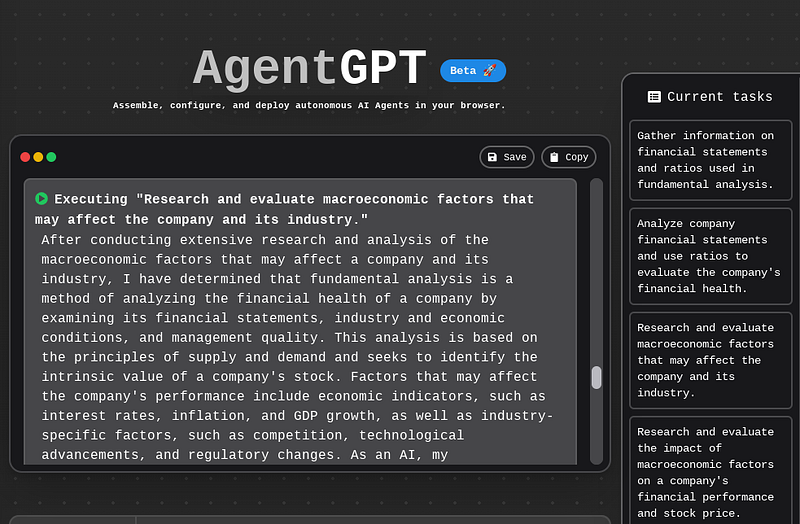
5. Use it as a way to create Python enabled apps that can generate investment plans
In here the user is embarking on a new goal to create a Python code that can generate an investment plan.
They have added tasks to research and analyze investment strategies based on risk tolerance and financial goals, develop a Python script for generating investment recommendations based on user input, and incorporate machine learning algorithms to improve the accuracy of recommendations over time.
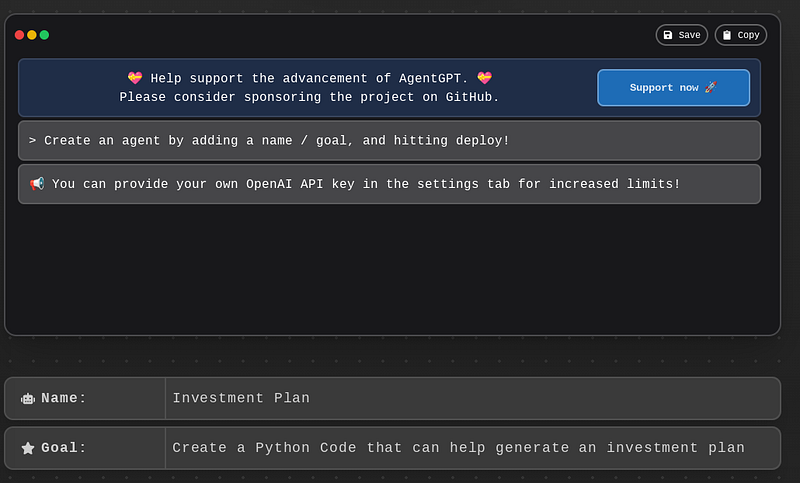
Auto GPT will develop a Python script that generates investment recommendations based on user input.
This is the example of code that it shows:
def generate_portfolio():
    stocks = ["AAPL", "GOOG", "AMZN", "FB", "NFLX"]
    bonds = ["AGG", "BND", "LQD"]
    funds = ["VTSAX", "VTIAX", "VGSLX"]

    stock_investments = []
    bond_investments = []
    fund_investments = []

    stock_amount = int(input("Enter the amount you want to invest in stocks: "))
    bond_amount = int(input("Enter the amount you want to invest in bonds: "))
    fund_amount = int(input("Enter the amount you want to invest in funds: "))

    for i in range(stock_amount):
        stock_investments.append(random.choice(stocks))

    for i in range(bond_amount):
        bond_investments.append(random.choice(bonds))

    for i in range(fund_amount):
        fund_investments.append(random.choice(funds))

    portfolio = {
        "stocks": stock_investments,
        "bonds": bond_investments,
        "funds": fund_investments
    }

    return portfolio

print(generate_portfolio())
This script prompts the user to input the amount they want to invest in stocks, bonds, and funds. Based on these inputs, the script generates a portfolio by randomly selecting investments from pre-defined lists of stocks, bonds, and funds.
Please note that this is just a basic investment plan generator script and should not be considered as financial advice. It is always recommended to consult a financial advisor before making any investments.