
5 Cognitive Biases To Blame For Your Poor Decision-Making
Psychological concepts I wish I had learned earlier

Staring at the ceiling at 3 a.m.? Replaying a conversation over and over? Second-guessing your every decision?
You think you’re logical and rational. Yet, you feel agitated and mentally disturbed.
I’ve always experienced that the more you think, the deeper you sink into overthinking.
My first Thanksgiving in Canada was at Joey’s house. I candidly blurted out, “Why is the Apple pie always too sweet?”
It was a joke, but the table went quiet. Joey’s mom looked surprised.
My brain started racing, “Why did I say that? She made that pie!”
For a week, every night, I’d toss and turn, replaying that moment. My mind was like a non-stop movie.
“Everyone thinks I’m rude.”
I’d imagine everyone whispering, “He’s so ungrateful.” The worst was thinking Joey would never speak to me again.
My stomach felt like I swallowed a bag of rocks.
This tiny comment felt like a huge monster in my head. It stopped me from enjoying fun things all week because I was too busy worrying.
Finally, I mustered the courage to call Joey to talk to her mom and apologize. I said, “I’m sorry about my comment.”
She laughed, “Oh, that? I forgot about it the next minute! But I’ll use less sugar next time.”
My learnings?
Every time I replayed that moment, my mind twisted it, turning a comment into a potential catastrophe.
Why?
1]. I created a vicious cycle of worry and rumination. ✅
The more you think about something, the more you find reasons to worry or doubt yourself.
The more you worry or doubt yourself, the more you think about something. This cycle traps you in constant anxiety and distress.
2]. I distorted my perception of reality by questioning everyone’s behavior. ✅
When you overthink, you focus on the worst-case scenarios.
You also ignore the positive evidence or the realistic outcomes. It subtly makes you pessimistic.
3]. I paralyzed myself. I didn’t talk with anyone with an open heart. ✅
When you overthink, you instantly feel overwhelmed by the negative thoughts.
You also fear making another mistake. Or regretting your decision. This leads to procrastination, reservedness, missed opportunities, wasted time, etc.
4]. I sabotaged my happiness and satisfaction. ✅
When you overthink, it’s hard to relax and enjoy the present moment. You dwell in the past. You also worry about what will happen next.
💥The Root Cause?
Information overload due to easy access!
Science says information overload has led to increased brain activities like information processing into sensory memory, working memory, and long-term memory.
It has also subtly taught us to think more. Even if it’s irrelevant.
But, we alone aren’t responsible for developing an overthinking habit. Deep-seated psychological biases also play their part.
Psychological experts call it cognitive distortions.
These are biases your mind convinces you to believe even if they aren’t true. They prevent you from thinking clearly.
That’s why knowing what traps you in the mental prison is inevitable. It’ll help you reframe and change the direction of your thinking. It’ll empower you to reduce their negative impact on your mood and behaviors.
Here’s what I share based on my experience and personal learnings.
1]. The Brain’s Favorite Echo Chamber
Remember my casual remark at a party I mentioned in the introduction?
I was convinced every hushed conversation was about me. Every subtle cue became a confirmation.
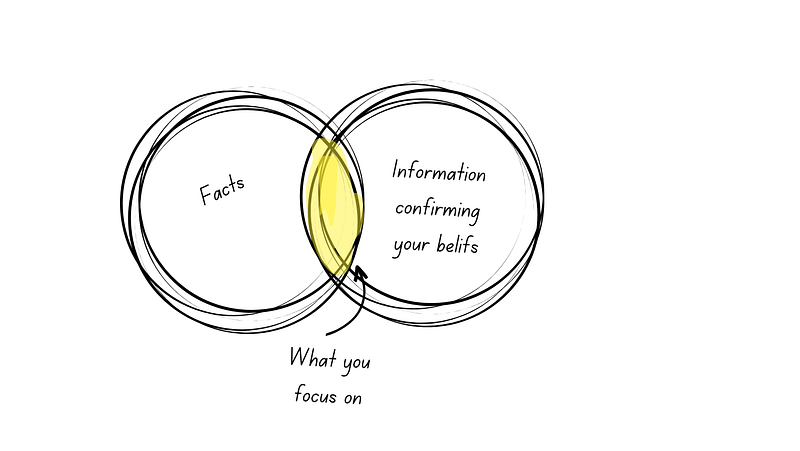
Psychologists call it confirmation bias.
Picture this:
You believe that four-leaf clovers bring good luck. Suddenly, you start noticing them everywhere — in books, TV shows, even on your neighbor’s lawn.
It feels like the universe is nodding in agreement with your belief.
But is it?
Or is your brain simply tuning into a frequency that amplifies what you already believe?
Our brains are like DJs at a radio station. They selectively play tracks that resonate with our existing beliefs while conveniently skipping those that don’t fit the playlist.
This selective hearing isn’t just about finding comfort in our convictions. It’s a survival mechanism, hardwired into our brains to make sense of an overwhelming world.
Take, for instance, politics.
Have you noticed how people stick to news channels that mirror their political views? It’s the echo chamber in action, where the resounding chorus of agreement drowns out contrasting opinions.
This is not just a matter of preference. It’s our brain’s saying, “I prefer the familiar comforts of my beliefs over the discomfort of contradiction.”
But, this echo chamber of confirmation bias can turn into a trap. How?
- Skewed Reality: When you only consume information that confirms your beliefs, your perspective becomes skewed. The world isn’t black and white, but Confirmation Bias paints it so.
- Poor Decision-Making: Imagine you’re investing in stocks. You only seek information confirming your choice and ignore warning signs. The result? You guessed it — potentially disastrous financial decisions.
- Polarization: On a larger scale, this bias fuels societal division. Political, religious, or cultural — divisions deepen when groups refuse to consider alternative viewpoints.
Solution?
Dr. Kahneman, in his groundbreaking book “Thinking Fast and Slow,” says:
Question your assumptions, and seek contrary opinions.
A trick I use these days is the “Devil’s Advocate” technique.
Whenever I find myself convinced about something, I intentionally search for counter-arguments. I regularly question my beliefs: “Why do I hold them? Are they based on facts or inherited opinions?”
I also talk to people with differing opinions. Listen more than I speak. Understand their perspective. Agree to disagree.
2]. The First Thought is the Golden One
Your day kicks off with a minor slip-up and bam. You’ve set the tone for a disastrous day.
It’s like spilling coffee on your shirt and assuming the stain’s going to ruin your whole week.
Ever happened?
Research explains why:
The first piece of information acts as an anchor, and people adjust their subsequent opinions based on this anchor. Even if it is irrelevant or inaccurate. It’s called the anchoring effect.
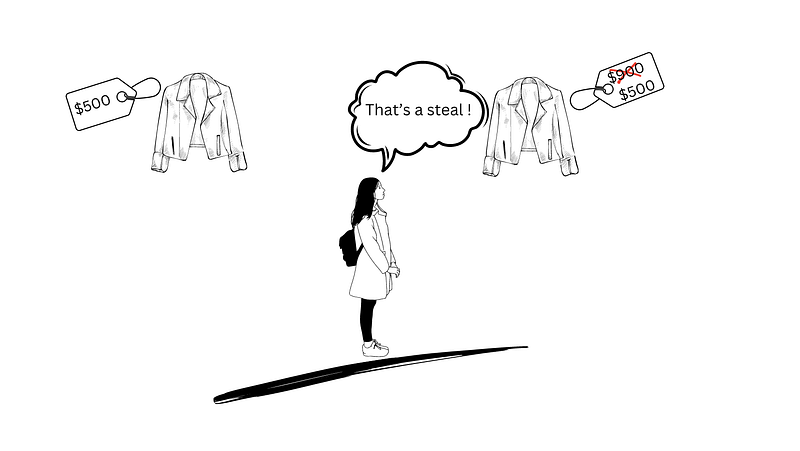
I remember buying my first car. The salesman, a smooth-talker with a smile as slick as his hair, initially quoted an outrageously high price. After some back and forth, we settled on a figure that was still above my budget, but it felt like a victory because it was lower than the first number.
In reality, I was anchored.
This bias isn’t just about shopping. It sneaks into every crevice of our lives.
In negotiations, first offers set a powerful precedent. Initial information forms a base we unconsciously refer back to in everyday decisions. Even in relationships, first impressions can become anchors that shape our perceptions, for better or worse.
We’re being taught from childhood, “The first impression is the last impression.”
But no one paused to ask why.
The answer is the anchoring effect. It’s a bias that prevents the brain from overriding the first reaction, thought, or emotion created in response to an external stimulus.
Best-selling author James Clear advocates for atomic habits to build a resilient mindset. By adopting small, positive habits, you can reset the anchor.
For every negative thought (an anchor) in the morning, I stack it with three positive ones. It helps reshape the day’s perspective.
Studies show that even brief mindfulness exercises can shift your attention away from anchors.
3]. If It Ain’t Broke…
The devil you know is better than the devil you don’t, right?
It’s why many of us stay in jobs we don’t love or relationships that don’t nurture us.
Overthinking often thrives on this status quo bias.
You dissect and ponder over potential changes, magnifying risks and downplaying benefits. Your brain gives you a million reasons to stick to the status quo.
And what happens next?
- You become satisfied with the current situation, so you do not see any need for change.
- You are afraid of the risks and uncertainties.
- People’s opinions and expectations influence your actions.
- You experience cognitive dissonance between your beliefs and actions.
- You become more sensitive to the potential losses than the potential gains.
- You take the safest route even if you know it doesn’t lead you anywhere
- You wait for more evidence or incentives to justify your stagnancy.
What can help?
Take calculated risks.
Dr. Robert Cialdini, in his book Influence, highlights our deep-seated need for consistency. Challenge this by setting frequent Status-Quo Checkpoints:
Review your life’s major areas every three months, asking, “Is this still serving me?”
It’s led me to some of the most liberating decisions of my life.
4]. The Trap of Past Investments
But I’ve put so much time into this! I’ve invested too much to back out now.
These thoughts result from being sensitive to the resources (time, money, emotions).
The downside?
It leads to wasting more resources on a failing project/ decision, instead of investing them in a better alternative.
It also has a name — Sunk cost fallacy!
As you struggle to justify your choices and cope with the consequences, you experience emotional distress and cognitive dissonance.
One way to combat this is the ‘zero-based thinking’ approach, a method I’ve adopted in recent times.
It’s a simple question:
“Knowing what I now know, would I still make the same decision?”
If the answer is no, it’s time to reevaluate.
5]. Endowment Effect — Overvaluing What You Own
I can’t part with a quirky mug gifted by a friend even though my cabinet’s bursting.
It’s not about the mug. It’s the sentiment.
The Endowment Effect describes this phenomenon where people tend to overvalue things merely because they own them.
It creates attachment and resistance to change, which prevent you from adapting and improving your situation.
The key?
Detachment.
Marie Kondo’s The Life-Changing Magic of Tidying Up teaches us to keep items that spark joy.
Reflect on what truly matters and be willing to declutter both physically and mentally.
How I Learned To Break the Cycle of Cognitive Biases
In The Matrix, Neo chooses the red pill and wakes up to the real world. His mind becomes free.
Why am I telling you that?
Because…
That’s how I found answers to beat the cognitive biases.
It’s called the A-A-A method:
>>>Awareness<<<
Recognize these biases.
Neo’s journey to awareness:
- Initially, Neo lives in a world that he feels isn’t quite right. But he can’t put his finger on why. This is a representation of his biases blinding him from seeing reality.
- His encounters with Morpheus and the choice between the red pill (truth) and the blue pill (illusion) symbolize the decision to confront one’s biases. Choosing the red pill, Neo becomes aware of the real world and the computer-simulated reality of the Matrix.
- As he trains, Neo begins to recognize the limitations and rules set by the Matrix are manifestations of cognitive biases. They’re designed to control and constrain.
>>>Action<<<
Take the first step.
Neo’s initiation into action:
- Upon recognizing the false reality of the Matrix and his own potential as The One, Neo starts training to understand and manipulate the Matrix. He learns how to bend or break its rules.
- By pushing past his previous cognitive biases and beliefs about what’s possible, Neo takes actions like dodging bullets, jumping between buildings, and eventually flying — things he previously believed to be impossible.
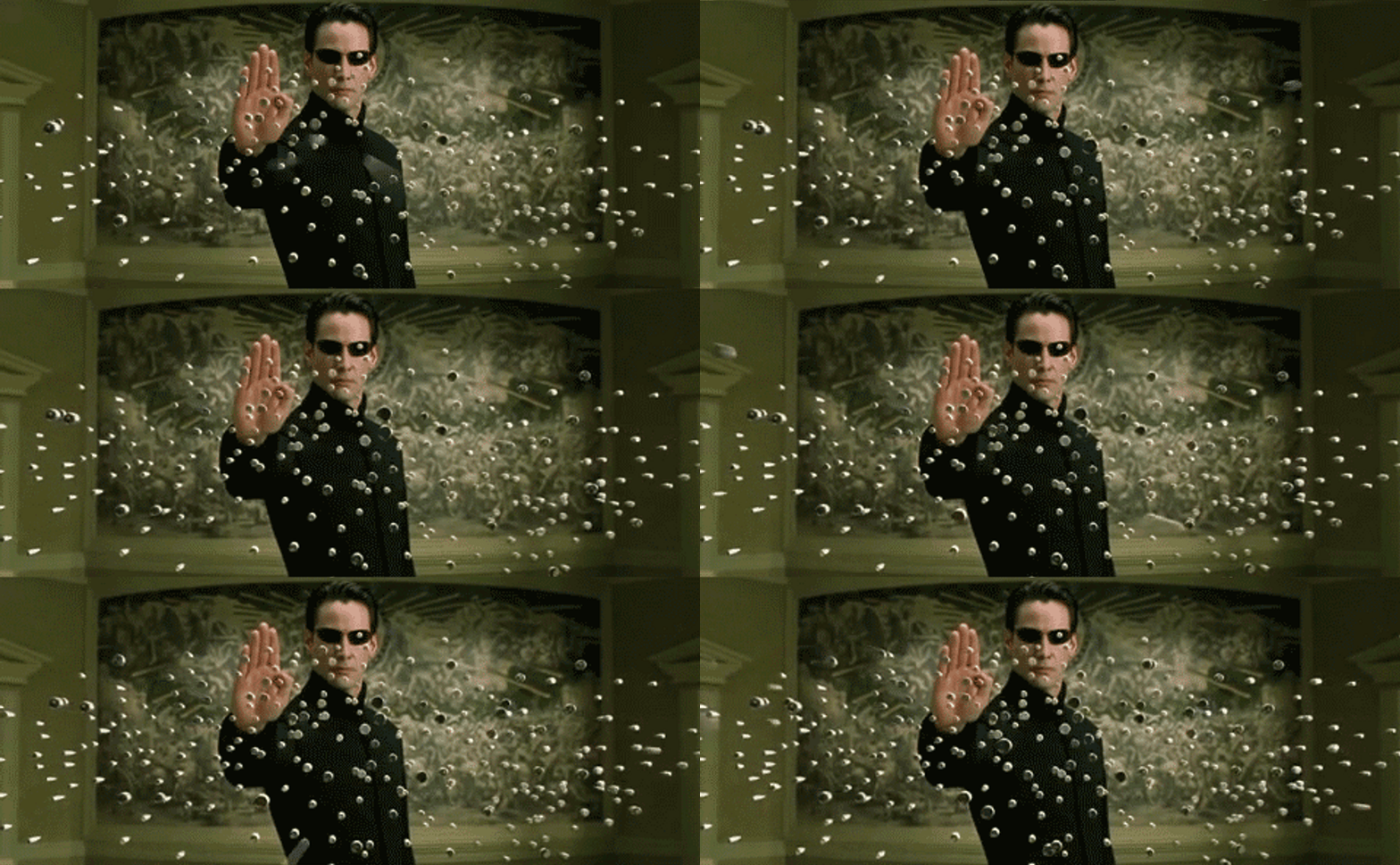
- His statement, “I’m going to show them a world where anything is possible,” captures his commitment to acting beyond conventional constraints.
>>>Accountability<<<
Seek feedback and make adjustments.
Neo’s path to accountability:
- Throughout his journey, Neo constantly seeks feedback. Morpheus, Trinity, and other rebels provide guidance, corrections, and advice. They act as external checks to his actions, ensuring he remains on the right path and isn’t succumbing to any lingering biases.
- The Oracle, a seer, provides him with prophecies and insights, which Neo learns to interpret in his own way. Although initially bound by her words, Neo later understands the importance of self-determination and reshaping destiny.
- The setbacks he faces, especially his confrontations with the Agents and the apparent betrayal of Cypher, act as feedback mechanisms. They force him to reassess, adapt, and improve his strategies and beliefs about the Matrix and himself.
The next time you find yourself stuck in your head, consider which bias might be in play and challenge it.
Tell me about the biases that you’ve caught yourself in. Let’s help each other break free.
P.S. If you found value in my story, consider signing up for my (FREE) friendly letter — a conversation jam-packed with motivation and practical takeaways for the most important person in your life — YOU!