
5 Best Strategies I Employed to Pass All 12 AWS Certifications Within a Year
Efficient approaches to mastering AWS certification exams in a short timeframe
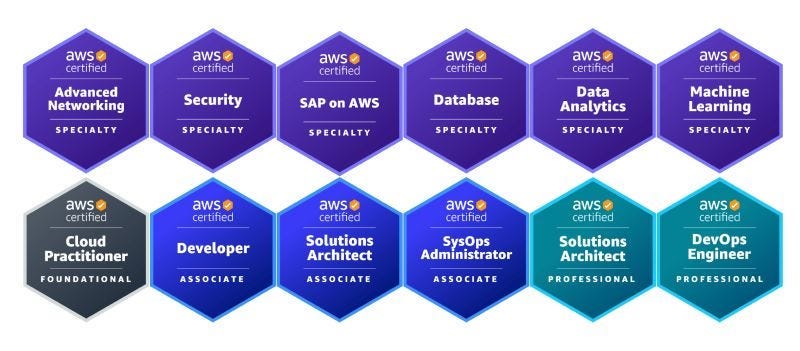
Undertaking the ambitious journey of acquiring all 12 AWS certifications within a single year was nothing short of exhilarating.
This pursuit not only provided me with a treasure trove of insights into the path to success but also allowed me to uncover invaluable strategies, learn from occasional missteps, and cultivate a profound understanding of the intricate AWS ecosystem.
In the pages that follow, I am eager to share my personal odyssey, offering a detailed account of my experiences and providing pragmatic advice for those who aspire to embark on a similar path.
For a comprehensive record of my attained AWS certifications, please feel free to explore them on my Credly profile. Let’s get straight into these strategies.
Maximize your tech career’s potential by exploring the handpicked articles in our curated list “Tech Certifications” I strongly recommend delving into this goldmine of knowledge and expertise. Take the opportunity to explore these articles and consider adding them to your own list for future reads.
1. Setting Clear Goals and Crafting a Strategic Plan
One of the strategies that propelled me toward achieving all 12 AWS certifications within a year was the unwavering commitment to setting clear goals and crafting a strategic plan.
This approach was instrumental in keeping me on track, combating the ever-present temptation of procrastination, and ensuring steady progress.
Defining Clear Goals
The journey began with defining clear and ambitious goals. I committed to acquiring all 12 AWS certifications within a year, a target that required careful planning and unwavering dedication. Each certification represented a significant milestone, and I established a roadmap outlining the sequence in which I would tackle them. Having a concrete goal not only provided a sense of purpose but also served as a constant reminder of what I aimed to achieve.
Aggressive Timeline
To ensure I stayed motivated and maintained a sense of urgency, I set an aggressive timeline. I allocated a maximum of one month to prepare for and pass each certification exam. This decision was strategic in several ways. Firstly, it eliminated the room for procrastination. With such a tight schedule, there was no option to delay or extend preparation periods. Secondly, it created a sense of discipline. I had to adhere to a strict study regimen to cover all the necessary material within the allotted time frame.
Focused Approach
The aggressive timeline was particularly beneficial when dealing with intricate and challenging topics, such as hybrid network connectivity or advanced security concepts. These domains demanded concentrated efforts, and the fixed one-month window forced me to stay focused. I couldn’t afford to get sidetracked or lose time on less critical subjects. This approach ensured that my attention was consistently directed towards the most essential and demanding aspects of each certification.
Eliminating Excuses
Perhaps one of the most significant advantages of this strategy was the elimination of excuses. It’s easy to procrastinate or delay studying when there’s no clear deadline in sight. However, by imposing a strict timeline, I removed any excuses for not dedicating sufficient time to preparation. There was a constant sense of urgency, which served as a powerful motivator.
In essence, setting clear goals and crafting a strategic plan was the foundational pillar of my success in achieving all 12 AWS certifications within a year.
It instilled discipline, eliminated procrastination, and ensured that my focus remained unwavering, even when faced with the most complex subject matter.
This strategy can be applied to various endeavors, not just certification pursuits, as it empowers individuals to maintain a driven and results-oriented mindset in their professional and personal pursuits.
2. Leveraging the Power of Exam Booking
An essential component of my strategy for successfully achieving all 12 AWS certifications within a year was the deliberate use of exam booking as a motivational tool and a cornerstone of my preparation process.
Commitment through Exam Booking
One of the key realizations early in my journey was that setting clear, tangible goals was paramount to my success.
The act of booking an exam served as a powerful commitment device. Before diving into the extensive study materials, I would go ahead and schedule the certification exam itself.
This seemingly simple step had profound implications. It provided me with a concrete target date that I needed to work towards.
Once the exam was booked, there was no turning back; it was a commitment I had made to myself.
Creating a Sense of Urgency
The exam booking created a sense of urgency. Knowing that there was a specific date on which I would be tested on my knowledge forced me to take my preparation seriously from day one.
There was no room for procrastination or complacency. This approach proved especially effective in combating the temptation to delay studying or to prioritize other tasks over certification preparation.
Measuring Progress and Milestones
Exam booking also helped me break down my certification journey into manageable milestones.
Each booked exam represented a specific goal to achieve. I could track my progress by the number of exams scheduled, passed, and the ones remaining.
It provided a structured approach to my learning journey, making it easier to stay organized and focused.
A Motivating Force
The knowledge that I had invested not only time but also money in booking the exams served as a motivating force.
It was a financial commitment, and I was determined to get a return on that investment by successfully passing the exam.
This external motivation, combined with my internal drive to succeed, provided a powerful catalyst for my efforts.
Strategic Planning
Exam booking also influenced my study schedule. I would work backward from the exam date, allocating specific periods for each topic, practice exams, and revision.
This structured approach ensured that I covered all the necessary material in a comprehensive manner.
Leveraging the power of exam booking was a crucial strategy in my journey to achieve all 12 AWS certifications within a year.
It instilled a sense of commitment, created urgency, and provided a structured framework for my preparation.
This strategy is applicable not only to certification pursuits but can be used in various contexts where setting and achieving goals is essential. It’s a reminder that sometimes, taking that first step by making a commitment can be the most powerful driver of success.
Strategic planning played a critical role in my journey, not only enabling me to successfully attain all 12 AWS certifications but also securing a position at Amazon.
Furthermore, it significantly accelerated my career growth, resulting in a threefold increase in my income within just 18 months.
3. Comprehensive Note-Taking as a Learning Tool
One of the fundamental practices that significantly contributed to my success in obtaining all 12 AWS certifications within a year was the meticulous art of note-taking.
As I embarked on this intensive learning journey, I realized that creating comprehensive and well-organized notes was an invaluable tool for both immediate comprehension and long-term retention of the vast amount of information I needed to master.
The Importance of Rich Learning Resources
To equip myself with the knowledge required for the AWS certifications, I tapped into a wealth of learning resources.
These included Udemy’s on-demand video courses, which provided structured and in-depth content, AWS’s extensive public documentation that offered detailed insights into each service, and the enlightening re:Invent videos that often presented real-world use cases and best practices.
While these resources were rich in content, they were also voluminous and dense, making it imperative for me to distill and digest the key takeaways effectively.
Meticulous Note-Taking Process
My note-taking process was meticulous and methodical. When engaging with these learning materials, I would have a notebook or digital note-taking tool at hand.
As I progressed through video lectures, documentation, or presentations, I actively listened and read, identifying core concepts, key terminology, diagrams, and practical examples.
For each topic, I would create a dedicated section in my notes.
Concise Summaries
Rather than transcribing content verbatim, I aimed for concise summaries that captured the essence of each topic.
This involved paraphrasing explanations in my own words, which not only reinforced my understanding but also ensured that the notes were clear and concise.
I used bullet points, diagrams, and charts to visually represent complex ideas or relationships between AWS services.
Reference Repository
Over time, these notes evolved into a personalized reference repository. This repository became my go-to resource when I needed to revise or clarify concepts.
Having meticulously curated notes meant that I didn’t have to revisit lengthy videos or documentation every time I needed to refresh my memory.
It expedited my learning process and proved invaluable when preparing for certification exams.
Effective Revision
The act of creating notes also served as an initial round of revision. While taking notes, I was essentially summarizing and revisiting the material.
Later, during dedicated revision sessions, I could quickly grasp the main points and reinforce my memory.
This revision process was particularly efficient because I wasn’t starting from scratch but building upon the foundation I had laid through note-taking.
Long-Term Retention
Beyond immediate exam preparation, these comprehensive notes played a crucial role in my long-term retention of knowledge.
AWS services and concepts often interconnect, and having well-organized notes allowed me to make these connections and understand the broader AWS ecosystem comprehensively.
In conclusion, comprehensive note-taking was an indispensable learning tool that helped me navigate the extensive content required for the AWS certifications.
It ensured that I not only grasped the material effectively but also had a valuable resource for revision and long-term retention.
This strategy can be applied to any complex learning endeavor, emphasizing the importance of active engagement with study materials and the creation of well-organized summaries for effective learning and knowledge retention.
These notes will also prove invaluable during your interviews. If you’re not a fan of taking notes, don’t worry, I’ve already published an article featuring the top 20 AWS Solutions Architect questions that I regularly use in my interviews.
Additionally, I’ve provided comprehensive answers to these questions, so be sure to give them a read.
4. The Revelation: Crafting an AWS Project Portfolio
During my intense pursuit of achieving all 12 AWS certifications within a year, I encountered a realization that transformed my approach to AWS learning.
It was the revelation that certifications alone, while valuable, were not sufficient to fully demonstrate my capabilities as an AWS Solutions Architect.
To demonstrate my expertise and practical skills, I needed to craft an AWS project portfolio.
The Missing Piece: Practical Experience
Up until that point, my focus had been primarily on absorbing the theoretical knowledge required for each certification.
While this knowledge was essential, I recognized that practical experience was the missing piece of the puzzle.
The ability to apply AWS services to real-world scenarios and solve practical challenges was a skill that could not be adequately measured by exams alone.
Immersive Hands-On Learning
With this realization, I embarked on an immersive hands-on learning journey.
Leveraging the AWS Free Tier, which provides a range of AWS services at no cost for a limited period, I had the perfect sandbox environment to experiment, create, and refine my AWS skills.
This was an opportunity to get my hands dirty and gain practical experience.
Building Real-World Solutions
I began by identifying areas where AWS services could be applied effectively.
These were not hypothetical scenarios but actual challenges that organizations might face.
For example, I created projects centered around building a scalable web application, implementing a data analytics pipeline, setting up a high-availability architecture, and more.
Each project was designed to showcase different aspects of AWS services and their practical applications.
Online Project Portfolio
As I completed these projects, I documented them meticulously. I created detailed project descriptions, including the problem statements, the AWS services used, the architecture diagrams, and the outcomes achieved.
These project descriptions, along with any relevant code repositories, formed the basis of my online project portfolio.
Demonstrating Expertise
My project portfolio became a powerful tool for demonstrating my expertise to potential employers and clients.
It showcased not only my theoretical knowledge, as validated by certifications but also my ability to translate that knowledge into real solutions.
It provided concrete evidence of my skills in action, and this practical demonstration was often more compelling than exam scores.
Solidifying Credibility
Additionally, my project portfolio played a crucial role in solidifying my credibility as a future AWS Solutions Architect.
It showed that I wasn’t just a passive learner but an active problem solver. It communicated my commitment to continuous learning and improvement.
This was particularly beneficial during interviews and discussions with prospective employers.
Learning by Doing
Beyond its utility for showcasing skills, the act of creating and managing the project portfolio was a profound learning experience in itself.
It reinforced my understanding of AWS services, honed my problem-solving abilities, and allowed me to learn from both successes and challenges in a real-world context.
Crafting an AWS project portfolio was a game-changing revelation during my journey to achieve AWS certifications. It transformed me from a passive learner into an active practitioner, allowing me to gain invaluable practical experience and showcase my skills effectively.
This strategy underscores the importance of not just acquiring knowledge but also applying it in real-world scenarios to become a well-rounded AWS Solutions Architect.
I suggest applying this technique not only to AWS certifications but to any tech certification you pursue.
If you’re interested in the top tech certifications that could shape your career in 2024 and beyond, I’ve written a detailed article, and I highly recommend checking it out.
5. The Significance of Practical Experience
Throughout my intensive journey to obtain all 12 AWS certifications within a year, I gained an unwavering appreciation for the profound impact of practical experience within the AWS ecosystem.
While theoretical knowledge undoubtedly forms the foundation of AWS understanding, it is the practical, hands-on experience that serves as the cornerstone of a truly solid grasp of AWS services and solutions.
Going Beyond Theory
AWS certifications provide an excellent theoretical understanding of AWS services, architectures, and best practices.
However, they are inherently limited by their ability to assess your practical problem-solving skills in real-world scenarios.
It’s the difference between knowing the theory of how to swim and actually swimming in a pool — the practical experience is where you truly learn to navigate the waters.
Immersion in AWS Services
The practical experience involves immersing yourself in AWS services and actively applying them to solve real challenges.
It goes beyond reading about services like Amazon EC2, Amazon S3, or AWS Lambda — it’s about launching instances, creating buckets, writing Lambda functions, and experiencing firsthand how these services interact and function within a live environment.
Constructing Meaningful Projects
To gain practical experience, I engaged in the construction of meaningful projects that encompassed a wide spectrum of AWS services.
These projects weren’t just academic exercises but were designed to address actual business needs or technical requirements.
For instance, I built a scalable web application, implemented a data warehousing solution for analytics, and set up an automated CI/CD pipeline for software deployment.
Learning from Challenges
Practical experience is not just about success; it’s equally about learning from challenges and setbacks.
In the course of constructing projects, I encountered various obstacles, such as optimizing resource costs, troubleshooting performance issues, and ensuring security best practices.
These challenges provided invaluable learning opportunities and deepened my understanding of AWS.
Expertise That Sets You Apart
In a competitive job market, practical experience in AWS can be a key differentiator.
Employers value candidates who not only possess theoretical knowledge but can also demonstrate their ability to design, implement, and troubleshoot AWS solutions effectively.
Practical experience showcases your readiness to tackle real-world problems from day one.
Staying Current
Practical experience is also instrumental in staying current with AWS’s ever-evolving landscape.
AWS continually introduces new services and features, and practical involvement allows you to adapt to these changes swiftly.
It’s a dynamic way of learning that keeps you agile in the face of technological advancements.
Community and Collaboration
Engaging in practical AWS projects often involves collaboration with others, whether it’s fellow learners, colleagues, or mentors.
This fosters a sense of community and encourages the exchange of ideas and best practices, enriching the learning experience.
In conclusion, my journey to achieve AWS certifications underscored the immense significance of practical experience.
It’s the real-world application of AWS services that solidifies your understanding, sharpens your problem-solving skills, and sets you apart as a capable AWS Solutions Architect.
Embracing practical experience is not just a strategy; it’s a commitment to continuous learning and growth within the dynamic AWS ecosystem.
In another article, I discuss how applying this technique, along with others, helped me secure a high-paying dream job at a FAANG company.
What makes it even more remarkable is that I achieved this while transitioning from engineering to tech. I highly recommend checking out that article as well.
Embrace Synergy and Consolidate Strategies
To further integrate and enrich the strategies discussed earlier, let’s compile a cohesive approach for navigating the AWS certification journey:
1. Prioritize Certifications: Initiate your certification journey by securing foundational certifications. Progress methodically to more advanced levels, considering their alignment with your career goals. As an example, after achieving the AWS Solutions Architect Associate certification, I made a significant leap directly to the AWS Solutions Architect Professional certification, bypassing intermediate associate-level certifications. This approach boosted my confidence and enabled me to swiftly conquer the remaining associate-level certifications within a fortnight.
2. Consistent Study Schedule: Allocate dedicated time slots each day or week for focused study sessions. Ensure comprehensive exploration of essential subjects and extensive practice opportunities. My preferred study approach involved three weeks of absorbing study material followed by a dedicated final week for intensive practice exams. This method fostered a holistic grasp of the material and enhanced my exam readiness.
3. Tap into Official AWS Documentation: Dive deep into AWS documentation to gain a firm understanding of the latest and most accurate service details. Dedicate ample time to peruse AWS Whitepapers to further augment your knowledge base.
4. Quality Online Courses and Training: Enroll in well-regarded courses available on platforms like Udemy. Streamline your learning experience by focusing on one platform to minimize redundancy. During my journey, Udemy courses proved exceptional for their up-to-date content, while I found that A Cloud Guru’s offerings struggled to keep pace with AWS’s rapid innovations.
5. Hands-on Experience: Leverage the AWS Free Tier to engage in practical exercises that deepen your understanding of various services. Overcome initial hesitation by proactively monitoring AWS expenditure using AWS Budget to ensure you stay within budget constraints and avoid unexpected charges.
6. Practice Exams and Community Engagement: Harness the power of practice exams, active participation in study groups, and vibrant involvement in forums to strengthen your learning and gather invaluable insights. I predominantly utilized practice exams on Udemy. An effective strategy was initiating the practice exam phase midway through my preparation to identify knowledge gaps, allowing focused study in these areas. Early gap detection significantly enhanced my exam preparation.
7. Effective Note-Taking and Regular Review: Create comprehensive notes, detailed flashcards, and concise summaries to aid your learning journey. Develop a habit of revisiting these study aids frequently. I compiled extensive Word documents of 100–150 pages for each certification and extended their utility by sharing them with colleagues and friends. These notes also benefited numerous individuals within the AWS community who found them instrumental in their certification pursuits.
8. Core Services and Continuous Learning: Prioritize foundational services like IAM, EC2, S3, and VPC. Stay updated on the latest AWS announcements and updates. Engage with AWS Blogs, utilizing the category filter to identify pertinent blogs tailored to your certification journey.
9. Maintain Balance and Adapt: Prioritize self-care by incorporating well-timed breaks. Adapt your study strategies to prevent burnout. For example, I maximized the quiet early morning hours and late evenings for focused study sessions.
10. Learn from Setbacks: Embrace failures as opportunities for growth. Deliberately challenge yourself, even intentionally stumbling in practice tests to identify areas for improvement. Paradoxically, this approach can pave the way for acing certifications on the first attempt during the actual exam.
This comprehensive approach synthesizes these strategies into a unified perspective for successfully navigating the AWS certification journey.
By implementing these strategies, anyone can seamlessly transition to technical roles.
Conclusion: Lessons Beyond Certification Numbers
In conclusion, the strategies delineated in this article have proven to be a dynamic framework that not only steered my journey but also empowered me to exceed my own expectations.
By employing these strategies, I accomplished what initially appeared as a bold objective: I successfully completed all 12 AWS certifications within a year, achieving this remarkable feat on my initial attempt.
Through unwavering dedication, strategic planning, practical hands-on experience, and a comprehensive approach to learning, I didn’t just acquire certifications but also cultivated a profound understanding of AWS technologies.
This expedition has affirmed that while reaching the destination is important, the lessons acquired and the skills honed during the journey are equally, if not more, invaluable.
As you embark on your own AWS certification odyssey, may these insights act as a guiding compass, aiding you in navigating the ever-evolving terrain of cloud technology toward your own success.
Explore More Tech Insights
Dive deeper into the world of tech with my handpicked curated lists. Save them for future reading and stay ahead in your tech journey.
- Tech Career Advice
- Tech Certifications
- Cloud Computing
- Cloud Solutions Architect
- Amazon Web Services (AWS)
- Microsoft Azure
- Google Cloud Platform (GCP)
- DevOps
- Data Science
- Programming
- Artificial Intelligence / Machine Learning (AI/ML)
- Generative AI (GenAI)
- ChatGPT
- Technology
- Medium Writing Tips
Before you go!
- Stay tuned for more insights! Follow and subscribe to Cloudmize.
- Did you see what happens when you click and hold the clap 👏 button?
About the Author
Usman Aslam stands as a seasoned Principal Solutions Architect, boasting over 16 years of experience within the technology domain. His remarkable journey includes achieving all 12 AWS certifications, a testament to his unwavering commitment and profound expertise. With an extensive background spanning Amazon Web Services (AWS), Capgemini, and Emerson, Usman has refined his skills in crafting resilient cloud solutions. He has been at the forefront of steering application migration and modernization onto the AWS platform. Usman’s leadership is a driving force behind the seamless transition and modernization of systems from on-premises environments to the Cloud. Notably, Usman has earned the trust of both enterprises and startups, owing to his exceptional skill set and adept leadership, rendering him an invaluable asset in their respective journeys to the cloud.


