
5 NoSQL Databases Developers Can Learn in 2023
These are the most popular NoSQL database programmers, software engineers, and full-stack developers who can learn in 2023 with links to the best resources and online courses.
Hello guys, if you want to learn about NoSQL and the popular NoSQL Database then you have come to the right place. Earlier, I have shared free SQL and database courses and in this article, I am going to talk about NoSQL and share the best resources to learn different types of NoSQL Database.
Though it’s not mandatory for Java or Web developers to learn the NoSQL database, the world is moving in that direction, and both Java and Web developer should be familiar with NoSQL databases.
If you are wondering what a NoSQL database is means, then here is a quick overview.
A NoSQL database refers to non SQL, non-relational, or not only SQL) that provides a mechanism for storage and retrieval of data, which is modeled in means other than the tabular relations used in relational databases.
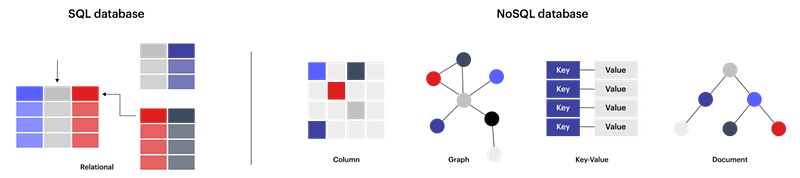
There are mainly four types of NoSQL databases: key-value store, document store, column-oriented database, and graph database. Each type solves a problem that can’t be solved with relational databases
With Spring 5 introducing Web-Flux, a new non-blocking web framework, the use of a NoSQL database will only grow, but the big question is which NoSQL database to start with? There are many popular NoSQL options available, like Apache Cassandra, MongoDB, Redis, and Couchbase. Well, it totally depends upon your project; if it’s using Cassandra, then you probably need to learn Cassandra, and if it is using MongoDB, then you probably need to learn MongoDB. But if you are a technical or a solution architect, which makes the decision to choose which NoSQL database to use, you probably need to be familiar with all of them to know their pros and cons and decide to depend upon your situation and their strength. When it comes to learning, I personally like to get familiar with as many technologies, frameworks, and libraries as possible just to widen my knowledge. Even if I don’t use them regularly, learning them sometimes opens new ideas to my mind, and I learn a thing or two which I can use in my existing project. If you aspire to become a software or technical architect, then it’s expected from you that you are familiar with the latest and greatest technologies, frameworks, and libraries as well. Keeping that in mind, I’ll share some of the critical 5 NoSQL databases in this article which you can learn or get familiar with within 2023.
5 NoSQL Database Developers Should Learn in 2023
As I said, there are many NoSQL databases available in the market like Apache Cassandra, MongoDB, Redis, and Couchbase, but each has some special functionality and there are pros and cons of using them. Good knowledge of these is required to make an informed decision based upon your requirements.
1. MongoDB
MongoDB is an object-oriented, simple, dynamic, and scalable NoSQL database. It is based on the NoSQL document store model. The data objects are stored as separate documents inside a collection instead of storing the data into the columns and rows of a traditional relational database. MongoDB uses JSON-like documents with schemas. If you want to learn MongoDB this year, I suggest you check out MongoDB — The Complete Developer’s Guide online course on Udemy. One of the best courses to start learning MongoDB NoSQL database.
If you need more choices and resources then you can also see this list of free Mongo DB Courses and the best MongoDB courses to start with.
2. Apache Cassandra
Apache Cassandra is a free and open-source distributed NoSQL database management system designed to handle large amounts of data across many commodity servers, providing high availability with no single point of failure. The Apache Cassandra database is the right choice when you need scalability and high availability without compromising performance. Linear scalability and proven fault-tolerance on commodity hardware or cloud infrastructure make it the perfect platform for mission-critical data
One of the key benefits of the Cassandra database is that it offers highly-available services and no single point of failure. If you decide to learn Apache Cassandra NoSQL database then Getting Started With Apache Cassandra course on Udemy is one of the better courses to start with.
3. Redis
Redis is an open-source in-memory database project implementing a distributed, in-memory key-value store with optional durability. It can also be used as a cache and message broker. It supports data structures such as strings, hashes, lists, sets, sorted sets with range queries, bitmaps, hyper logs, and geospatial indexes with radius queries. If you decided to learn Redis in 2023 then Learn Redis from Scratch on Udemy is a nice course to start with.
4. Couchbase
Couchbase Server, originally known as Membase, is an open-source, distributed multi-model NoSQL document-oriented database software package that is optimized for interactive applications.
If you want to learn more about the Couchbase database and need a resource then I highly recommend you to check out Understanding CouchDB 3: Learn Basic & Advanced NoSQL Skills course on Udemy. This is the best resource I got to learn Couchbase online.

If you need more choices then you can also earn them from the official tutorials and documentation which can be found on. Btw, they also have a couple of free online training which you can use as a course.
5. Apache HBase
HBase is an open-source, non-relational, distributed database modeled after Google’s Bigtable and is written in Java. It is developed as part of the Apache Software Foundation’s Apache Hadoop project and runs on top of HDFS (Hadoop Distributed File System), providing Bigtable-like capabilities for Hadoop. If you decide to learn Apache HBase then you can also join The Complete Apache HBase Developer Course on Udemy to learn it from scratch.
Frequently Asked Questions about NoSQL Database
Here are some of the common questions asked about NoSQL databases
- What are the 4 types of NoSQL databases?
There are four main types of NoSQL databases:
- Document databases.
- Key-value stores.
- Column-oriented databases.
- Graph databases.
2. Which is the best NoSQL database?
It depends upon scenarios, for example, if you need a document-based NoSQL database then MongoDB is the best NoSQL database. Similarly, if you need the full-text search as part of your solution then ElasticSearch is the best. For scalability, AWS DynamoDB is also a great database.
3. What type of NoSQL is MongoDB?
MongoDB is a document database. Graph databases are used to store information about networks, such as social connections.
4. Which is faster SQL or NoSQL?
As for speed, NoSQL is generally faster than SQL, especially for key-value storage in our experiment; On the other hand, NoSQL database may not fully support ACID transactions, which may result in data inconsistency.
That’s all about some of the best NoSQL databases you can learn and explore in 2023. Even if you are not using any NoSQL database in your current project, it’s time to learn them well in advance.
They will help you to widen your knowledge and also keep you up-to-date with the latest technology development. Knowing the latest technology development also them while searching job and going for an interview. Other Programming Resource articles you may like to explore
- 10 Things Java Programmer Should Learn in 2023
- 5 Free Spring Framework Courses for Java Developers
- The 2023 DevOps Developer RoadMap
- Top 5 Java design patterns courses for experienced Java devs
- 10 courses for Programming/Coding Job Interviews
- 5 Courses to learn Shell Scripting in Linux
- 10 Free Course to Learn Python Programming
- The 2023 Web Developer RoadMap
- 21 Tech Skills Java Developers Can Learn in 2023
- 10 Web Development Skills for Junior developers
- 50+ Data Structure and Algorithms Interview Questions
- How to become a Modern React JS Developer in 2023
- 10 Free Online Course to Learn Java Programming
- 10 Free Courses to Learn Data Structure and Algorithms in Depth
Thanks for reading this article so far. If you like these best NoSQL databases, then please share them with your friends and colleagues. If you have any questions or feedback, then please drop a note.
P. S. — If you are interested in learning NoSQL technology, particularly MongoDB but looking for a free online training course to start with then I highly recommend you check out — MongoDB Essentials — Understand the Basics of Mongo DB course on Udemy. It’s completely free and you just need a Udemy account to join this course.


