Free AI web copilot to create summaries, insights and extended knowledge, download it at here
4331
Abstract
.nih.gov/pmc/articles/PMC3969271/">say</a>. This bacterium<i> </i>also coats its enzyme in outer membrane vesicles (OMVs) that shield it from being degraded by the host’s proteases (i.e., an enzyme that breaks down proteins).</p><p id="cbf0">Other common gut bacteria that have the gene encoding InsP6 phosphatase <a href="https://www.ncbi.nlm.nih.gov/pmc/articles/PMC3969271/">include</a> <i>Bacteroides</i>, <i>Bifidobacterium</i>, <i>Prevotella</i>, and <i>Alistipes</i> species. But their enzymatic structures have not been crystallized or resolved, so their functions await further confirmation.</p><h2 id="5fdf">2. Oxalates</h2><p id="6667"><a href="https://www.healthline.com/nutrition/oxalate-good-or-bad#section3">Oxalates </a>— or oxalic acid — are found in leafy greens, cocoa, nuts and seeds. It binds to calcium and iron to form crystalline compounds that are normally eliminated via stool or urine. These crystals can accumulate in the kidneys of some individual — causing oxalate kidney stones, the most common form of kidney stones.</p><p id="a520">Gut bacteria break down oxalates — via a two-step enzymatic pathway using oxalyl-CoA decarboxylase first and later formyl-CoA transferase — are classified into two groups:</p><ul><li><a href="https://www.ncbi.nlm.nih.gov/pmc/articles/PMC5300851/">Generalist oxalotrophs</a>: <i>Lactobacillus, Bifidobacterium, Enterococcus</i>, and <i>Eubacterium</i> species that degrade oxalate and other food compounds.</li><li><a href="https://www.ncbi.nlm.nih.gov/pmc/articles/PMC5300851/">Specialist oxalotrophs</a>: <i>Oxalobacter </i>species that can only obtain its food from oxalates.</li></ul><p id="e1f5"><i>Oxalobacter</i> species are particularly important when it comes to oxalate kidney stones. People with this medical condition commonly tested <a href="https://www.ncbi.nlm.nih.gov/pmc/articles/PMC5300851/"><i>Oxalobacter</i>-negative</a>. Further, low levels of <i>Oxalobacter</i> species often correlated with <a href="https://www.ncbi.nlm.nih.gov/pmc/articles/PMC5300851/">higher recurrence</a> of kidney stones episodes.</p><p id="c70b">An important note is that <i>Oxalobacter</i> species are ‘<a href="https://www.sciencedirect.com/science/article/pii/S0065216410720037?via%3Dihub">fastidious</a>’ — a term given to microbes who need complex nutritional and environmental conditions to grow. This makes them highly sensitive to alterations in the gut microbiome, especially from <a href="https://www.sciencedirect.com/science/article/pii/S0065216410720037?via%3Dihub">antibiotics</a> usage.</p><div id="0ebe" class="link-block"> <a href="https://readmedium.com/can-gut-bacteria-resurrect-from-antibiotics-937a069c4ef9"> <div> <div> <h2>Can Gut Bacteria Resurrect from Antibiotics?</h2> <div><h3>Some don’t and probiotics don’t help. Now I understand what a 5-year antibiotic therapy did to my gut.</h3></div> <div><p>medium.com</p></div> </div> <div> <div style="background-image: url(https://miro.readmedium.com/v2/resize:fit:320/0*ymH8JW_ihGT_xSun.png)"></div> </div> </div> </a> </div><h2 id="9c65">3. Tannins</h2><p id="7a73"><a href="https://www.healthline.com/nutrition/tannins-in-tea#bottom-line">Tannins </a>— or tannic acid — are found in leaves, spices, nuts, seeds, legumes, wine, coffee and tea. They are polyphenols that give food its bitter flavour. And it <a href="https://openbiotechnologyjournal.com/VOLUME/13/PAGE/68/#r47">binds</a> to iron and certain proteins, limiting their absorption.</p><p id="808f">Tannase is an enzyme that breaks down tannin into gallic acid and pyrogallol that have anti-cancer properties. <a href="https://www.frontiersin.org/articles/10.3389/fmicb.2014.00684/full#T1">Gut microbes</a> that synthesize tannase include <i>Lactobacillus plantarum</i>, <i>Fusobacterium </i>species and <i>Streptococcus gallolyticus</i>.</p><p id="e839">These gut microbes, especially <i>S. gallolyticus</i>, frequently increase in numbers and colonize tumorous tissues in patients with colorectal cancer. But this is an <a href="https://www.frontiersin.org/articles/10.3389/fmicb.2014.00684/full#T1">adaptive mechanism</a> as these gut microbes then delay the
Options
progression of colon cancer therein via generation of anti-cancer chemicals from tannin metabolism.</p><h2 id="2f06">4. Saponins</h2><p id="5106"><a href="https://www.phytochemicals.info/phytochemicals/saponins.php">Saponins </a>— a steroid or triterpene glycoside compound — are found in peas, soybeans and some herbs. It <a href="https://openbiotechnologyjournal.com/VOLUME/13/PAGE/68">inhibits</a> metabolic and digestive enzymes, as well as binding to zinc.</p><p id="0860">Saponins can be degraded by the beta-glucosidase enzyme, which is <a href="https://pubmed.ncbi.nlm.nih.gov/18537837-distribution-of-beta-glucosidase-and-beta-glucuronidase-activity-and-of-beta-glucuronidase-gene-gus-in-human-colonic-bacteria/">carried by</a> most of the <i>Bifidobacterium</i> species and <i>Bacteroides thetaiotaomicron</i> (that also metabolizes phytates) in the human gut. Some <i>Faecalibacterium</i> and <i>Roseburia</i> species are also capable of breaking down saponins to some extent.</p><h2 id="73ca">5. Amylase-Trypsin Inhibitors (ATIs)</h2><p id="0d8c">ATIs can be found in grains containing gluten. They are also known to irritate and <a href="https://www.frontiersin.org/articles/10.3389/fimmu.2018.03174/full">induce inflammation</a> in the gut, though individuals’ tolerance to it varies. ATIs are, nonetheless, responsible for wheat allergies (baker’s asthma), non-celiac wheat sensitivity, and other allergies and autoimmune diseases.</p><p id="b919">Gut bacteria that break down ATIs <a href="https://pubmed.ncbi.nlm.nih.gov/30802444-lactobacilli-degrade-wheat-amylase-trypsin-inhibitors-to-reduce-intestinal-dysfunction-induced-by-immunogenic-wheat-proteins/">include</a> <i>Enterococcus</i>, <i>Bifidobacterium</i>, <i>Clostridium</i>, <i>Bacillus</i>, and <i>Lactobacillus </i>species. Administering ATIs-degrading <i>Lactobacillu</i>s species — isolated from the human gut — into mice <a href="https://pubmed.ncbi.nlm.nih.gov/30802444-lactobacilli-degrade-wheat-amylase-trypsin-inhibitors-to-reduce-intestinal-dysfunction-induced-by-immunogenic-wheat-proteins/">prevented</a> the occurrence of gut inflammation and leaky gut upon consumption of ATIs-containing foods.</p><h2 id="1b5a">Takeaways</h2><p id="8083">Other antinutrients — namely lectins, goitrogens and cyanide — may not be degradable by gut bacteria, or at least have not been shown to.</p><p id="d7a7">See if <a href="https://openbiotechnologyjournal.com/VOLUME/13/PAGE/68">common side effects</a> —i.e., nausea, bloating, headaches, rashes, and nutritional deficiencies — from excessive exposure to antinutrients are present after consuming antinutrient-containing plants. If yes, the antinutrient-degrading gut bacteria may not be thriving well. It could be due to stress, antibiotics or other factors that may have disharmonized the gut microbiome.</p><p id="1ee8">Nonetheless, Harvard.edu <a href="https://www.hsph.harvard.edu/nutritionsource/anti-nutrients/">reports</a> that antinutrients are not a concern for the majority of people:</p><blockquote id="5795"><p>“The pros and cons of anti-nutrients on long-term human health is an area of active research. Though certain foods may contain residual amounts of anti-nutrients after processing and cooking, the health benefits of eating these foods outweigh any potential negative nutritional effects. Eating a variety of nutritious foods daily and avoiding eating large amounts of a single food at one meal can help to offset minor losses in nutrient absorption caused by anti-nutrients.”</p></blockquote><p id="b34b">“They are typically dangerous only when you have a unique situation usually created by very limited or very poor diet,” <a href="https://www.mnn.com/food/healthy-eating/stories/what-are-antinutrients-and-do-you-need-worry-about-them-your-diet">agrees</a> Sarah Ash, Professor of Nutrition at North Carolina State University. “Plants may contain things that are good for us. They may contain things that are less good for us. Trying to look at one without looking at the other is problematic,” she <a href="https://www.mnn.com/food/healthy-eating/stories/what-are-antinutrients-and-do-you-need-worry-about-them-your-diet">continues</a>.</p><p id="d3b7" type="7">“If you eat a variety of things in moderation, then none of it matters,” Professor Ash assured.</p></article></body>
Plants engage in chemical warfare against their predators. It’s a form of self-defence to avoid being eaten. One type of plant defence chemical is antinutrients that bind to essential metals such as calcium, iron and zinc — limiting their bioavailability for the host.
Excessive antinutrients in the body — if it’s not broken down — commonly cause nausea, bloating, headaches, rashes, and nutritional deficiencies.
“Plants, for their own defence, primarily use antinutrients… Antinutrients are found in their highest concentrations in grains, beans, legumes and nuts, but can also be found in leaves, roots and fruits of certain varieties of plants,” writes a team of Bulgarian researchers from the University of Food Technologies in a 2019 review.
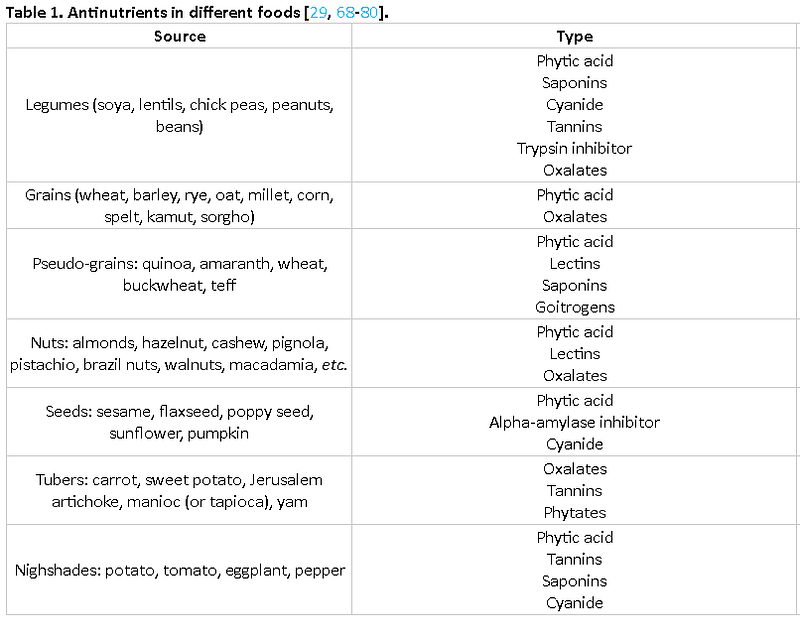
Antinutrients aren’t inherently bad. “When used at low levels, phytic acid, lectins and phenolic compounds…have been shown to reduce blood glucose and/or plasma cholesterol and triacylglycerols,” says the Bulgarian scientists.
Various methods can keep antinutrients at low levels. They include cooking, fermentation, soaking and sprouting. A less emphasized method, however, is maintaining a healthy gut microbiota — to nourish the gut bacteria that help break down some of these antinutrients.
Phytates — or phytic acid or inositol hexaphosphate (InsP6) — are found in seeds, grains, legumes and nuts. It blocks the absorption of iron, zinc and, to a lesser degree, calcium.
Screening the genomes of gut bacteria from humans, Dr Régis Stentz and colleagues from the Institute of Food Research and the University of East Anglia, UK, identified one bacterium — Bacteroides thetaiotaomicron — that encodes an enzyme — InsP6 phosphatase — capable of metabolizing phytate. They further crystallize the enzyme’s molecular structure and test it for the ability to break down phytate. And indeed it did.
Good news is that “B. thetaiotaomicron is a dominant human gastrointestinal tract symbiont,” the researchers say. This bacterium also coats its enzyme in outer membrane vesicles (OMVs) that shield it from being degraded by the host’s proteases (i.e., an enzyme that breaks down proteins).
Other common gut bacteria that have the gene encoding InsP6 phosphatase include Bacteroides, Bifidobacterium, Prevotella, and Alistipes species. But their enzymatic structures have not been crystallized or resolved, so their functions await further confirmation.
Oxalates — or oxalic acid — are found in leafy greens, cocoa, nuts and seeds. It binds to calcium and iron to form crystalline compounds that are normally eliminated via stool or urine. These crystals can accumulate in the kidneys of some individual — causing oxalate kidney stones, the most common form of kidney stones.
Gut bacteria break down oxalates — via a two-step enzymatic pathway using oxalyl-CoA decarboxylase first and later formyl-CoA transferase — are classified into two groups:
Oxalobacter species are particularly important when it comes to oxalate kidney stones. People with this medical condition commonly tested Oxalobacter-negative. Further, low levels of Oxalobacter species often correlated with higher recurrence of kidney stones episodes.
An important note is that Oxalobacter species are ‘fastidious’ — a term given to microbes who need complex nutritional and environmental conditions to grow. This makes them highly sensitive to alterations in the gut microbiome, especially from antibiotics usage.
Tannins — or tannic acid — are found in leaves, spices, nuts, seeds, legumes, wine, coffee and tea. They are polyphenols that give food its bitter flavour. And it binds to iron and certain proteins, limiting their absorption.
Tannase is an enzyme that breaks down tannin into gallic acid and pyrogallol that have anti-cancer properties. Gut microbes that synthesize tannase include Lactobacillus plantarum, Fusobacterium species and Streptococcus gallolyticus.
These gut microbes, especially S. gallolyticus, frequently increase in numbers and colonize tumorous tissues in patients with colorectal cancer. But this is an adaptive mechanism as these gut microbes then delay the progression of colon cancer therein via generation of anti-cancer chemicals from tannin metabolism.
Saponins — a steroid or triterpene glycoside compound — are found in peas, soybeans and some herbs. It inhibits metabolic and digestive enzymes, as well as binding to zinc.
Saponins can be degraded by the beta-glucosidase enzyme, which is carried by most of the Bifidobacterium species and Bacteroides thetaiotaomicron (that also metabolizes phytates) in the human gut. Some Faecalibacterium and Roseburia species are also capable of breaking down saponins to some extent.
ATIs can be found in grains containing gluten. They are also known to irritate and induce inflammation in the gut, though individuals’ tolerance to it varies. ATIs are, nonetheless, responsible for wheat allergies (baker’s asthma), non-celiac wheat sensitivity, and other allergies and autoimmune diseases.
Gut bacteria that break down ATIs include Enterococcus, Bifidobacterium, Clostridium, Bacillus, and Lactobacillus species. Administering ATIs-degrading Lactobacillus species — isolated from the human gut — into mice prevented the occurrence of gut inflammation and leaky gut upon consumption of ATIs-containing foods.
Other antinutrients — namely lectins, goitrogens and cyanide — may not be degradable by gut bacteria, or at least have not been shown to.
See if common side effects —i.e., nausea, bloating, headaches, rashes, and nutritional deficiencies — from excessive exposure to antinutrients are present after consuming antinutrient-containing plants. If yes, the antinutrient-degrading gut bacteria may not be thriving well. It could be due to stress, antibiotics or other factors that may have disharmonized the gut microbiome.
Nonetheless, Harvard.edu reports that antinutrients are not a concern for the majority of people:
“The pros and cons of anti-nutrients on long-term human health is an area of active research. Though certain foods may contain residual amounts of anti-nutrients after processing and cooking, the health benefits of eating these foods outweigh any potential negative nutritional effects. Eating a variety of nutritious foods daily and avoiding eating large amounts of a single food at one meal can help to offset minor losses in nutrient absorption caused by anti-nutrients.”
“They are typically dangerous only when you have a unique situation usually created by very limited or very poor diet,” agrees Sarah Ash, Professor of Nutrition at North Carolina State University. “Plants may contain things that are good for us. They may contain things that are less good for us. Trying to look at one without looking at the other is problematic,” she continues.
“If you eat a variety of things in moderation, then none of it matters,” Professor Ash assured.