
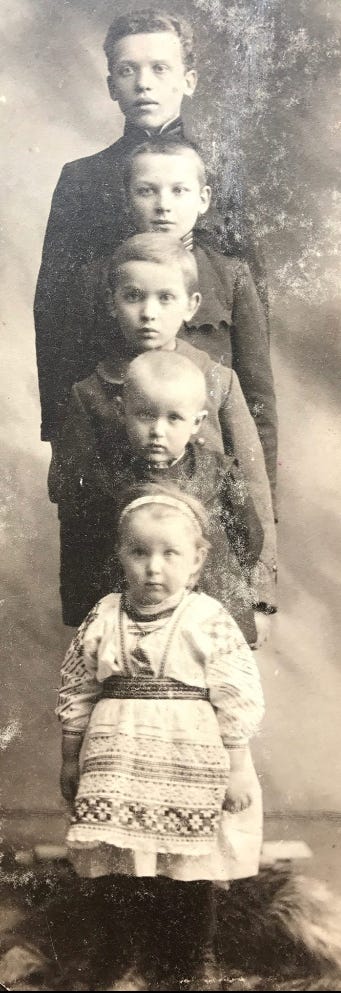
What My Grandmother Was Trying to Tell Me.
A couple weeks ago, I did something I haven’t done in over two years. I went on an extended business trip. As I settled in for the six-hour flight to Vancouver, I immediately checked out the movie menu and couldn’t believe my luck: Dune. The allegory about the moral dangers of colonialism is filled with symbolism, action, and plot twists, and it’s set in a mysterious world that grabs hold of you immediately, refusing to let go for a full three hours — in other words, for half the flight.
My entire life, I’ve been a sucker for that kind of story.
When I was little, both my parents worked, and I was raised largely by my grandmother, who lived in the downstairs apartment of our 2-family house. My grandmother, my Baba, was a painter who spent her days in her back bedroom studio, working viscous, multi-colored puddles of acrylic paints into flowers.
Midway through each day, Baba would rinse her hands in turpentine and treat herself to lunch, usually a few slices of bread with butter, a mug of coffee, and a cigarette. Menthols, coffee and turpentine. That was the smell of my childhood.
Before getting back to work, my grandmother would usually follow up lunch with a nap on the couch…at least she would try. Because more often than not, I would crawl onto the sofa next to her, and ask her to tell me a story about Ukraine. But she and I both understood that the story I really wanted to hear was more accurately titled Escape from Ukraine. I wanted to hear about the war. What happened to them, and how they made it to our brick, two family home near Cleveland, Ohio.
Though she never told the story the same way twice, and the details of each chapter changed a bit with every retelling, it always started with a singular theme: Ukraine was beautiful. Whether it was the sun-drenched fields of her childhood home in Kulchytsi, or the narrow streets that led to my grandfather’s family greystone in Lviv, my grandmother could paint Ukraine as vividly with her words as she could illustrate bouquets of poppies with her acrylics.
It’s usually at this point in the story where Baba would reach over, light a cigarette, and take a deep breath.
“…i todi vyjna pryjshla.”
And then the war came.
First it was the Russians. Then the Germans. Then the Russians again.
The war always came to my family. Never the other way around.
Of course, for me, that’s when the story got good. It was filled with danger, near misses, and do-or-die decisions. There was the time the Russians were about to take my grandfather away until they realized that he, an engineer, was the only one who knew how to run the local sugar mill. And there was the time when the Germans actually did haul my grandfather away. But my Baba, who had heard that the Germans respected moneyed aristocracy, put on a fur coat, her best hat, and every piece of expensive jewelry she could get her hands on. She then marched straight to the German headquarters, and demanded they release her husband immediately — because she had an important dinner to attend. It worked. There was also the time after the Russians returned, when one of the local communists pulled my grandfather aside at the sugar factory and told him to go home, grab his family, and never come back. And, he emphasized, it had to be that night. My grandfather didn’t need to be told twice.
As they fled westward, the story got even better. In a desperate scramble to get behind British or American lines, the family talked their way onto the cargo car of a train heading for Austria. They pushed into the cold, windowless boxcar, when my grandmother heard a man’s voice behind her: “Nina?” It was her younger brother, my uncle, Yarema, who had finagled his own young family’s passage onto the same car. The way my grandmother told the story, she hadn’t seen her brother since before they fled Ukraine. But from that moment, they wouldn’t lose touch for the rest of their lives. After the war, our family followed his wherever they went. First to the displaced persons camp, then across the ocean to New Haven, and finally to Cleveland, where they lived less than a mile from one another. My uncle Yarema would stop by Baba’s house every week or so. They would play cards. My grandmother would cheat. He would storm out, swearing he’d never play with her again. And the next week, they’d do the whole thing all over again.
It was an amazing story. And best of all for a four year-old curled up with his grandmother on the couch, it seemed to have a happy ending. Every single person I knew and loved survived the story, and lived happily ever after in Ohio.
But not everyone my grandmother knew and loved did.
Four of her five brothers didn’t live to see the end of the war, two of them executed by the Russians. When Baba got to that part of the story, I felt the loss as one does when a character dies in a movie, invested…but at a distance. What I didn’t understand at the time, was that for my grandmother, these weren’t characters in an oral history. They were her brothers. And they weren’t simply written out of the story. They were butchered.
As I approached school age, I began to sense my grandmother’s tension as she relayed these moments. The long pauses. The deeper drags on her Salems. Eventually, we would replace those lunchtime stories with a game of cards. We’d play gin rummy at her kitchen table, while my grandmother drank her coffee, smoked her cigarette — and yes, cheated. Baba was always on-brand.
And that’s what my family’s history was to me for most of my life — a great story. But just because I knew the stories didn’t mean I understood them. And just because I’ve studied Ukrainian history doesn’t mean I could ever truly comprehend the terror of its darkest chapters.
But something changed the second I landed in Vancouver, and my phone blew up.
“Are you watching the news?”
“Have you seen the pictures?”
“Did you hear about Bucha?’
A bullet riddled man tangled up in a bicycle. An entire family incinerated in a trash dumpster. A basement full of villagers, bound and executed with a single bullet to the back of the head…probably the same way my grandmother’s brothers were.
But the image that has haunted me most was that of a three-year old girl, not in Bucha, but in Mykolayiv. Stripped naked. Bound. Gagged. Likely raped. Murdered. Her body dumped on top of her 17 year-old sister’s, next to the rest of their family.
That’s when the story of my family and my ancestral home, the one I’ve been listening to my entire life, suddenly clicked into sharp focus. But for an accident of history, that could have been my daughter. That could have been my family. Instantly, the usually chronic Ukrainian-American survivor guilt found another gear and became acute and painful. Why would it matter whose daughter that is? Why would I even think that? And why am I just sitting here? Where else can I donate? What other congressman can I call? What can I do to make this stop? And what permission do I have to feel any of this? I’m literally on my way to wash a plate of oysters down with an IPA right now. My home is intact. My children are safe. My wife knows I’m still breathing. What gives me the nerve to even think that I’m in any way a part of this story?
Now, I can hear the PTSD in my mother’s voice on the phone when she’s talking about the news. And for the first time, I can actually feel something close to the anxiety in my grandmother’s voice, now existing only in my head. Why didn’t I feel it then? Why didn’t I ever think to ask her if she was okay? Do they still sell Salem Lights 100s? Am I the only one who needs a cigarette?
A few weeks ago, a friend posted a simple plea on her social media accounts. It said “Check on your Ukrainian-American friends. We are not okay.” And after Bucha, it’s hard to see how any of us will be okay anytime soon.
Because my grandmother’s story, epic as it is, is not unique. My mother’s side of the family has the same kind of story. My (also Ukrainian) wife’s maternal grandmother saw her father dragged out of their house in Drohobycz in the middle of the night. Later that week, she went with her mother to look for his body among the lines of corpses in the town square, but they never found him. They left their home, and everything in it, that very night. And they didn’t look back until they landed in Chicago, where they remained for the rest of their lives.
Every Ukrainian you’ve ever met has a story like this. Most have several.
You’ll find all of our collective DNA in mass graves located in places like Baturyn, Vinnytsia, and Odesa. And now Bucha, Borodyanka, Kramatorsk, and Mariupol. Places where our family trees were sprayed with bullets, torn apart by bombs, strung up by ropes, and starved nearly to extinction. And so when Russia’s state media outlet openly states that Ukrainians have no right to exist as a nation, and those who insist on retaining elements of Ukrainian language and culture need to be eliminated as part of this ethnic purification, we are keenly aware of what moment in time we are in. It’s the same moment we’ve always been in.
Because this is no story. This isn’t Dune. This isn’t an allegory about the moral dangers of colonialism. This is Russian imperialism — raw, unvarnished, bloody and cruel. Brought to you daily on TikTok. This is as real as it’s ever been. Only this time, we can see what it really looks like. This time, we can feel it.
Because it turns out our grandparents’ stories were never just stories. They were a warning, largely unheeded, that history is something that happens to you — and that everyone you love is just a character in a tale penned by an unfeeling hand.
So maybe it’s fitting that Ukrainians, in the most decisive moment of their history, have chosen as their leader a storyteller. One who knows that the key to a good story is to keep rewriting it until you get the ending you’re looking for. An ending where NATO countries provide Ukrainians with the exact weapons and training they need, where Germany chooses the right side of history over the comforts of Russian fossil fuels, and where the global business community helps to rebuild Ukraine into the modern, democratic free market nation they always hoped Russia would eventually become.
An ending where Russia can’t simply erase us, no matter how hard they try. That’s the story my Grandmother was trying to tell.


