
Idioms and the Broken Record Conundrum.
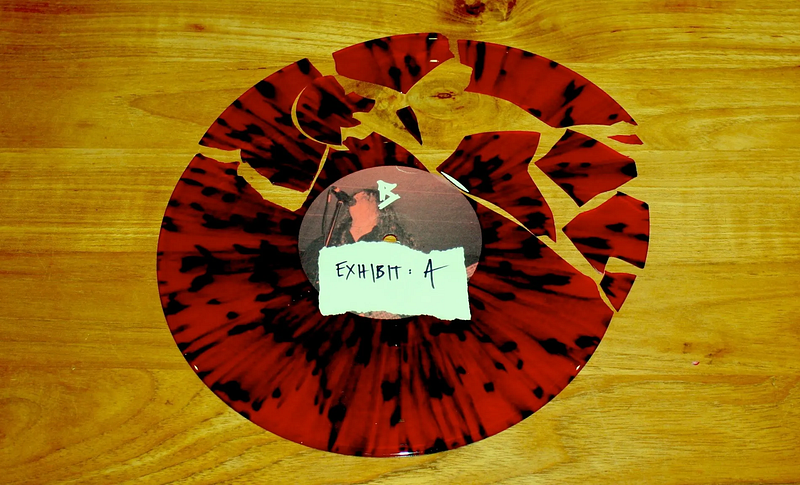
A lot of people use the expression “goes on like a broken record.”
Have you ever considered the inherent flaw in that idiom?
I have. Gather ‘round, me tell you all about it.
Imagine you’ve been employing an expression for longer than you can remember. Now, imagine you learn that the logic of that idiom is flawed; its premise is straight-up wrong.
Granted, you won’t die of embarrassment — it’s not public speaking after all — but you’d probably find yourself landing somewhere between sheepish and mortified. You could persist with using said idiom, but to deny oneself the right to phrase effectively? No need for self-flagellation — way too Marquis de Sade for such an innocent misstep.
While there are a host of questionable colloquialisms, the one that most grinds my gears is to sound like a broken record. That, or its doppelgänger, goes on like a broken record.
The specific point of contention lies in the word broken.
Let’s establish the reason for using this well-worn declaration.
The inference is assigned to people who tend to repeat the same message over and over. It bears a typically negative connotation; the issuer of the observation is uttering irritation or annoyance from the individual’s repetition. It would be inaccurate to suggest there can be no affection afforded the offender; like all admissions of frustration, the collected works of endearment through to contempt have many chapters.
But what is wrong with this expression?
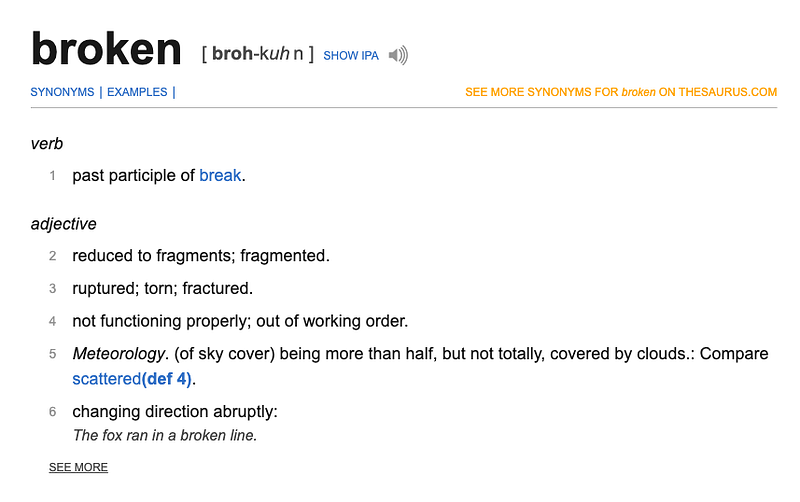
It’s right there in the adjective of the phrase: to sound like a broken record.
The fact is, a broken record doesn’t promote sound waves. It doesn’t skip, and it doesn’t get locked into an endless loop of repetition. A broken record is devoid of any practicability when considered as a conduit for the playback of recorded sound.
Attempts to play a broken record (assuming you can mount some component of this polyvinyl chloride composition onto the turntable), will be met with futility. You’ll get static, sure; the turntable platter will rotate, and the needle will produce a response to whatever surface it skates over. The tonearm will bounce around, chaperoned by the rise and fall of the turntable surface at any stage of rotation.
What it won’t do is repeat the same passage over and over again. The unchanneled stylus will output a random array of noise; pandemonic fuzz interspersed with designed messaging embossed into arbitrary grooves it may happen across.
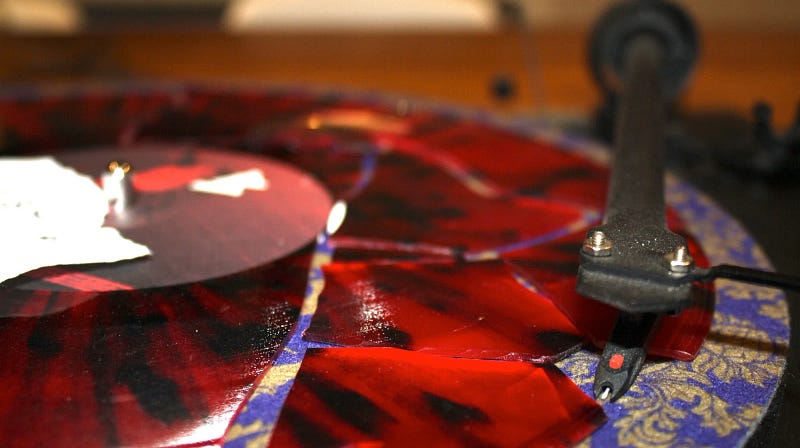
In order for this expression to be effective, it should be affirmed as To sound like a scratched record. Scratched records, or records bearing a defect such as a stubborn piece of dust or dirt, can definitely achieve the outcome of the original asseveration, though it is worth stating that when comparing human to machine endurance in this context, the record is likely to deteriorate, long before the human outrage will.
The sonic message, originally embossed into this locked corrugation, will devolve into an emanation of transcendental static and, depending on your preferred pursuit of audial zen, will be decidedly less maddening that your friend, colleague, or significant other — whoever it is in your orbit with an axe to grind. Generally speaking, the broken record in your life is unhappy about something.
How did we get here? What’s the origin of this outrage?
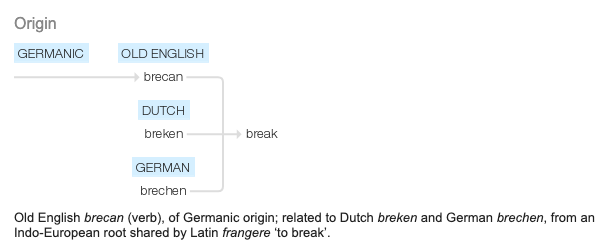
The Grammarist posits the idiom as first applied during the 1940s. Etymonline places it in 1944. Because the record enthusiast in me wants you to care about the evolution of the vinyl record as much as the semantics of this phrase, let’s take in a little history that won’t be on the test.
The origins of the phonograph date back to Thomas Edison’s invention in 1877. The first format that bears a resemblance to the records of the 1950s through to today can be attributed to Berliner Gramophone, who, in 1897, produced the first shellac record that was 7” in diameter. The 10” would follow in 1901, and the 12” in 1903.
Shellac is a resin secreted by the female lac bug. It is taken from forest trees in Thailand and India. As a storage format for music, it had the dubious honour of being fragile and not particularly durable.
Shellac was replaced in part by a vinyl precursor called Vitrolac in 1929. In 1931, this Picture Disc styled format surfaced in a notably more robust quality. Discogs cites a version of Paul Whiteman And His Troupe, A Night With Paul Whiteman At The Biltmore, as released in 1932, and an additional discussion about it can be reviewed on the Talking Machine forum. I’m going to label this as a peculiarity, however, and not the manufacturing standard for records during that period. Besides, this bodes much more strongly for my argument.
And now, a word from our sponsor.
Vinyl, in a semblance most proximate to what we contemporaneously know it to be, didn’t emerge until 1949. This post-war triumph coincided with the first LPs; 12” in diameter with a speed of 33RPM.
So, what I’m hearing is that the terms broken and scratched are interchangeable.
No. People have argued that both adjectives wield the same intention, but even the etymology of the word broken summons no affinity with scratched.
As we traverse this seldom charted passage of nuance, we can see that broken being interchangeable with scratched is a leap no thesaurus will make.
Is it then a case of people simply never thinking about the expressions they use? Or is it a case of an unwillingness to evolve to diversify one’s communications? Is it an affront to their established comforts?
An illustration, if you please.
If presented an iPhone with a scratched screen and another with a shattered screen, which is more likely to be described as broken? Better still, if offered a choice of the two, which would you select for yourself? In terms of utility, records are no different. I’ve no doubt that the king’s horses, as well as the king’s men, would have found a solution to Humpty Dumpty’s perpetuity far more readily had the egg merely been dealt a flesh wound.
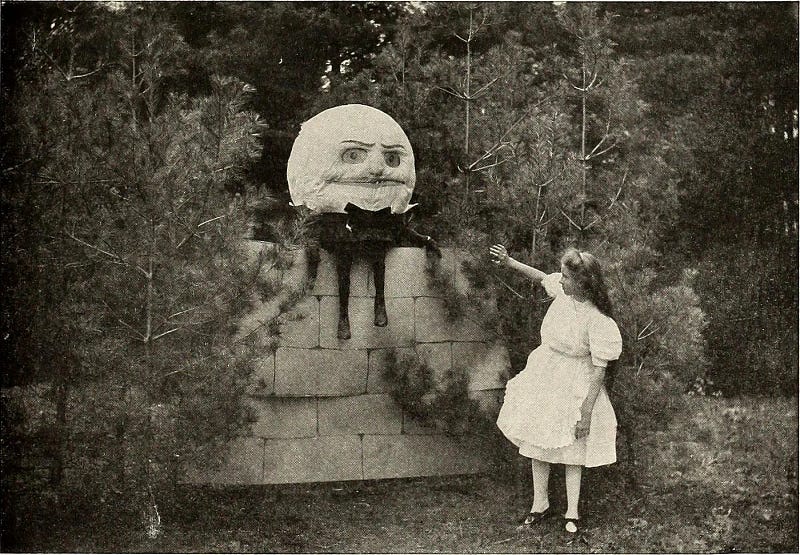
Why has, and why will this expression survive?
There is a quote attributed to wartime British Prime Minister Winston Churchill that reads;
Any man who is under 30, and is not a liberal, has no heart; and any man who is over 30, and is not a conservative, has no brains.
The actual source is more likely to have originated with French Statesmen, François Guizot who wrote:
Not to be a republican at twenty is proof of want of heart; to be one at thirty is proof of want of head.
Variants of this position were touted by various French dignitaries into the twentieth century.
Attribution aside, it’s reasonable to say that consideration has been granted to the correlation between growing older and one’s susceptibility to conservatism. Though this isn’t the explicit point of this discussion, it does serve to align one view as to why people use illogical expressions and why this adherence becomes more steadfast as they advance in the years. I’m also applying the term conservative to a stagnation effect rather than being strictly political, though in this relationship, one hand invariably washes the other.
So it’s not only about the correct usage of expression; part of the consideration is wanting to understand why people remain steadfast in their idioms and, as they age, are less likely to veer from familiarity. Why is a settled position viewed as normal?
Am I trying to extract too much from such innocuous parlance?
Generally, yes.
If you take note of the types of exchanges that take place on any social media platform, one can readily deduce that no matter how inane the theme, people will contribute deeply considered theories and conclusions, tapping into currents infinite and complex in pursuit of a definitive position.
Some of those opinions will be informed, others not so much. Particular sources cited as the basis for the evidence may only bear the fuzziest of truths — conspiracy theories often residents of this zip code. Whichever frame you apply, a lot can be extrapolated from a little — even the most insipid expressions.
Despite a keen desire to learn and evolve, some beliefs have remained constant.
- As people age, they become increasingly comfortable in their routines.
- Comfortable is synonymous with conservative.
- Don’t succumb to point one. Don’t ever become point two.
Survival of the idiom
As the twilight years of the last millennium faded, so too did the commercial viability of the vinyl record. If you scour message boards of this era, you’ll find the odd discussion about expressions relative to the pervasiveness of the object referenced within.
As the MP3 received a significant, turn-of-the-century push from the likes of Napster, Lars Ulrich, and Apple with the launch of iTunes and the iPod, online thinkers wondered, “How long will people continue to say, ‘like a broken record?’”
If an argument can be made that people use idioms without consideration for logic or legitimacy, I’d dispute whether the expression's survival has any reliance on a sustained interface with records. In fact, the following Venn diagram serves to bolster, if not completely validate, my position.
A Venn Diagram that shows the relationship between people who collect records and people who use the Scratched Record idiom.
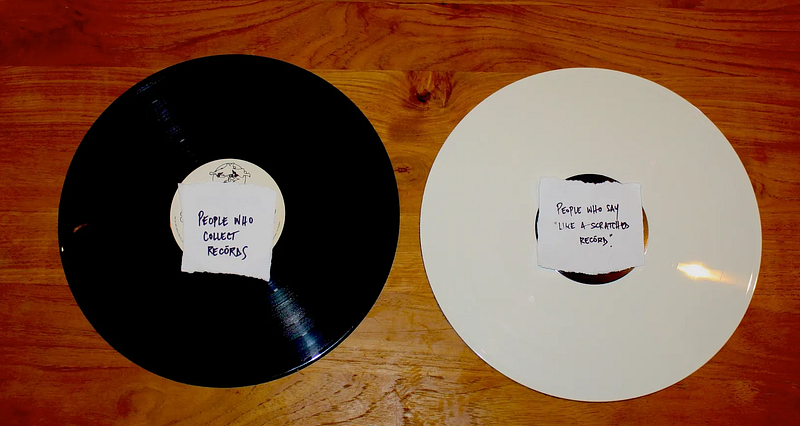
I mean, you can see the science behind it. As a result, the vinyl renaissance of the last decade isn’t required to guarantee the survival of the idiom. The connection between the act of dropping the needle on a vinyl record and using a poorly phrased expression doesn’t bear the correlation one might expect. As the great Sherlock Holmes may have observed:
Looks like the cat was never actually in the bag.
Que sera sera…
So, what is worse? Repeatedly using an illogical expression to criticise another person for their repetition?
Or is it the offender who is most at fault? Were they to complain less, could this be the strategy through which the expression goes the way of the Caspian tiger?
The answer to this riddle lies in empathy. Were the offender afforded empathy rather than disdain, their problems may not cycle like a record stuck in a solitary groove. This is the simplest of the two challenges to solve.
For the conservative idiom-ist, the road to deliverance may be too thorny to travel.