
GPT-4 Turbo’s “Laziness” Issue Fixed And GPT-3.5 API Is Now 25% Cheaper

OpenAI just dropped four major updates in a blog post today:
- An updated GPT-4 Turbo preview model
- An updated GPT-3.5 Turbo model
- An updated text moderation model
- Two new embedding models
For starters, GPT-3.5 is the base free language model that powers the free version of ChatGPT. If you are a paying subscriber, you’re likely using GPT-4 language models (although you can switch to GPT-3.5 if you prefer).
New GPT-4 Turbo Model
The new model is called “gpt-4–0125-preview.” It contains a fix for the bug impacting non-English UTF-8 generations. But what’s an even more interesting update to this model is the fix for the issue of “laziness.”
According to OpenAI, the new model “completes tasks like code generation more thoroughly than the previous preview model and is intended to reduce cases of “laziness” where the model doesn’t complete a task.”
What does that mean exactly?
In OpenAI’s community forums, some users are complaining that ChatGPT often refuses to execute tasks that involve a lot of data.
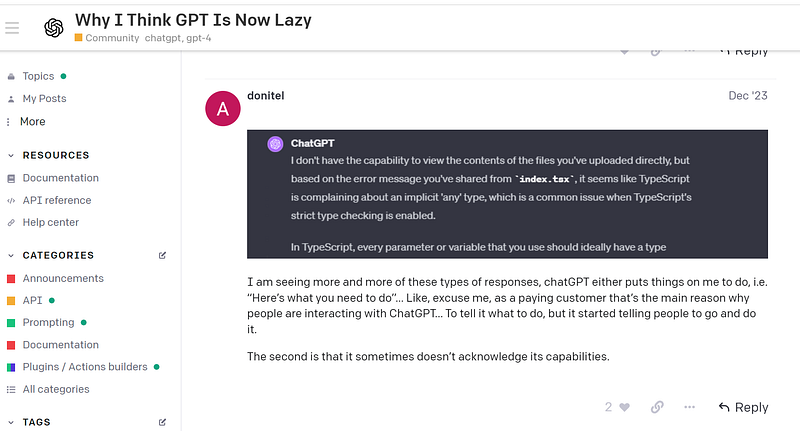
I’ve experienced the same issue myself—ChatGPT can be quite lazy at times, refusing to provide detailed responses or generate long texts. Have you noticed this laziness as well?
In a tweet on December 2023, OpenAI acknowledged that GPT-4 was getting lazier, but it wasn’t intentional.
I haven’t tested the updated model myself yet, but it should now fix this laziness issue based on OpenAI’s description. That would be a very welcome improvement!
A Cheaper GPT-3.5 Turbo
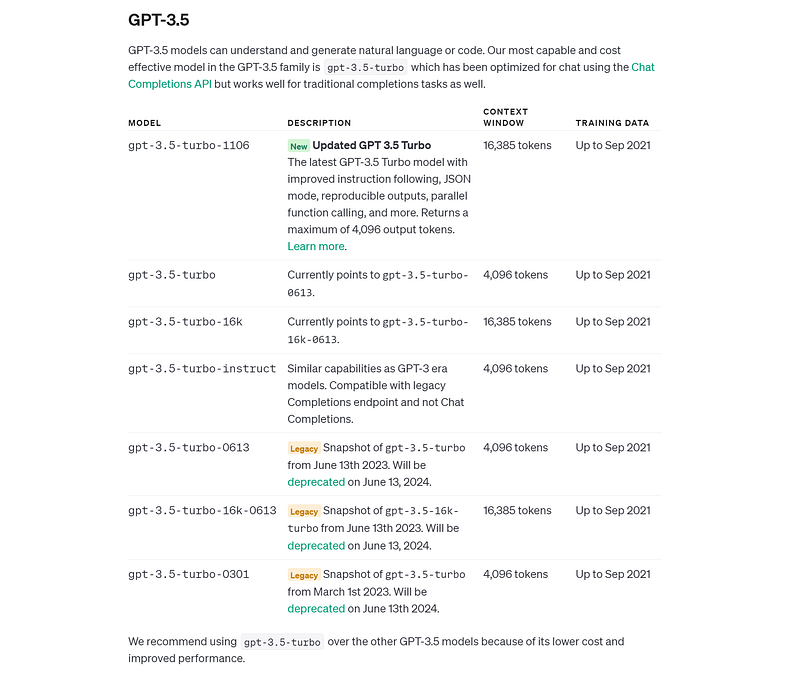
OpenAI also released a cheaper version of GPT-3.5 Turbo called “gpt-3.5-turbo-0125.” The pricing is different than the previous model:
- Input prices are reduced by 50% to $0.0005 /1K tokens
- Output prices are reduced by 25% to $0.0015 /1K tokens
So for a single Q&A exchange with 2,000 tokens, you’ll now pay just $0.002. That’s a nice discount for the API access.
A token is usually 4 characters long; an average sentence would be around 25 tokens; an average paragraph around 100 tokens; and 1,500 words about 2,000 tokens.
The updated model will also have accuracy improvements for responses in specific formats. Plus, a fix for a bug causing text encoding issues for non-English languages.
You can view the differences between the GPT-3.5 models here if you’re interested in more details.
New embedding models
Aside from the updated GPT-4 Turbo and GPT-3.5 Turbo models, OpenAI also released two smaller AI models called embeddings.
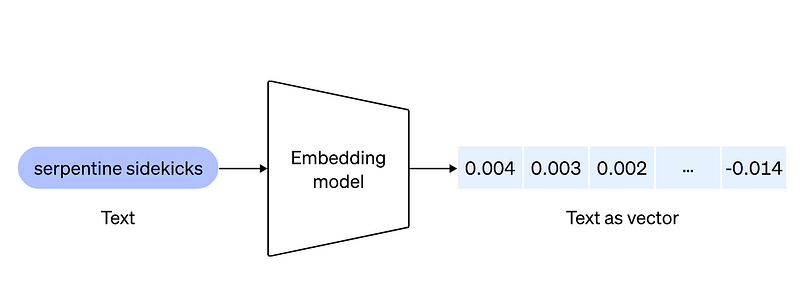
An embedding is a sequence of numbers that represents the concepts within content such as natural language or code. Embeddings make it easy for machine learning models and other algorithms to understand the relationships between content and to perform tasks like clustering or retrieval. — OpenAI
- “text-embedding-3-small” is a new highly efficient embedding with 31.4% to 44.0% better performance over its predecessor. Pricing is also 5x cheaper.
- “text-embedding-3-large” is their next-gen larger embedding, with embeddings up to 3072 dimensions. It has up to 64.6% better performance compared to “text-embedding-ada-002.”
Updated text moderation model
For developers wanting better text moderation, OpenAI released "text-moderation-007"—their most robust moderation model yet.
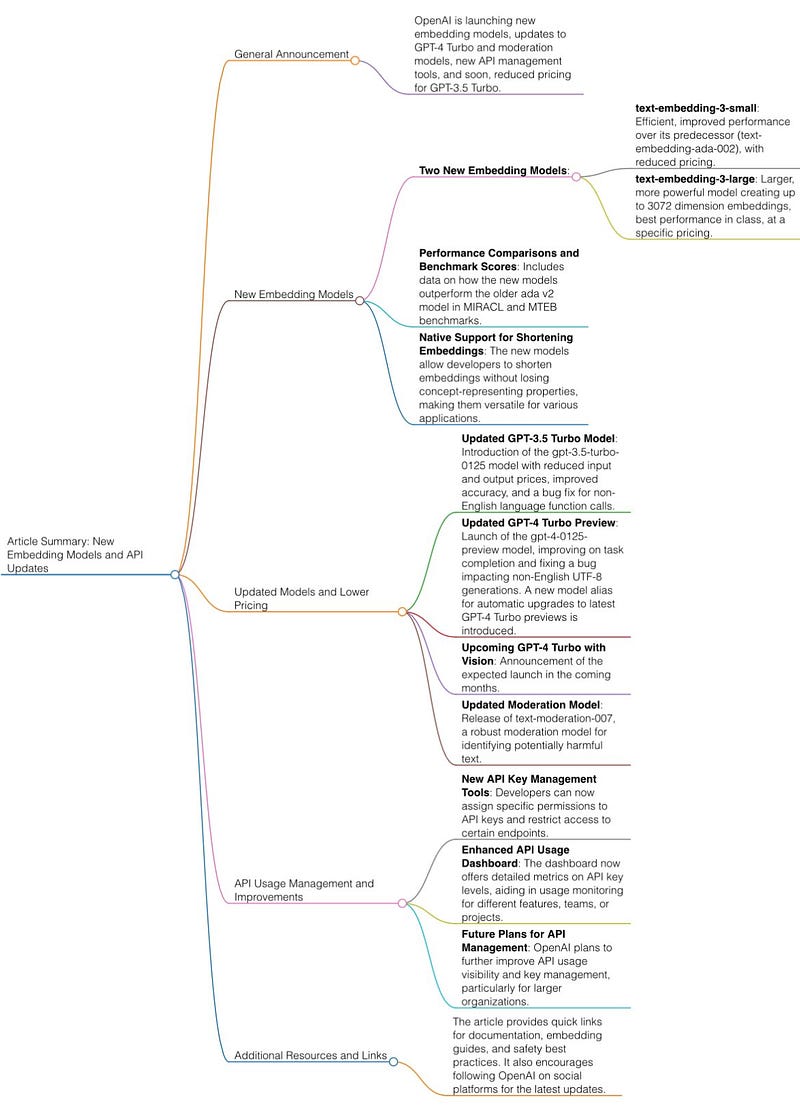
Here’s a great illustrated summary of what’s been announced by OpenAI today by an X user, MindBranches.
Final Thoughts
The release of GPT-4 Turbo shows OpenAI’s commitment to rapidly improving their AI models. Performance fixes like reducing “laziness” are welcome upgrades that will improve the user experience. However, the fact that models degrade over time is concerning. AI is becoming more ubiquitous; we need systems that remain robust and reliable over extended periods.
Also, when are we, ChatGPT Plus users, going to get access to the updated GPT-4 Turbo model? I hope OpenAI clears this ASAP.

This story is published on Generative AI. Connect with us on LinkedIn and follow Zeniteq to stay in the loop with the latest AI stories. Let’s shape the future of AI together!



