
The Only Black Guy in the Office
Why I’m Skeptical About Joining My Company’s Diversity Committee
Sure, I want to help voice our race-related concerns, but am I playing myself?
Update 6/7/22: Level has a new home. You can read this article and other new articles by visiting LEVELMAN.com.
There are few things more cringeworthy than performative White wokeness in the workplace — and I have a feeling most Black folks working in corporate America will back me up on that. In the weeks following George Floyd’s death and the subsequent uprisings, we watched as big brands added to the stockpile of Black solidarity squares, wondering if the profound quotes they paired them with were simply masks for hollow promises. Now that doing away with systemic racism and doing better by the few Black employees in some of these spaces is at the top of everyone’s to-do list, companies know they’ll need some guidance to avoid getting canceled.
My job already had its share of fumbles: A few White colleagues called out leadership for failure to release an internal or external statement in response to the glaring and traumatic examples of racism in the news. But higher-ups have personally encouraged me to share ideas on how they can keep the subject matter top of mind, whether it’s through a campaign or internal programming. (Best believe I’m going to hold them to that next time I pop-up with an edgy proposal.)
But I was surprised that some of my colleagues sought to take it a step further from the ground level. The other day, a couple of my co-workers asked me if I’d be down to participate in a racial caucus slash town hall that was in the works. Wait, what? Listen, I’m all for organized action, but before anything else, I’m a results guy. So while I love that the idea was brought up, I stalled a bit when it came to taking on responsibilities past my workload.
As one of the few Black people there, it’s all too likely that any negative fallout from the table-shaking falls on yours truly.
The first thing that came to mind was: What is the action plan actually going to look like? It’s one thing to say, these are our demands, our grievances, all that good shit, but then what happens next? Is there going to be a designated accountability team? Who’s going to get on the CEO’s ass about those raises I know folks have been asking for? Will this really be a “safe space” to talk about the mountain of microaggressions I’ve endured from my sometimes petty, mostly broey work peers? These are grand plans, but I’ve still got to move with caution and consider the possibility of things backfiring on me.
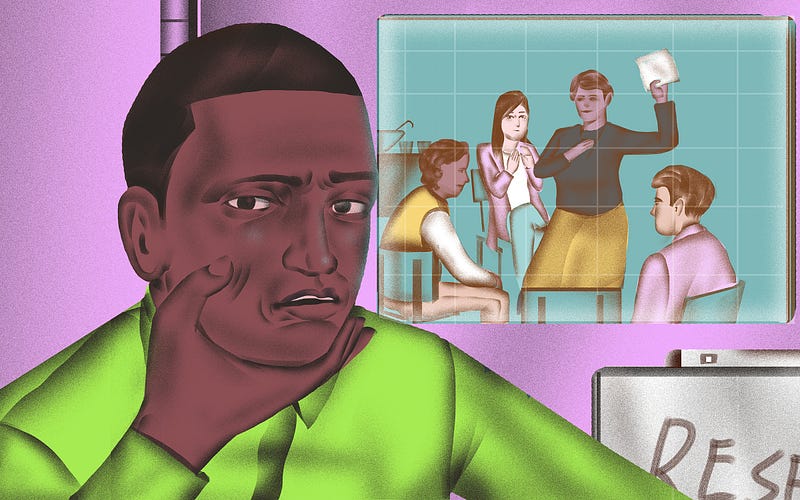
(Plus, we already had a beta test of one of these say-how-you-feel forums during one of our weekly Zoom marketing meetings, and let’s just say one guilt-stricken member of our team cried enough White tears to fill up her artisanal Mason jar. Since my camera was actually on for this one, I had to remember to keep my face as neutral as possible the entire time.)
You can’t fault me for being a little iffy on signing up for this so-called progressive collective they’re trying to set up here. Especially knowing that the folks who want to be part of this racial caucus are such a mixed bag. There’s a grand total of three Black people, a sprinkle of Asian and Southeast Asian folks, while the rest of the group is made up of outspoken White allies — sorry, “accomplices” — who can speak up for these demands. I just wonder if we’d all be on the same page with whatever plan comes out of it. And, as one of the few Black people there, it’s all too likely that any negative fallout from the table-shaking falls on yours truly. I don’t know. It’s dicey territory.
I’ve never actually been in one of these groups before — I usually keep my head down, do the work, and mind my Black business — so I don’t want to permanently opt out of something that could shake shit up for the better. But I’m also a newbie to this company. My POV on sensitive matters only comes from past gigs, and I don’t know if I’m really here to help invoke change just yet. Things are still continuing to unfold, and the Gs move-in-silence-like-lasagna part of me is inclined to see how it plays out before I jump in.
In the end, I agreed to come into the caucus as a casual observer; that way, I can dip a toe before I dive into disruption. The apprehension is still very much alive and kicking, but I’d be playing myself if I didn’t show up in some capacity. Not only do I believe in solidarity with all these people I work with, but having an established racial caucus during this pivotal moment — or even one really effective all-hands town hall discussion — has too much potential to ignore.
It’s refreshing to see how things like this are blossoming as a result of the different types of organizations and protests here in Seattle and across the country. A lot of companies are starting to realize that there’s more at stake than they thought, and that they need to find ways to see these uncomfortable but necessary conversations through. There’s a sense of awareness going on in these places with however many Black employees they’ve got, and I appreciate them for acknowledging that they don’t know shit and finally listening to the people who do. Hell, maybe it is my time to speak up a little louder.


