
The WHO Speaks Out About Rumors of Racism in Vaccine Trial
Crowds recently gathered in Johannesburg, South Africa in protest
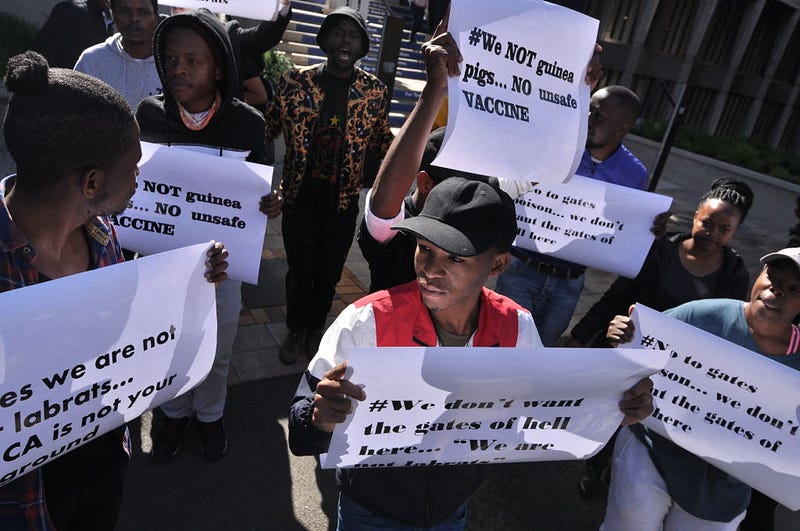
At the end of June, the University of Oxford announced it would begin a new trial of its Covid-19 vaccine in South Africa. It would be the first Covid-19 vaccine trial on the African continent. The choice of location sparked a lot of questions among locals about how the country got involved and how people would be chosen to participate. It also ignited fears of racism.
The University of Oxford stated that the vaccine had been developed at Oxford and was already being tested in the U.K. in a trial that had enrolled over 4,000 people and planned to recruit 10,000 more. The trial was a collaboration between the University of the Witwatersrand, Johannesburg and the Oxford Vaccine Group. Nevertheless, people raised concerns about racist Western companies using African people as “guinea pigs,” as protesters in Johannesburg recently alleged.
On Thursday, experts at a World Health Organization Africa virtual press conference addressed these concerns. Professor Shabir Madhi of Wits University, the principal investigator of the Oxford trial in South Africa, clarified the reasons why South Africa was involved in the study, saying it was not the University of Oxford’s intention to specifically start a trial in the country. “In fact, it was South Africans that approached the University of Oxford to determine whether they would be willing to include South Africa as part of the clinical development plan,” he said. He further stated that the trial was not funded by the University of Oxford but by the South Africa Medical Research Council and the Bill and Melinda Gates Foundation.
The rising unease about the South African vaccine trial has roots in a long history of white racists experimenting on Black people. In the mid-1990s, for example, the pharmaceutical company Pfizer was found to have violated ethical guidelines in Nigeria by failing to inform study participants of the risks associated with a drug meant to treat meningitis, like joint damage and liver toxicity. Decades earlier, in the United States, scientists working on the Tuskegee syphilis experiment in the 1930s did not tell the Black study participants the true aim of the study — which was to observe the effects of syphilis when left untreated — and never treated them adequately for their disease, even though a treatment eventually became available.
More recently, issues of racism toward Black people have been thrust into the spotlight by the George Floyd protests in the United States and by racist statements made by French doctors in April. In a televised debate, Jean-Paul Mira, head of intensive care at Cochin hospital in Paris, said: “If I can be provocative, shouldn’t we be doing this study in Africa, where there are no masks, no treatments, no resuscitation?” Mira’s comments were widely denounced as racist; in April, WHO director Dr. Tedros Adhanom Ghebreyesus called them “appalling” and a “hangover from a colonial mentality,” offering assurance that “Africa cannot and will not be a testing ground for any vaccine.”
At the press conference today, the WHO regional director for Africa, Dr. Matshidiso Moeti, stressed the importance of African participation in vaccine trials and Covid-19 research. “When we have an effective Covid-19 vaccine, it will make sure that it takes into account, if countries have participated, the immune response of populations in Africa,” she said. She acknowledged the unequal treatment of African nations in the past: “Too often, African countries have ended up at the back of the queue for new technologies, including vaccines,” she said. “These life-saving products must be made available to everyone, not only those who can afford to pay.”
When asked during the press conference about the “rumors” about Africans being used as guinea pigs, Pontiano Kaleebu, director of the MRC/UVRI (Medical Research Council/Uganda Virus Research Institute), stressed that they were indeed rumors — nothing more.
“That concern is not surprising,” he said, noting that previous HIV trials in Africa had seen the same pushback. To address those concerns, he emphasized that it was absolutely necessary to ensure the highest possible scientific, ethical, and legal standards for any trial done in Africa and to communicate this to African populations. “I want to assure our African brothers and sisters that we as scientists will make sure this happens,” he said.
Moeti added that it was their duty to help African people understand that it is “extremely important” that “these tools be tried out in African populations so that we can understand how they interact with us and how to benefit.” Even more important, she said, was that once African people have participated in the vaccine trial, they have “the rights to have access to those tools,” as illustrated by the Ebola vaccine trialed in the Democratic Republic of the Congo in 2018.
Meanwhile, in the United States, the question of who will get the Covid-19 vaccine first has likewise become a racially charged issue. Some argue that Black and Latino communities, which have been harder hit by the coronavirus than people of other races, should get the vaccine first. Critics of this idea pointed out that these communities have been subject to long-standing structural racism in the United States, which may make them wary to get the vaccine in the first place, especially if it has not been proven safe. Last week, Centers for Disease Control and Prevention director Dr. Robert R. Redfield said in a Senate hearing: “The last thing we want to be is trying to recommend who gets the vaccine and we don’t have any data on how the vaccine works in the population that we think really needs this vaccine.”
In an opinion piece published in STAT this week, infectious disease experts shared advice for vaccine researchers who need to enroll Black and Latino participants, acknowledging the need for diversity in clinical trials but foregrounding existing concerns about racism. The advice, though it addressed an American issue, emphasized similar points as the experts who spoke alongside WHO Africa. To enroll people into vaccine trials, experts must clearly communicate the benefits and risks to the communities involved, offer full transparency of the results as they come in, and ensure payback — the promise that the people who agree to be test subjects will get full and equitable compensation and access to the vaccines or therapies they’re risking their health for.


%22%3E)