
The Additional Coronavirus Risk Faced by Black and Asian Americans
Fear of discrimination makes mask-wearing a fraught choice
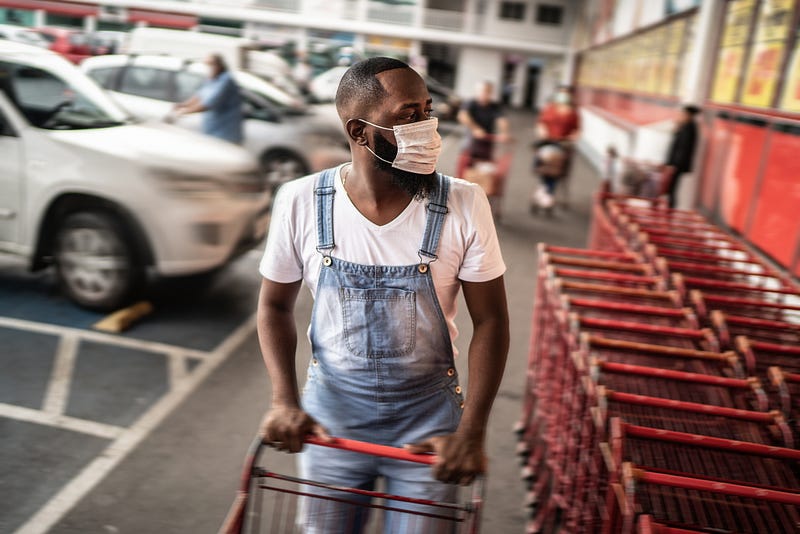
There’s no question that wearing a mask can prevent the spread of the coronavirus. Experts have been saying it for months. Today, finally, even notoriously mask-ambivalent President Trump changed his tone and said he’s “all for masks,” likening his own masked reflection to the Lone Ranger.
But unfortunately, a wealth of data and a late co-sign from the White House doesn’t mean masks are becoming mandatory everywhere, which is sorely needed as cases skyrocket in 38 states. Many policymakers and citizens continue to view mask-wearing as a choice, rather than a matter of personal and civic responsibility. This has opened up new opportunities for discrimination against people who choose to wear one.
The greatest burden of this discrimination has fallen on Black and Asian Americans, suggest the results of a Pew Research Center survey released yesterday. The survey, which involved about 9,600 participants, was meant to investigate American’s experiences and opinions about racial and ethnic discrimination during the pandemic. Among its many eye-opening findings, one of the most concerning is that 42% of Black Americans and 36% of Asian Americans surveyed said they worry a “great deal” about other people being suspicious of them if they wear a mask. Twenty-three percent of Hispanic adults and 5% of white adults feel the same way. The survey also found that about 40% of Black and Asian adults have felt as though people have acted like they were uncomfortable around them because of their race or ethnicity.
Their feelings are rooted in the wave of racist events that have destabilized this country. A recent controversy in Oregon, for example, illustrates all too well the effect of racism on mask-wearing and policy: In mid-June, Lincoln County commissioners issued a mandate to wear masks, with an exemption for “People of color who have heightened concerns about racial profiling and harassment due to wearing face coverings in public.” But due to heated racist backlash against the exemption, the county removed it a week later.
Black Americans and Asian Americans have dealt with especially unique circumstances over the past few months. Black people, already disadvantaged by long-running systemic racism, have been hit incredibly hard by the coronavirus, dying at a rate more than 1.5 times higher than their population share, and they are far more likely to know someone who has died from the coronavirus. Now, the fiery Black Lives Matters protests across the country have put Black Americans in the spotlight, their visibility creating new opportunities for the same racist attacks that have been ongoing for 400 years. Some feel especially vulnerable when they are wearing a mask.
Meanwhile, Asian Americans have faced discrimination and occasionally violent harassment throughout the pandemic from bigots that blame Chinese people for spreading the coronavirus. Belief in this false claim was no doubt bolstered by the president’s repeated use of the racist term “Chinese virus” or “Wuhan virus” when talking about Covid-19, as well as his earlier insistence on the widely debunked conspiracy that the virus was released from a Wuhan lab. Scientists have established that the outbreak likely originated in a Wuhan wet market, but the virus is of animal origin, its original geography as yet unknown. Nevertheless, the incorrect and racist belief that Asians spread the coronavirus, and the doubly incorrect and racist assumption that all Asians are Chinese, have left all Asian Americans especially vulnerable.
Perversely, for many Black and Asian Americans, fear of racist harassment has turned mask-wearing into a question of personal safety, even though the whole point of mask-wearing is to ensure personal safety. The dangers they now face are twofold: The risk of becoming infected with Covid-19, and the increased risk of being harassed by racists while wearing a mask.
That’s not a choice they should have to make, but you can’t blame someone if they decide racism is a bigger threat than the coronavirus. The potential consequences of having to make this choice are staggeringly unjust: If Black and Asian Americans choose not to wear a mask out of fear of racism and thereby expose themselves to the coronavirus, they may end up paying the price for other peoples’ racist beliefs.
The coronavirus doesn’t pick and choose who to infect, so it’s absurd that Americans can still pick and choose who wears a mask. Strong federal guidance mandating public mask-wearing wouldn’t solve the racism driving the harassment of Black and Asian Americans, but it would at least help neutralize the playing field. For one thing it’d be a lot harder to racially stigmatize mask-wearing if everyone was mandated to wear one. (And it’d eliminate the conditions for mask-shaming, too.)
According to the Pew survey, 69% of Black adults and 80% of Asian adults say they’ve worn a mask or face covering all of the time in the past month (the survey was conducted from June 4 to 10). Fear of racism isn’t the only reason why some Black and Asian people don’t wear masks, but the fact that it’s a factor in their decision-making must urgently be addressed. You can help: If you see a Black, Asian, or other person of color being harassed for wearing a mask, and you’re in a position to safely intervene, speaking up in their defense will not only be a step toward ending the country’s coronavirus epidemic, but its epidemic of racism as well.