
It’s Time for Us to Nuke ‘Em
The anti-nuclear lobby is responsible for climate change
In 1987, the world generated 10,096 TWh of energy. 1,654 TWh or 16.4% of it was from nuclear power, while 6,396 TWh or 63.4% of it was from fossil fuels.
In 2017, the world generated 24,322 TWh of energy. 2,484 TWh or 10.2% of it was from nuclear power, while 15,627 TWh or 64.3% of it was from fossil fuels.
Source: U.S. Energy Information Administration
Despite what you’ve heard, we humans aren’t weaning ourselves off of fossil fuels. If anything, the share of fossil fuels is increasing in our energy portfolio.
Ask yourself, over the past 30 years, how many exciting discoveries and innovations have you read about which told us that a clean, renewable future was just around the corner?
Here’s a CNN article from 2003. Does the breathless enthusiasm about some Brave New World that will be ushered in by cheap solar sound any different than what you still hear about today?
Oh, but this time’s different.
Sure it is.
A Tale of Two Countries
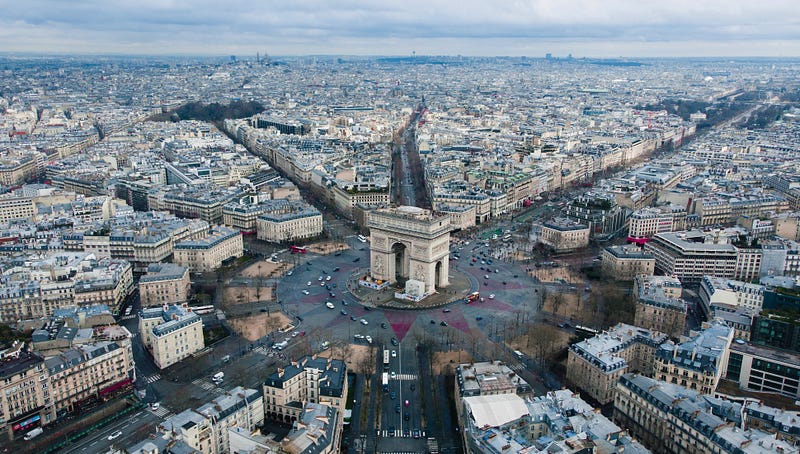
The French do not have abundant oil, coal, and natural gas reserves the way that the United States does. Therefore, in 1974 the French made the fateful decision that their energy grid would be powered primarily by nuclear energy.
The result? In 2017, 71% of the energy production in France was produced by clean, beautiful, zero-emissions nuclear power. Because of this, France enjoys a high level of energy independence and some of the lowest energy prices in Europe.
Tragically, many of the inheritors of that proud nation’s enviable position have been duped by the lies of the anti-nuclear lobby.
As shocking as it is to realize that a population can be so deeply confused by a disinformation campaign, the truth is that in a poll of the French conducted in 2003, “58% thought that nuclear power caused climate change while only 46% thought that coal burning did so.”
If you thought that by now the truth would have triumphed and that the French people would have been fully made aware of their catastrophic misunderstanding, think again.
“In October 2014 the Energy Transition for Green Growth bill was passed by the National Assembly and so went onto the Senate. This set a target of 50% for nuclear contribution to electricity supply by 2025, and capped nuclear power capacity at 63.2 GWe, the level at the time. This meant that EDF would have to shut at least 1650 GWe of nuclear capacity when its Flamanville 3 EPR starts commercial operation.”
Source: World Nuclear Association
Shockingly, the French politicians of this era are actively working to commit economic and geopolitical suicide, perhaps after listening to biased articles such as this one. I could spend a great deal of time deconstructing it, but I won’t let myself get sidetracked into doing that.
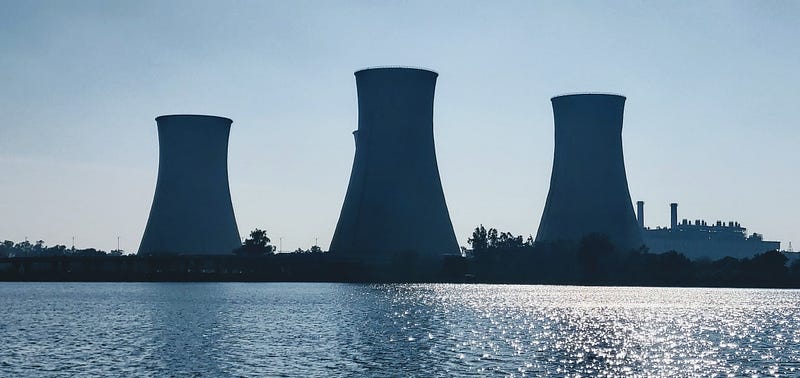
I will, however, briefly comment on this similarly biased article though because it is more straightforward to identify the deception once you notice it’s absurdly misleading photography. The lighting and angle give the viewer the impression that the water vapor exhaust is somehow toxic or similar in kind to coal smokestacks without actually saying so. Such a claim is never made in the text and so fact-checkers will give everything these folks say the “green” check, but human minds are far more deeply influenced by visual cues than by textual ones, as we are reminded by the saying “a picture’s worth a thousand words”.
By tying imagery that falsely insinuates pollution with people’s instinct to help overcome the threat of climate change, the anti-nuclear lobby is doing an insidious bait and switch with enormous real-world consequences.
To demonstrate just how serious these consequences can be, the second country we’ll examine is not the United States, as you might have expected. We’ll get there eventually, in future articles. For now, we head to Germany.
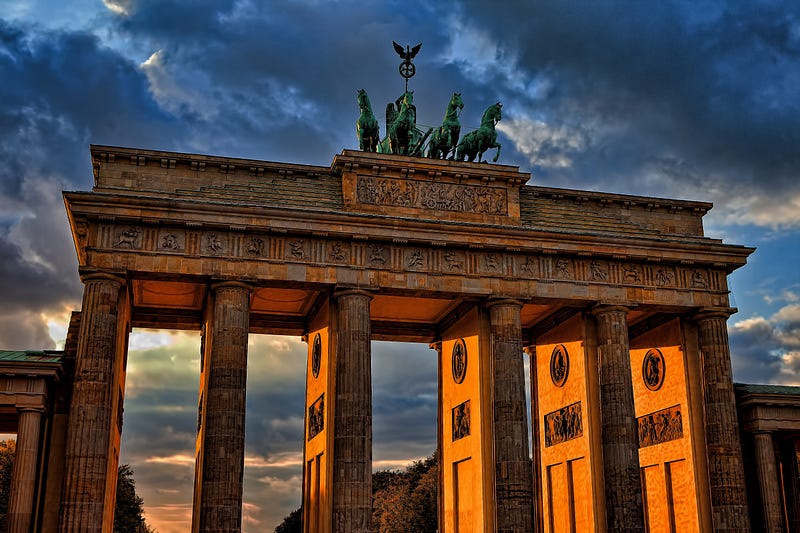
The German (over)reaction to the Fukushima disaster in 2011 was the complete and near-immediate dismantling of their entire nuclear power infrastructure, which will be completed by 2022.
Chancellor Angela Merkel shows no signs of having any changes of heart.
To her credit, she does also plan to discontinue the use of coal as well, but that’s not until 2038. By then it may already be too late, as the damage of climate change may be irreversible.
Germany’s bet on renewables may ultimately be vindicated, but it is a risky and unnecessary gamble. The risks are so extreme because if wind and solar fall short, the Germans will be forced to meet the shortfalls with coal and lignate, which is the lowest, most heavily-polluting grade of coal.
Lignate is already the second-highest energy generation source in Germany, behind renewables. The admirable good that Germany has done with a heroic push towards renewables is largely undone by reliance on this filthy source of energy.
As a result, in 2018, Germany was the 6th greatest contributor to CO2 emissions. In 2019, Germany’s per capita CO2 output was a disappointingly high #36. For all the effort put into renewables, you’d think they’d be one of the lowest CO2 per capita emitters, but this is not the case. Germany has almost double the emissions per capita than France does.
Consider Potential Risks of Nuclear, But Do So Weighted Against the Realities of Fossil Fuels
Nuclear vs Fossil Fuels
There are many opponents of nuclear energy who will cite the incidents at Three Mile Island in 1979, Chernobyl in 1986, and Fukushima in 2011 as proof that we must put the nuclear genie back into the bottle once and for all, and make no more wishes lest we suffer from its curse.
But ask yourself, how many people died in those rare events?
Three Mile Island? None. Some people may have been exposed to trace amounts of radiation and there is some possibility that cases of thyroid cancer, in particular, are higher than normal, but the incident would have been only one contributing factor to issues that developed many years later.
Chernobyl? 31 directly from the incident. The number who died from related cancers after the fact due to exposure varies depending on who you ask. The World Health Organization estimates somewhere between 4,000–9,000.
Fukushima? None. The earthquake itself killed around 18,500 people, but none were killed directly from the incidents at the nuclear plant. The first worker exposed to radiation died of cancer in 2018, and more will certainly follow, but the number will surely be far lower than the deaths from the earthquake itself.
Make a mental note that these are the three worst incidents relating to nuclear power. Let’s use 9,032 deaths from nuclear power in the last 50 years as our number, for the sake of argument, which comes down to 180 deaths per year, on average. This isn’t a great metric, because the structural defects leading to the Chernobyl disaster are no longer an issue, but again, this is just to give us an extreme point of comparison, pretending that modern reactors are still just as dangerous as older models even though we know they aren’t.
Now as far as the land goes, parts of Chernobyl are still dangerous, but much of it has become a popular tourist destination that experts say is basically safe.
Even deliberate targets of nuclear war have grown back with tremendous resilience. Nagasaki and Hiroshima are today both beautiful and thriving cities with trace background radiation levels that are nearly identical to that of any other city. According to Trip Advisor, you can visit more than 400 restaurants within 0.3 miles of Hiroshima’s Ground Zero Memorial!
Of course this in no way excuses the horrors which were inflicted upon civilians by the decision to drop nuclear warheads or minimizes the seriousness of the toll on human beings resulting from nuclear conflict. But the point is that these examples demonstrate how misplaced fear of radiation is.
By contrast, how many people die from fuel-burning each year? Consider the risks of nuclear, but do so weighted against the reality of fossil fuels.
We know that there’s some cost in lives due to using fossil fuels. That’s obviously going to cause respiratory diseases and premature death. But how much?
Remember that it took 50 years and Soviet-level incompetence to cause perhaps 9,032 deaths from nuclear power. But more people than that die EACH DAY due to fossil fuels. The numbers are truly staggering. This year, and every year, far more people will die from the respiratory effects of fossil fuels than die from COVID, HIV, all forms of violence, and by a very large margin.
Approximately 3.6 million deaths this year could have been avoided if fossil fuel emissions were reduced to zero. If we had a nuclear-powered world, like the French already have, how many lives could have been saved?
Over the past 49 years, to the extent that organizations like Greenpeace have been successful in supporting the status quo of fossil fuels by thwarting the possible alternative of nuclear, they have de facto contributed to no less than tens of millions of premature deaths due to respiratory ailments.
I am reminded of the philosopher Alan Watt’s warnings about do-gooders. “Kindly let me help you or you’ll drown said the monkey, putting the fish safely up a tree.”
It Isn’t by Accident
You might be inclined to assume that the anti-nuclear ecologists support of fossil fuels was incidental rather than intentional. You might believe that even if they are misguided, they came from a benevolent place.
Here are some quotes by key elites in the movement. You can make up your own mind, but as far as I’m concerned, they have about the same moral authority as Thanos.
“We don’t need nuclear power… [because we] have a far greater amount of fossil fuels in this country than we’re owning up to…the tar sands…oil out of shale…methane in coal beds.” — Ralph Nader
“Giving society cheap and abundant energy would be the equivalent of giving an idiot child a machine gun.” — Paul Ehrlich
“I didn’t really worry about the accidents because there are too many people anyway….I think that playing dirty if you have a noble end is fine.” — Martin Litton, the Sierra Club member who led the campaign to kill Diablo Canyon nuclear power plant in California.
“Our campaign stressing the hazards of nuclear power will supply a rationale for increasing regulation…and add to the cost of the industry.” — Michael McCloskey, then Executive Director of the Sierra Club
Source: Reason
The only other reasoning which comes to mind that I find so egregious and offensive are perhaps the paternalistic pro-slavery arguments George Fitzhugh once forwarded.
A Turning Point
Thankfully, there is hope on the horizon.
… but no, it doesn’t come from the fast-growing right-wing organization Turning Point USA, which has strong ties to elites in the fossil fuel industry.
Rather, the turning point I speak of is that of the attitude among progressives. Once a primary source of opposition to nuclear power, progressives who are serious about tackling climate change now realize that the only way to do so on the timeline which we have to work with is going to be through aggressive use of nuclear power.
One of the most outspoken and knowledgable proponents about nuclear power is the former presidential candidate, New Jersey Senator Cory Booker.
I began to care about this issue thanks to my interest in former presidential candidate Andrew Yang.
But fortunately in the United States, it isn’t just one party that supports nuclear power. Republican President Trump and his Democratic opponent former Vice President Joe Biden both recognize nuclear power to be a key component in securing American energy independence. The Green New Deal is going nowhere, but its opponents are not opposed to carbon-free alternatives that incorporate nuclear power.
The Chinese have profited from decades of American inaction and neglect, but there are good reasons to believe a nuclear power renaissance is beginning. Among the promising new technologies is Small Modular Reactor (SMR) technology from NuScale that can use the “waste” of other reactor types as fuel.
If you’ve fought against nuclear power in the past, it isn’t too late to save the future that could have been. You likely came from a place of ignorance. As the persecutor Saul repented and became known the Apostle Paul, you too can become an evangelist for the good news of abundant, clean, safe, emissions-free power, and with your help, we can still save humanity from the grim fate we’re still headed towards.
The hour is late, there’s no doubt. The best time to rid ourselves of fossil fuel dependence would have been 45 years ago. But the second best time is now.
About the Author
I don’t have a doctorate. I don’t write for any leading journals. I tutor mathematics.
I make a lot less money at it than I probably would have if I had listened to my wife and learned air-conditioning repair certificate instead.
I am literally just some dude with a computer and an internet connection who realized that there is no excuse for me to not speak up and talk about the things that I know are important. Even if I’m a small nobody shouting in the wilderness who can get barely anyone to listen… you still read this far, didn’t you?
And who might listen to you? And who might listen to someone who listened to you, and on and on? How far might the message cascade? It is interesting to think about.
It doesn’t matter that it is a David vs Goliath match since we have both the truth as well as network effects on our side.
Anyway, here’s my bio.
I should also mention that it was in my interview with Phil Ord, the President of Americans for Nuclear Energy, that helped me realize that this is the single most decisive issue of our time. This was easily one of the best and most important conversations I’ve ever had. Please listen.


