
What Celebrities Can Do to Really Help Democrats Win the Election
Here are three easy steps to turn fame into power
If the GOP has long been the party of concentrated wealth, the Democrats are increasingly the party of concentrated fame. There are exceptions. Trump has Scott Baio and Roseanne Barr. But in our polarized politics the overwhelming majority of entertainers — singers, actors, comedians, athletes, late-night hosts — can’t wait to see this president voted out of office. And they’re more eager than ever to use their platforms to bring change in November.
In theory, this should be a major political advantage for Team Blue. But in practice, it doesn’t always work out that way. In one 2019 poll, 65% of Americans agreed that political endorsements from entertainers “have no bearing on my vote.” Twenty-four percent went even further, saying that celebrity endorsements would actually make them less likely to vote for a given candidate.
I’ve spent plenty of time — first as a speechwriter in the Obama White House, then as a head writer for Funny Or Die — thinking about how well-known people can translate their fame into power. But I must confess that I find Americans’ stated lack of interest in celebrity endorsements encouraging, and maybe even inspiring. Voting is the decision that defines our democracy. We don’t like the idea of outsourcing that responsibility to someone else, even someone we admire for their talent in other areas, and good for us.
But that doesn’t mean famous people can’t enter the political arena, or that Democrats can’t use the celebrity gap to help win elections. Fame is power. You just have to have to wield it strategically. And in my experience, that strategy can be boiled down to three simple questions.
One: Is It Informative?
In some ways, famous people are particularly ill-equipped to be persuasive when it comes to politics. The first step in persuasion is convincing people you understand and empathize with their lives and concerns — if you have a giant platform, and the money that often comes with it, that can be a tough sell. Unless you have deep and unique personal experience with an issue, we probably aren’t going to be persuaded by your take on it.
What famous people can do, though, is use their platforms to give us factual information. Celebrities are, by definition, fantastic at getting and holding our attention. At a time when local news is disappearing, Americans tune out traditional political ads, and disinformation is everywhere, the ability to make us stop and listen is more valuable than ever. That’s especially true for progressives, who don’t have the benefit of Fox News and its friends to amplify the stories they want to tell. The very aspects of celebrity that make famous people ill-equipped to persuade make them well-equipped to inform, because they can get and hold our attention long enough to deliver a piece of information we need to hear.
That’s especially important when it comes to races that are not the presidential contest. Most Americans know there’s an election coming up. But many Americans don’t know if they live in a competitive state legislative district, or if there’s a statewide race that could make an enormous impact on their community. Highlighting these underappreciated campaigns is the kind of thing people with large social-media presences, and the ability to get the attention of both the political and entertainment or sports press, can do extremely effectively.
Two: Is It New?
Of course, it’s not enough to provide us with something factual rather than persuasive. For the information to have value, it needs to be something we don’t already know. This is why celebrity endorsements really do seem to work in primary and midterm politics (where voters may not know much about the candidates) as opposed to the general election. There just aren’t many eligible voters who will stay home in November because they haven’t heard enough about Donald Trump or Joe Biden, or the importance of this election.
But that still leaves plenty of room for messages that present us with something we didn’t already know. That’s particularly true in 2020, when Covid has fundamentally changed our elections. Getting voters’ attention and presenting them with clear pieces of information — a registration deadline, a how-to for voting by mail, or a website that helps people check their registration status — can make a real difference when it comes to turnout.
Three: Is It Motivating?
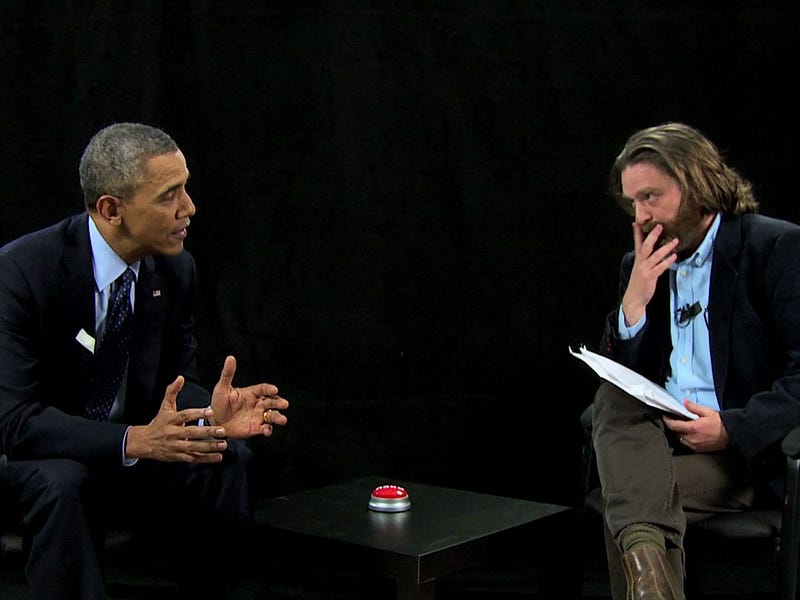
In 2014, President Obama appeared on Zach Galifianakis’ talk show Between Two Ferns, an appearance that drove hundreds of thousands of young people to Healthcare.gov, helped save Obamacare, and ushered in a boomlet of celebrity political content.
For the record, I didn’t write any of the president’s Ferns appearance and was sure it wouldn’t go over well, so it’s good no one listened to me. But looking back, it’s helpful to examine exactly why that interview was so successful. The central message of the video wasn’t an appeal, or a traditional call to action. Instead, it was a fact: Most young people could get insurance for less than $100 if they signed up with Obamacare. The White House already knew that young people wanted insurance, but assumed it was expensive. Once they knew the truth, they didn’t need any inspiring rhetoric — they took action on their own.
There will be plenty of similar opportunities in the next three months — and not just around voting itself. America faces a poll worker shortage. Campaigns are desperate for volunteers. While Joe Biden himself has been raising large sums of money in recent months, plenty of worthy candidates still struggle to keep up with opponents who have deeper pockets or more corporate support. Giving would-be supporters the information they need to get more deeply engaged could have a measurable impact between now and November 3.
It’s worth noting that this three-question checklist rules out plenty of types of political activism. But there’s plenty of room left for strategic, effective engagement that allows campaigns, and the famous people who support them, to make the most of their platforms, especially this year.
Finally, while most Americans will make up their mind about the importance of voting without the help of any artists or entertainers, there remains an opportunity to highlight the importance of additional types of political commitment.
New information that motivates. It’s a relatively simple rubric, but employed correctly, it can be the difference between cringeworthy and changemaking, and for Democrats in particular, that can be a deciding factor between success and failure this fall. That’s important, because as we all know, the stakes couldn’t be higher.


