
Cute Google Coding Interview Problem: Maximum Points from Cards
This is a commonly asked Google interview question. Can you solve it?

There are several cards arranged in a row, and each card has an associated number of points. The points are given in the integer array
cardPoints.
In one step, you can take one card from the beginning or from the end of the row. You have to take exactly
kcards.
Your score is the sum of the points of the cards you have taken.
Given the integer array
cardPointsand the integerk, return the maximum score you can obtain.
Let’s take a look at an example. Say we’re given the array [1,2,3,4,5,6,1] and we can pick 3 cards. Remember that we have to pick our cards from the *ends* of the list — so the first card we pick can’t be a card in the middle.
What are our choices?
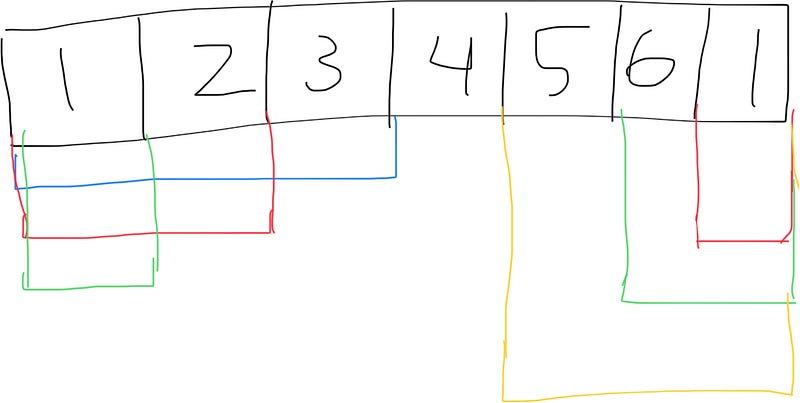
With the blue line, we’ll take the first three cards, which gives us a score of 6.
With the red lines, we’ll take two from the front, then one from the back, which gives us a score of 4.
With the green lines, we’ll take one from the front, then two from the back, which gives us a score of 8.
With the yellow lines, we’ll take all three from the back. This gives us a score of 12, which is the best answer.
Intuition
Would sorting help? No, because the order of the cards matter.
Is there a “smart” way to figure out which cards we should take? It’s not as simple as taking the higher card at each turn.
Well, what if we just tried every combination? Start by taking all the cards from the left, then try taking one fewer card from the left and one from the right, and so on, like we did our example above.
But wait, isn’t that super slow? We’d have to try k possibilities, each summing an array of size k, so the runtime is O(k²).
Key Insight
We don’t need to recompute the sum every time! Let’s start by selecting all k cards from the left. On our next attempt, we’ll remove the rightmost selected card, and add on the rightmost card in the entire list, and we’ll repeat that for the next iteration. Note that only the beginning and end elements of the sum are changing — and that’s a constant time operation, so our runtime is reduced to O(k).
Code
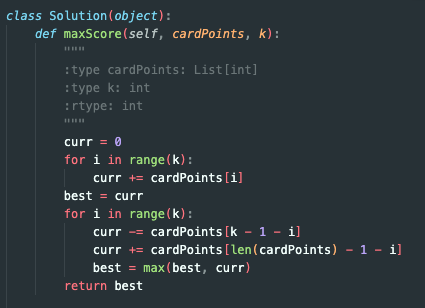
- Our first loop is taking every card from the left.
- On the next loop, we have to try k options — you can think of this as “How many cards will I take from the left?” We can take anywhere from 0 to k cards from the left.
- We keep track of the highest value we’ve seen so far, and return that at the end of the loop.
This is an O(k) time solution and uses O(1) space.
Hopefully you thought this was a fun question and let me know if you have other questions!
For more articles like this, follow me on Medium. Not a member yet? Join the community. Want more software engineering interview guides and coding question tips? Check out all of my writing organized by topic in this article.
If you have any requests for what I should write, please let me know!


