
40 Core Values You Should Seek in a Relationship
Identify them and incorporate them into your love list.
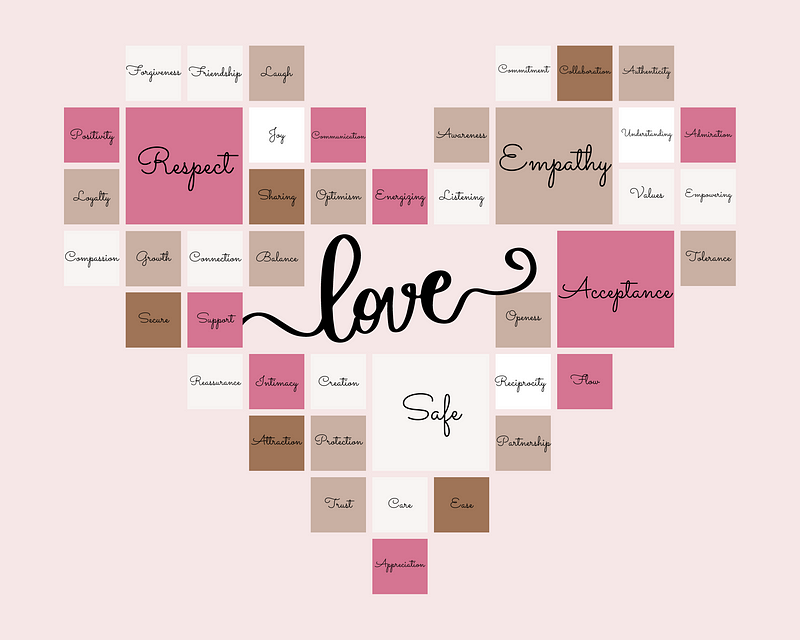
Do you have a “love wish list”?
It’s a checklist of everything you desire in a romantic partner. After you’ve written it down, you’re supposed to put it away for some time. Then, the magic happens — this person appears in your life months later.
Without any other method to it, you’ve surely attracted a sexy wealthy guy or a gorgeous feminine woman into your life. But will that make your relationship good? No, of course not. That’s because, like most people, you’ve likely missed one thing: listing the core values that are important to you in a relationship.
Values are standards of behaviour — they are judgements of what is and isn’t acceptable for you. They are the structure for how we live our lives, deep down at our core.
If you don’t know what’s important, meditate on it. Ask yourself; What are the values I want my partner to embody? Identify them and incorporate them into your love list.
When my ex broke up with me I spent the next months reviewing what I did wrong, what I was missing. Until one day I realized faults were in committing to someone who was missing a lot of things I value in a human being. I hadn’t spent enough time identifying the important values that I require in a partner before entering that relationship.
So, I’d encourage you to get a piece of paper and a pen. Start by writing down any of the 40 values below that resonate with you. How important is each to you?
#1: Forgiveness
Beware of a partner who holds grudges easily. When it’s an “eye for an eye”, it leaves everybody blind. Being able to forgive, make peace, and move forward after conflict is a quality to look for in a partner.
#2: Friendship
Friends share similar interests and enjoy spending time together. They enjoy talking, laughing, and are there to support each other. Your lover should be your best friend above all. When either of you begin to see the other as an enemy, the relationship is in danger.
#3: Laughter
I watched the movie “Pieces of a Woman” on Netflix recently. There was a scene where a man tries to make his wife laugh to help her relax as she is in the beginning stages of labor. A partner who can make me laugh in the most awkward of situations is golden.
#4: Joy
Joy should balance sadness. When sadness overweights joy in a relationship for a long period of time, it’s a bad sign.
#5: Communication
Communication is about expressing ourselves in a way that does as little harm to others as possible. But above all else it’s about hearing each other with compassionate ears. It’s about staying open and receptive even when we’re hurting.
My ex was doing this ugly stonewalling thing where he would shut down completely. In the long run, his lack of openness and receptivity was very harmful to the relationship.
#6: Respect
Respect is key. If you notice contempt in your partner, abuse may follow. Contempt is identified by signs of disgust and superiority when someone talks to you. Name-calling, sarcasm, and condescending body language — such as eye-rolling or sneering — are contemptuous. My ex was the champion of these behaviours.
#7: Loyalty
Someone is loyal when they have their partner’s best interests at heart. It’s the opposite of selfishness.
#8: Compassion
Being compassionate is being able to put yourself in someone else’s shoes. It’s having the desire to ease their suffering. If your partner doesn’t care about your pain they’re being insensitive and thus may lack compassion.
#9: Growth
When both partners feel committed to growth — individual and collective growth as a couple — you have a conscious relationship. Overcoming challenges and enduring hardships together is growth. Your partner will not be able to commit to the growth of the relationship if they aren’t committed to their own growth.
#10: Connection
A sign of a healthy emotional connection is when you feel safe enough to share anything with your partner. But, when there is fear or unwillingness to be open, then you’ll notice that emotional disengagement or withdrawal begin to slowly develop.
#11: Balance
In a balanced relationship, you make sure that you and your partner are both feeling good. You adjust to each other’s life and try to find a fair way to meet everyone’s needs. If one partner tries to maintain power and control over the other, then there is no balance. For example, a narcissistic/codependent relationship is unbalanced.
#12: Secure
When we are insecure, we are typically hyper-vigilant to potential threats and abandonment from our partner. While it’s our responsibility to take care of our feelings, a caring partner can support us in regaining our sense of security. Being secure in a relationship means that we feel safe enough with our partner to open, love, and express.
#13: Support
A supportive partner will show their belief and faith in you. They’ll give encouragement and express approval. They’ll validate your experience or help you with something you’re struggling with. My ex was supportive financially, but emotionally, he wasn’t.
#14: Reassurance
Reassurance is the action of attempting to ease someone’s doubts or fears. It can look like praise, or making gestures that soothe and comfort the other. “It’s gonna be okay”, “Stronger together” are simple words that offer reassurance.
#15: Intimacy
Intimacy is more than being physically close to someone, it’s also the desire for deeper connection. You build intimacy by sharing your most personal stories and self with another. By responding to each other with attentiveness, understanding, and validation. The only difference between a romantic relationship and a friendship is the level of intimacy.
#16: Protection
Most of the time when we hear the word protection we think only of physical protection from harm. We don’t realize another aspect of protection: emotional. My ex would switch sides when we were walking on the street so that I wouldn’t be harmed by passing cars. Yet, he wouldn’t protect me from the harm of his words or behaviours. There was no emotional protection.
#17: Care
When you care for someone you will show concern for and interest in their well-being and health. You will go out of your way to make your significant other know that they are special, to make them happy, and help them feel more confident in themselves. With care, actions speak louder than words.
#18: Appreciation
Appreciation is the act of recognizing something for which you’re grateful. It’s the opposite of taking something for granted. If I receive only blame for my contributions to a relationship, that is when I know I am being taken for granted.
#19: Ease
When you feel at ease in a relationship you can lean into it and fully be yourself. There is a certain freedom that comes with that feeling of being at ease. Those who support us to be ourselves can make wonderful partners.
#20: Partnership
Romantic relationships require team-work, a statement with which my ex disagrees. For him, in a romantic relationship, there’s a leader and a follower; there is no team. Even if there is “hierarchy” within a relationship, that it’s still a partnership; a team working towards a mutual goal.
#21: Reciprocity
Reciprocity is the balanced exchange of give and take. Relationships that lack reciprocity contain one selfish partner and one partner whose needs aren’t met. The selfish partner burdens the relationship with loads of illogical expectations. They will dominate most conversations and interactions. My ex claimed himself to be a “selfish” man who strongly desired a “selfless” woman. There was no reciprocity.
#22: Safe
Feeling safe in a relationship means that you can let your guard down and show your authentic self. Threatening to break up or making ultimatums are counterproductive to your emotional safety. They are also manipulative and abusive.
#23: Openness
Openness is about honesty and mutual self-disclosure. To be open is to let go of control. Being open means dropping your conditioned defences. Doing this helps build an intimate relationship with your significant other.
#24: Flow
When a relationship is flowing there is very little resistance between both parties. A relationship that flows adapts to the rhythm and the changes of life with ease. A controlling relationship is inflexible and will stagnate quickly.
#25: Acceptance
Acceptance is about seeing your partner as they are and accepting their differences even if they may frustrate you. It’s about focusing on problem-solving and acknowledgement rather than on rejection and criticism.
#26: Empowerment
A relationship that is empowering is at the opposite of a relationship that is disabling. It will strengthen, encourage, and help build you and your partner to become your best-selves.
#27: Empathy
People often describe empathy as being able to feel others’ feelings. For me, empathy is wanting to know your partner’s point of view. It means choosing care and curiosity over judgment.
#28: Admiration
Admiration for your partner does not mean you put them on a pedestal. It means that you like and respect who they are and how they carry themselves through the world. The other side of admiration is disgust.
#29: Understanding
Understanding comes from emotional intelligence. It involves being aware, sensitive, and intuitive to others feelings and needs. A romantic relationship without understanding is based on lust, greed, or control.
#30: Authenticity
Being authentic in a relationship means freely expressing yourself and choosing to be vulnerable. Well, my ex was authentic — authentically a real selfish man. But I was inauthentic, as I was always trying to please him despite my hurt feelings.
#31: Collaboration
When a couple collaborates the two partners find a way to cooperate from a place of openness. They avoid criticizing, getting defensive, or wanting to be right at the cost of the relationship. There is no winner in a relationship, even if you “win” the argument.
#32: Awareness
Awareness means understanding and taking responsibility for our emotions and actions. It also means recognizing our destructive patterns and taking steps to become more mindful. Becoming more aware starts by noticing our behavioural patterns. Then adjusting those that are destructive to ourselves and to the relationship.
#33: Listening
Listening demonstrates attentiveness, care, and respect. It’s about making space for the other to express themselves and be fully present. Your body language can others tell if you’re listening or not. If you’re not looking into your partner’s eyes when they’re speaking, you might be hearing but not listening.
#34: Energizing
A relationship should be energizing rather than draining. Everyone feels energized in different ways. For me, I get energy by doing fun stuff such as working out or discovering new things with my loved one. However, my ex and I had mismatched energy which created a dynamic that would constantly drain each other.
#35: Positive-thinking
Have you ever met people who are only focused on other’s faults and flaws, be they real or imagined? Those kinds of people who just can’t seem to see the good in others? I know positive thinking may look like denial, but negative thinking is also denial. Negative thinking is a way to gain power over others and mask someone’s own insecurities at the detriment of others.
#36: Creation
A relationship should be creative rather than destructive. It can involve the creation of life and moments of connection and happiness. A destructive relationship is one with unequal concerns for one partners’ needs. This leads to the gradual destruction of one party’s well-being.
#37: Attraction
Attraction is not only physical, it’s emotional as well. You are attracted to your partner when you take an interest in their life, past, present, and future. Attraction is strongest when one partner embodies femininity and the other masculinity. And it’s lost when partners no longer have the play of masculine and feminine energies between them.
#38: Optimism
Optimism is different from positive-thinking. Positivity is focusing on what’s good rather than what’s bad. Optimism is looking forward to a brighter future. It’s about being hopeful. During the inevitable rough patches, it means sticking together and moving forward with hope of a brighter future ahead.
#39: Trust
Trust is crucial to becoming emotionally intimate with someone. It’s the base of all healthy relationships. When you trust another fully, there is a deep knowing that it’s safe to be vulnerable. This brings with it honesty and freedom.
#40: Commitment
When there is commitment, there is devotion to one another. Commitment is attachment and dedication to a partner. Commitment is the basis of a safe relationship, one with the shared goal of supporting each other in love and respect. Lack of commitment means uncertainty. From within a relationship full of uncertainty, the future will not feel safe. It’s fertile ground for insecurity and anxiety.
What are some other values that are important to you that aren’t listed here? Share in the comments.
Let’s keep in touch! Sign up for my newsletter and receive sex, love & relationships tips once a month.