
4 Ways to Make Your Words More Powerful in the Next 4 Minutes
Avoid weak words if you want to engage your reader

Changing one word in a sentence can dramatically increase its impact.
Most writers keep using the same words. This produces boring content. Doesn’t engage the reader. And causes low read rates.
But by mastering a few simple tricks you can craft captivating words. And keep your readers enthralled.
I discovered this when writing 5 Ways to improve your writing. I was using the word ‘improve’ in every paragraph. So I searched out alternatives:
- strengthen
- upgrade
- develop
- explode
- expand
- refine
- boost
- enrich
Then the penny dropped for me.
Individual words matter
Since then I’ve strengthened my writing by improving my words. I’ve got 4 tips you can quickly use to upgrade your writing too.
But first, you need to spot 3 mistakes writers make.
3 Mistakes to avoid
1. Using weak words
When talking we use weak language.
How’s your week been? Quite good
I’ve had an idea on how to make this room look a bit better
The phrases ‘quite good’ and a ‘bit better’ lack impact.
Writing needs strong direct language, without all the qualifications and softeners.
Steer clear of adverbs that dilute your writing. eg:
- probably
- really
- very
Learn to spot weak words in your writing.
2. Using phrases past their sell-by-date
Some words and phrases are timely.
They have an impact because of the moment. But then everyone uses them and they become cliche. It is important to notice when this is happening. So you can stand out with fresher words.
Consider the impact of Black Lives Matter.
When this first appeared on the scene. It provoked a lot of thought and reaction. When you see it in print now you don’t even read the words. It’s become so familiar it has lost its impact.
In my sphere of helping new creators, people talk about building an audience. But it’s been overdone so I’ve started using other phrases (I’ll show you my examples later).
Key your eyes peeled for cliches.
Updating these is an easy way to stand out.
3. Using big words (which make you sound stupid)
Simple words make your writing more compelling.
This is hard to believe. We think complicated words are a sign of intelligence. We make this assumption because we feel stupid when we don’t understand something.
But the evidence proves simple is more persuasive.
Princeton University asked people to look at reports with different levels of complexity. Readers rated the:
- intelligence of the author
- persuasiveness of the writing
Reports with simple language were seen as more persuasive with more intelligent authors.
Big words make you sound stupid.
People even believe companies with simpler names will perform better. Easy-to-read words increase the trust of the reader. I use Hemingway in my editing process. Because it spots complex words for me.
Simplify your words to magnify your power
4 Ways to upgrade your words
1. Make your words stronger
Most writers need to make their words more powerful.
As part of my editing process, I look for weak or ordinary words. Then put them in a thesaurus to find stronger alternatives.
Let me show you an example
- John Smith takes a different approach.
Different is an overused word and is unlikely to capture much attention. Consider these alternatives:
- John Smith takes a distinct approach
This is stronger than different and has positive undertones
- John Smith takes a unique approach
Unique is an even stronger virtue
- John Smith takes a contrary approach
This creates curiosity. Shifting the emphasis to being controversial
- John Smith takes an odd approach
This suggests a criticism and will grab the attention of the reader. It feels like a stark choice of words. You’ll need to make sure the following sentence can deliver on the tension raised.
Time invested in upgrading your words will pay dividends.
2. Vary your words
Notice when you are overusing a word.
We get stuck in a rut of using the same words. You can stand out as a writer by avoiding this.
Look at your last 3 articles. Which words appear the most? Use a thesaurus to come up with alternatives.
Each piece of writing has the danger of repeating the topic words. So if you are writing about ‘taking risks’. Gather a few options so you can vary your approach.
Recently I was writing about new ideas and realised I’d repeat this phrase too much. A thesaurus gave me these choices, which I scattered throughout the article:
Idea = approach, tip, concept, hack, thought, way
Use variety to retain your readers’ interest.
3. Use ChapGPT for inspiration
ChatGPT writes terrible articles
But is a brilliant tool for upgrading your words.
Here’s how I used it to find an alternative for the word new:
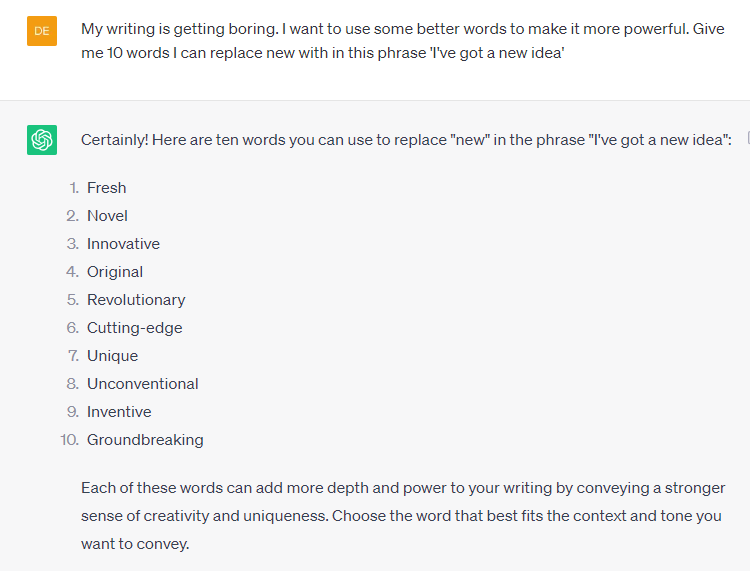
You can even ask ChatGPT to tweak the list it’s created:
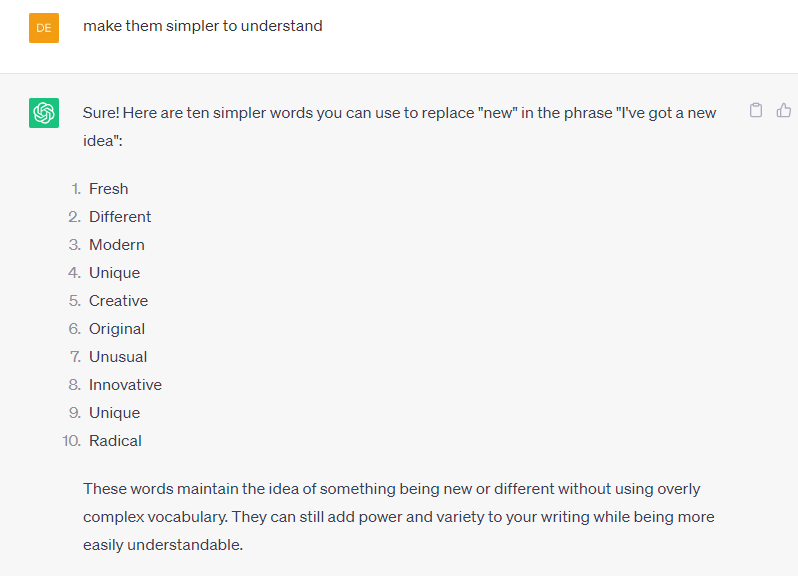
Remember AI generates ideas. But you decide what works.
4. Update cliches to your advantage
Cliches and trending phrases are popular because their underlying message connects with people. You can use this to your advantage. The message still has power if you can liberate it.
Fresh words will capture your attention and make you stand out.
Take the overused phrase of online creators:
Build an audience
ChatGPT and a thesaurus offer these alternatives:
- grow your tribe
- find your people
- attract more fans
- explode your views
- cultivate your network
- multiply your followers
- develop your community
- strengthen your online presence
None of these are an exact replacement. So make sure the new phrase fits the context.
Tweaking specific words is a quick way to improve your writing. Include these tips in your editing process. Then watch your views grow.
Try this easy guide to quickly improve your writing next:


