
4 Ways I Leverage Twitter As A Writer In 2021
Twitter is one of the greatest tools for writers

I had no idea why the world was crazy about Twitter until I started using it last year. I was amazed by the amount of knowledge you can gain and how easy it was to get into a person's mind on the platform.
During the initial weeks, I read tweets from various topics — varying from celebs to bloggers to founders. It was a breath of fresh air, especially after hopelessly scrolling through Instagram for hours.
The fact that only words rule the realm of Twitter makes it the easiest and accessible platform to use. There’s substance, and there are honesty and wisdom.
Few months down the line, I started experimenting with the platform by posting tweets and threads on multiple topics and niches.
I started with zero tweets and zero followers back in 2020. I haven’t reached my first 1000 followers yet, but I have leveraged the platform for my writing, and today I am sharing how you can do that too.
Idea Repository + Content Creation
Ideas come when you’re not thinking about them. A writer can get ideas in the shower while eating, walking, or even writing another piece. These ideas can be brilliant, absurd, or maybe both.
Storing ideas for writers is crucial. Some writers use idea journals, some use Medium drafts, and some use their phones to store the ideas that come to mind. Most of these ideas are normally trashed by the time we get on working on them.
Now, what else can be done with our ideas?
What if you could create content while storing your ideas?
Well, I tried doing that on Twitter. I tweeted everything that I was thinking about creativity, writing, trends in my country, and everything that came into my mind. What is writing if it’s not thinking out loud, anyway?
Here’s my tweet about what I learned from content creation in my four-year journey. I had no intention of writing an article on it when I created the tweet shown below, but I later thought of detailing each point in this article.
The best part about this is you’re creating content without even trying. In the future, if you feel stuck and don't find anything to write about, you can always go back to your Twitter feed and pick up an idea that you still find interesting.
This way, your ideas see the daylight and can be accessed anytime, even after a decade, unlike your journal, which gets lost after a few months.
Idea Testing
Writers can have too many ideas. They can get confused about which idea to work on or no ideas to work upon, but they’ll never hear them complain about too many ideas.
Once we find the right idea we want to explore and write an article or even a book about, we spend endless days and nights working on it. Most of us even stop midway, finding that idea to be less appealing and begin from scratch.
What if you can test your idea before investing 3–6 hours in writing an article nobody wants to read? Twitter enables you to do that.
Every tweet is an idea and when an idea resonates with people, they engage with it.
Unlike Instagram and Tiktok, Twitter has no filters, no exotic images that can cover up for a poor idea. A great idea receives a lot of respect on Twitter, and people celebrate high-quality thinking.
It doesn’t matter how many followers you have or if you're a celebrity; if your idea, aka tweet, is good, people will applaud by liking and retweeting it.
When I was toying around with an idea about dating being a great tool for personal development, I wasn’t sure if people would resonate with that. Before jumping onto the research about Indians and dating, I decided to write a Twitter Thread (we’ll cover that in the next point) to see if the idea was any good.
I wrote about how dating can teach us more than a college. It was a bold move, but people loved it. The tweetstorm got mini viral, I got tons of comments and retweets, and till today, it’s my most successful tweet.
Seeing the crazy result, I decided to convert that thread into an article you can check here. The article performed well and was immediately curated.
Testing ideas on Twitter is not a new concept; many great products and services were started by running the same experiment. The next time you are not sure about an idea or are stuck with two, tweet about it and see how people react to it, and you’ll get your answer.
Microblogging = Twitter Threads or Tweetstorm
A Twitter Thread is a series of connected tweets by a person. The engagement on a thread is much higher than a single tweet or a tweet with a link. It’s also called a tweetstorm.
It is a perfect example of a microblog. It starts from writing the headline with an intro, and then you keep adding a new tweet and continue completing your story. Microblogging on Twitter forces you to divide your big blog into bite-size pieces that make sense individually.
It makes you eliminate fillers and jargon. You become a better thinker and learn how to deliver a message efficiently.
The best example to understand the Twitter thread would be studying Naval Ravikant’s most famous Tweetstorm on How to Get Rich Without Getting Lucky which has over 50k retweets and 1.37k likes. This thread has been converted into multiple books, podcasts, and videos.
A great Twitter thread is hard to get unnoticed as people love getting good information in short pieces. I tend to leave a long-form article in the middle, but it rarely happens when reading a Twitter thread.
It also saves time, shareable, evergreen, and on the public platform.
Quote Sharing and Creating a Quote Library
A quote is an essential part of an article.
Quotes make an article complete, build credibility, and give another perspective. When you can find a citable source for your piece, you can always find a related quote that puts weights on your case.
I started my Twitter journey by sharing my favorite quotes. I would also tweet the quotes that I’d intended to add in the upcoming article to keep them stored. This becomes a regular habit, and I started calling it my Quote Library.
Before keeping a Quote Library, I would spend 10–20 minutes finding the perfect quote because nothing is worse than knowing the right quote to add to your story but not finding it.
We think we’ll remember it, but the truth is we won’t.
To avoid that mistake and save my time, I started collecting all the quotes I like and resonate with on my Twitter feed.
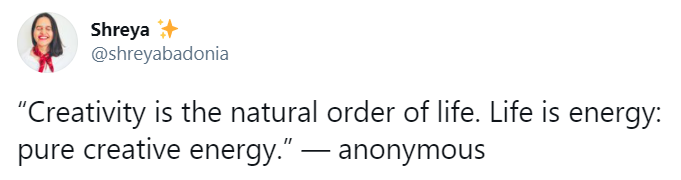
Every time I see a quote that lights me up, I tweet it. Some people may think about why I am sharing random quotes, but I am simply helping my future self from the pain of not finding the right quote.
Bonus Point
The Twitter writing community is a blessing. Use one writer hashtag, and you’ll find tons of people ready to support you and spread your work. It’s so much easier to connect with fellow writers and see what they’re up to.
You can also interact with your readers without an email list or a Facebook group. I read content by people I follow on Twitter and vice versa. It helps create connections and makes you engage with them.
If you’re not on Twitter, try it out; you’d surely find something to stick and if you are, say hello :)
If you enjoyed this piece, you’ll love this one


