
4 Ways Handwriting Can Help You Succeed In This Digital World
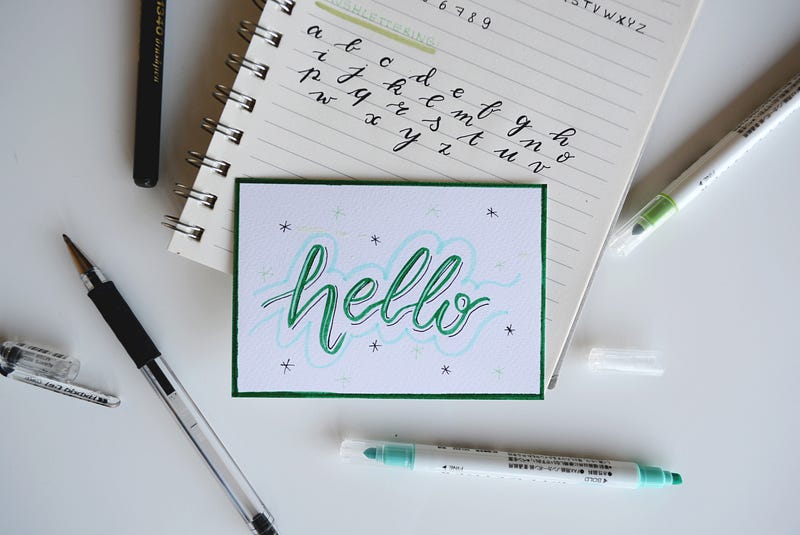
I love handwriting. Yes, even in this crazy digital age, I still love to make good old-fashioned notes written down on paper using a pen.
It’s not rocket science.
I know you probably think that I am a technophobe or I have just old fashioned ideas. I may even be nostalgic for the good old days when paper was used for notes.
No, there are several good scientific reasons why this sort of note-taking is way better than the digital one. I will explain what these are below.
The most important one is we are much more likely to remember what we have written down than if we had typed it using the keyboard.
Handwriting is in danger
Last week, a clerk in our bank had written down the banking code on a piece of paper. Normally everything is sent digitally, but this was an exception. She had written several digits with what we thought was the number 9. But this number was backwards and we could not make it out. How come people can no longer write letters, words or even numbers? Yes, it was a 9 but it was a 9 written the wrong way round. It looked more like a “p”!
One reason is that handwriting is disappearing from the school curriculum. It seems it is no longer valued as an essential skill. Did you know that there were plans to abandon cursive writing in many school districts in 2014? That was because it was actually dropped from the Common Core Curriculum Standards in 2013. That is the bad news.
And the good news? Many states realize that this is a mistake because the benefits which I will show below are just too good to miss. Texas schools are all set to introduce cursive writing again in 2019–2020.
It is not dated skill.
“Print is predictable and impersonal, conveying information in a mechanical transaction with the reader’s eye. Handwriting, by contrast, resists the eye, reveals its meaning slowly, and is as intimate as skin.” ― Ruth Ozeki, A Tale for the Time Being
What happens when we put pen to paper?
A part of our complex brains is called the RAS (reticular activating system). This gets going once we start the writing process. It is hard to interrupt you when writing and that is because the RAS will filter out distractions and interruptions and help you focus.
At the manual level, we have to master the physical act of holding the pen and then get our brains together to get the letters and meaningful words down on the sheet. That is a pretty complex process using visual and motor functions.
The next level is even more complex. We have to make the words useful, as a memory aid so they have to convey meaning. That is why writing is so good for helping us remember the information. Banging it out on a keyboard is far too easy and we forget what we have actually typed. Feedback from what we see on the screen is a different process.
The benefits of handwriting.
One great benefit is that the act of writing slows down the brain and allows for a certain amount of creativity, according to one neuroscientist, Dr. Claudia Aguirre. I wonder if I were actually writing this down on paper, would it be a better article and it might make me more creative? Of course, I am a keyboard slave so that is not likely to happen.
But thankfully, writing handwritten notes is still an essential part of my writing.
Researchers at the University of Stavanger (Norway) found that visual perception and motor functions are always exercised when we write. This is such a valuable skill in educating children that we cannot ignore it. It reinforces the whole learning process.
One experiment got learners to try to learn a new alphabet of only 20 letters by just using a keyboard. The other group was told to write and practice all the letters by hand. After a period of six weeks, the hand writers remembered the letters much better than the keyboard group.
I always took notes during university lectures. There were no laptops then. I am very glad I did that because I always wrote up the notes at home. That process was a double aid for my memory. I just remembered everything better.
One researcher at Cornell University, Walter Pauk maintains that this writing process is a great memory aid. He has developed a system called the Cornell Note-Taking System. Watch the video here to see how this can become a great study aid.
When Americans are using handwriting at work, it seems they are not doing a great job. It can lead to bad communication and errors. The survey conducted by Bic USA Inc. found that bad handwriting led to at least two instances of miscommunication during their working lifetime.
Not to mention doctors’ handwriting.
4 ways handwriting can help you succeed.
1. It is lovely to receive a handwritten thank you note from a coworker, customer or manager. It makes the recipient feel special. Beats a sterile email any day. Try writing these when you want to really show your gratitude to an important client.
2. Taking minutes at meetings. Don’t be tempted to use a laptop. You can concentrate much more easily with a pen and paper. Multi-tasking risks are practically nil when you do that. Think of all those tabs winking at you on your laptop screen. Writing gives you greater freedom and it will help you enormously when you type up the minutes.
3. When sending a formal typed letter, it is always a good idea to add a personal touch with a short handwritten note. If your writing is illegible, forget this one!
4. I love the fact that I can switch off my computer when I really want to focus on a task or topic for my writing. Managers also find that it is a great way to focus and to concentrate when they want to plan a project.
Using mind maps and diagrams are also a great way to focus. You cannot do that on-screen because the actual formatting takes up all your creative energy. No distractions from social media or pesky emails either.
Back to pen and paper for good old-fashioned handwriting.
“Handwriting helps us develop the skills essential for all communication. Without it, our brains don’t create some of the processes which help us be good communicators, and all parts of communication suffer.” Laura Petrolino