
4 Tips From A Writer Mom On Applying For Jobs On Upwork
The said mom is a top-rated, non-native English speaker with a 100% job success score.

I recently got an Upwork Happy Anniversary email reminding me that 5 years ago I started my journey on this freelancing platform as a writer. I’m a non-native English speaker who managed to keep a 100% job success score. I’ve worked with 44 different clients and completed 56 projects. I could have done a lot more if I wanted to. But as a mother writing whenever my child allows me and already relying on a client roster outside of Upwork, I believe that this platform has given me just the extra I needed.
Below, I’d like to share with you four tips that are helping me to stand out whenever I apply for a job. Small details that can make a difference and that you’ll be happy to learn. The way I see it, Upwork is a community. The more we support each other to thrive within this community, the higher the odds of it growing bigger and unfolding new opportunities for all of us, writers or not.
Before we get started, the proof that I speak from experience:
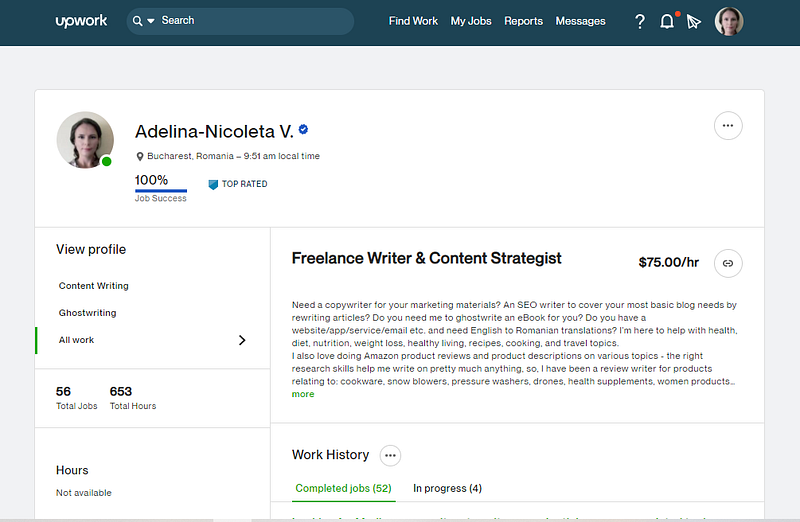
And now, the four tips I promised to share with you. Here’s to your success:
1. KISS that client from the first application
Clients feel overwhelmed, too. Do you think it’s complicated to scroll through thousands of job offers? Wait and see how it feels when you post a job ad and your inbox is flooded with tens of proposals within a few short hours. And you’re supposed to choose the one that will give you the most value for your money, all while applications keep coming in.
Go ahead and KISS that overwhelmed, soon-to-be-yours client. Keep your job application sweet and simple. Don’t give too much or unnecessary information. Say enough to stand out and show him either your expertise or the drive to make his life easier.
After one or two lines where you show you’ve done some research, jump straight to the part where you provide value — suggest topic ideas or an article structure or a short intro to a chosen topic. If the job description is broad, add extra questions to show you’re interested in learning what they need in order to provide just that.
Don’t brag about what you do, tell them what you’re going to do for them. Or boss them around by demanding answers to your questions. If the client isn’t willing to give you answers, chances are it’s a client you’ll have a hard time working with!
2. Be perky and call him by his name
They all tell you to customize your cover letter but how about if you salute the client by his name? Some clients sign the job post with their name and you should definitely use it.
But if you’re not getting any name at a glance, take a few minutes to surf through the reviews. Freelancers tend to mention the client’s name when they leave feedback, and you’re missing on an opportunity if you don’t look into it.
Sometimes, you might notice that freelancers mention more than one name. It’s because some companies share one account among their employees. If that’s the case you can still use this information by either picking the name that shows up more often or by simply saying — “Hi! Is this John or Dave I’m talking to?”
Even if you don’t get the right name from the first interaction it still shows you’ve done a little effort. On one occasion where I did this, I also found out that the client had a successful history of working with Romanian freelancers, and I used that information in my application as well. It certainly resonated with him!
3. Pay attention to how you answer the questions
Many job descriptions are accompanied by some questions. While you craft the answers to those questions and your cover letter, keep in mind that the client’s view is different.
You see the window where you write the cover letter first, and then the questions. He’ll see it reversed with the questions first and your cover letter last.
So, refrain from trying to make connections between the two of them. Things like “As I said/showed above…” will sound weird since your “above” is actually the client’s “below”.
4. Prices shouldn’t intimidate you
There’s a lot of controversy around how much money you can make on Upwork. The truth is that you can make as little as $5 for a 2000-word blog post and as much as $2000 for a 2000-word article or… you know, the sky is the limit. Still, most will notice the $15 gigs and complain about it.
Why make general assumptions about a $15 gig? For some people, in some countries around the world, $15 could mean food for a week. And for some clients, getting the chance to hire a freelancer at this rate could mean the opportunity to scale their business and soon enough demand more work and higher quality, affording to pay more for it.
In short, there are different clients and different freelancers who have their own expectations and needs. I know some clients indeed look for the cheapest freelancers while others want to hire freelancers at much higher rates, intentionally disregarding the low bidders. In every project, as long as the client and the freelancer are happy, it’s a win-win.
I encourage you to go with your gut while being sincere with the client. You can charge less and tell the client that you’re looking to earn his trust or trying to set foot in a certain niche or simply make an estimation of how easy it will be for you to complete the task at a lower price. For instance, the $75 an hour fee on my profile is for copywriting projects. I charge less for content writing jobs and I make sure to let the client know.
At the same time, if you feel like the project involves more work, by all means, bid higher. Again, explain why and strive to show value. I once negotiated with a client for ghostwriting a short book and his offer was $1500. I quoted $2000 from the start and made sure to make my sample shine. In the client’s words… “Wow. It is wonderful; I am SO glad you did this and so thrilled that Jay sent me your details. The effort you have put into this assures me you would be wonderful to work with and I would be EXTREMELY happy to hire you based on this sample.”
Eventually, I had to pass on that offer because of other incompatibilities, which again, goes to show that you need to know your value and stand for it. Even when you position yourself differently than the client expects, your honesty will be appreciated. Explain why you charge what you charge, whether it’s lower or higher than the client’s offer. It’s something you have to do in order to prove your professional stance. Plus, it is yet another way to make your application stand out.
One last thing before the baby demands your attention, mom!
Sure, I’ve come a long way on Upwork and it hasn’t always been that easy. But if I would have considered these aspects from the very beginning, I’m pretty sure it would have been easier. I hope that no matter at what stage you are trying to make some money on Upwork, you’ll make good use of these tips:
1.Say enough to be convincing and stand out;
2.Show that you’ve looked into them;
3.Pay attention to how you answer questions;
4.Be honest about the price.
Of course, if you look at the client’s previous jobs and see they’ve only been paying $20 per article, you can’t come and ask for $200. You can ask, however, $25 or $30, offering to be the one who chooses the topics or suggesting the $20 price in exchange for getting your name on the article. Ghostwriting — publishing content that doesn’t credit you as the real author — should cost the client more because he’s taking you the benefit of showcasing that work to future clients.
I guess what I’m trying to say is that you should dare more. Dare more, and do more — many Upwork writers don’t bother with it, but if you do, you have higher chances to accomplish your goals on that platform.