
4 Tips For Becoming a Relevant and Relatable Writer
How to stand out from the crowd and get your piece of the cake

Writing is therapy. That should be enough. That should be the major reason to write. Because it’s your passion. But this doesn’t mean you can’t make a living out of it. There is nothing more rewarding than to do something you love and get paid for doing that. Working on something you love. Not everyone has that chance.
Passion can get you far and beyond your dreams. But to succeed and live from your dream, you need to work hard. Easy recognition doesn’t exist in this industry. And luck only happens to lucky people.
If you want to live from your passion, you need to take it seriously. Enjoy it, yes. But don’t think just because you love writing it will be an easy ride. Like an athlete, you need to train, make sacrifices, know your competitors, and visualize the race.
The blogging (and writing) industry has never been more saturated. And like in any saturated market, competition is harsh. If you want to get your piece of the cake, you need to be relevant, relatable, and stand out from the crowd.
How to be relevant, relatable, and stand out from the crowd?
There is not just one answer. But probably the one that will get you closer is: speak your truth. Write about something you know and do it with passion. Write about it because there is no other way. Write with passion. Focus on the why.
Once you have that, then you are closer than you think. Now you can focus on getting your piece of cake. If you have a good story to tell, people will read.
After 4 years of casual blogging and 2 months of full-time blogging, these 5 things have been my major lessons.
Write, write, write
I’m not saying you should publish everything you write. But the more you write, the better you get at writing. Writing is a skill. The more you train, the more you improve. Write each time you can. Make it a habit. Experiment with topics, styles, length, approaches. But write.
Some of your writings will be crappy, not publishable material. But one might stand out from the drafts and become your trademark.
You can only find your voice, your identity as a writer if you look for it. Endlessly, because you are human. You are in this world to grow, your writing too.
This is no guarantee that you will be a talented writer, but not writing is the only reason you can’t be a writer. That is a guarantee.
Writing regularly not only improves the quality of your writing but also increases your exposure to readers. It is a loop. The more you write, the more potential readers will read. The better your writing gets, the more new (and old) readers will engage with your content.
When I started on Medium, I would write one story every month or so. Since May 2020 I am writing every day and publishing at least one story per week. My writing has improved amazingly — although far from perfect — and the stats grow organically.
Use Facebook groups for good
There are many controversial opinions on how Facebook groups are good or bad for your writing. Both have valid points. Facebook groups can be distracting and full of fake engagement.
I agree with Jon McDonell up to some point, Facebook groups don’t make you any favors if you don’t use them for the good reasons. I mean, it’s easy to fall for the clap me and I clap you forward routine. Every writer is looking for easy and fast gratification.
But Facebook groups are more than that. They are actually a place to connect with like-minded humans. You can discover wonderful stories you wouldn’t otherwise because of your medium preference settings or because of curation algorithms. You can get advice from writers just like you who put their best into their pieces and still struggle from getting views. You can connect with talented writers and editors and get their best advice on writing and freelancing prompts. You might find writers willing to contribute to your publication or collaborate with you. You can have genuine advice on your drafts and get to pitch to editors directly.
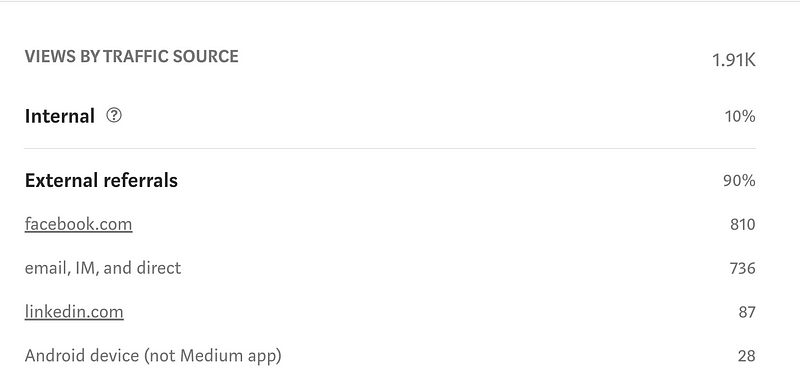
Yes, there is a lot of space for self-promotion, egocentrism, and victimization. But you can just ignore this, as you would ignore a bad story on Medium or on any platform. Read something else.
But if you use these groups for the right reason, you will definitely grasp their value.
I have enjoyed and learned so much from groups like The Writing Coperative Community or Womxn of Medium. And the fact is that Facebook is an important channel for your stories.
Don’t obsess with stats
We will be lying to ourselves if we said we don’t care about recognition. It’s hard not to think about the likes, claps, and follows you’ll have once you hit the publish button. Who doesn’t like to be pampered and recognize for the hard work?
But obsessing with statistics is counterproductive. You spend more time trying to understand what went wrong than on crafting your stories. Now, don’t get me wrong, stats are important. There is a reason Medium, and other platforms, make this data available for writers. You can learn from your data. It helps you understand your audience and your writing. It helps you find your best strategy for getting your piece of the cake.
But most of the time we (new) writers use these stats the wrong way. We look at them every minute after hitting the publish button to see if the green bars are taller. And when the numbers don’t move, we question the platform’s algorithm, the publication’s reliability, the readers’ taste, the timing, the weather. We questioned everything but ourselves and the quality of our stories.
My advice is to look at the stats once a week. Use the data to learn. What was your best performing story? Why did it perform well? What were the channels that got you more traffic? Read your story again and learn from it. Can you repeat that success? If your story flopped, ask yourself what you could have done better. But before blaming everything else, look at your writing style, your story, the actions you took to promote it, and so on.
Whatever you do, don’t get obsessed with instant recognition. It’s not real. Gaining engagement from readers takes time and a lot of practice. Fail many times before you can succeed. Writing for the views is simply not worth it. This kind of mindset will never pay off, not in the long term.
Learn to market your stories
No matter how big the publication you publish with is. Or how many topics your story got curated in. If you want people to read your stories you need to market them properly. Writing is like having a company. You won't sell your product unless you market it to the right customer. Your stories are your product. And it works like any other consumable. Only, they usually address unexpressed needs. Unless your story answers to a specific reader question, readers will not come voluntarily to look for your story. You are not selling toothpaste here, and even if you were your toothpaste would have to be at the top of the mind of your customer to be bought.
Before readers can find you and feel the need to read your story. You have to be visible and make your story visible. You need to let them know that you are writing at them.
Even then, your stories might not get the recognition they deserve. This doesn’t mean they are not good or that no one wants them. It might mean that you need to look for your readers, reach out, and help them find your stories.
There are, in my experience, three effective ways of getting your work noticed by readers: Social Media, SEO, and Expertise.
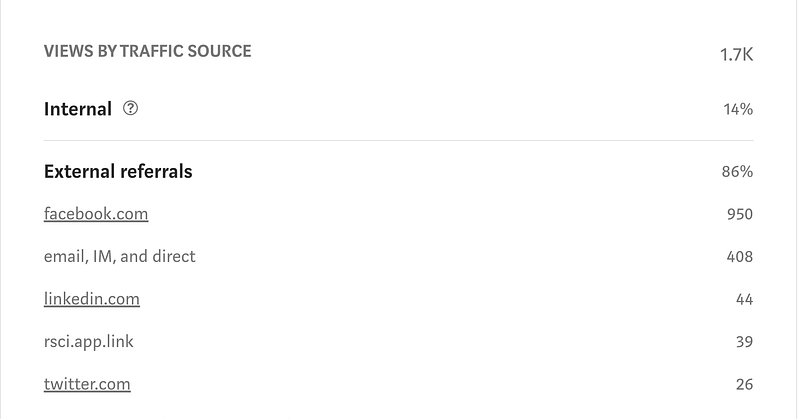
Using social media for promoting your articles is something you shouldn’t overlook. Now, it doesn’t mean you should be present in every single platform. I think that is not ideal, because you end up procrastinating more than should. And because you will disperse your efforts too much. Rather focus on two platforms that are more suitable for the stories you write. In my case, I focus on LinkedIn and Facebook, because is where I can reach a wide audience of educators and scientist, which are my target readers. I am a member of private groups related to education, science, teaching, and so on. This is where I promote most of my work and what gets me the most traffic. The amazing thing is that contrary to Instagram and Twitter, you don’t need a large follower base to get your post read and share by many people.
Search Engine Optimization (SEO) is another thing you should care about when promoting your story. If you want people to read your story it has to be visible. Top of Mind, remember. If someone is looking for “how to get more views for my stories” and you happen to have a post answering that question, you need to appear at the top of the search list for that. Otherwise, you are losing a potential reader to your competitors. SEO techniques are essential for getting traffic and being visible. I recommend reading Casey Botticello’s stories on how to use SEO for your stories.
And finally, use your expertise to become reliable. The best way to make into the market of content creation and gain reputation is through your expertise. Write about what you know, become an expert, and build your reputation on that topic. You will not buy running shoes from Panasonic, would you? You buy from New Balance or Nike, because you know they are experts on running shoes. The same happens with stories. You will not read advice on writing from someone who has never written before. Or about creating a startup from someone who hasn’t yet left his paid job to build her thing, right?
I’m not saying they can’t write brilliant stories about those topics. I mean, I’m sure if Panasonics enters the shoe market they will probably make amazing running shoes. But I don’t want to be the first person to try it. I will let other people validate it for me. If I want to read about how to teach online, I want to read from someone who has done it successfully before, at first.
Building a reputation and expertise on a topic makes you relatable and reliable to the reader. How do you do it? By creating more content on that topic. Experiencing and experimenting with the tools you want to talk about. Advice from your own practice. Build your name, your brand. Have a place where you can showcase your work. Engage in conversations around the topics you are expert in. Be present in communities like Quora, Reddit, LinkedIn. Invest in your brand: buy a domain name for yourself, build a publication for those topics. Stay coherent and relevant.
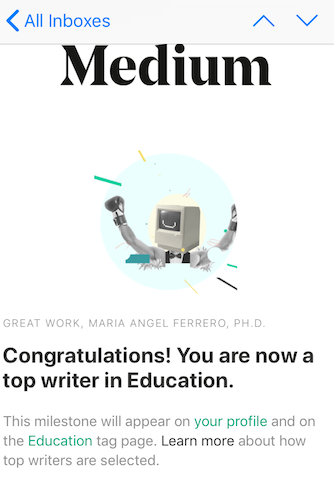
My follower base has grown significantly since I started The Faculty, a Medium publication about Science and Education. I publish regularly on it and invite other like-minded writers to publish their work. The publication has grown organically and I became Top Writer in Education. This has not only helped with my views but with the views and stats for other writers collaborating in The Faculty. I have been invited to webinars, podcasts and Q&A sessions with educators from all around the globe because I became relevant.
People will start noticing your work once you gain become reliable.
Now, following these tips will not guarantee your success as a writer. But it can get you closer to your goals.
Success doesn’t happen overnight. You just don’t wake up being lucky. Either you work hard to get your piece of the cake or you don’t. There is no easy ride, no shortcut. Doing what you love is amazing, but living from doing what you love takes effort, sacrifices, and constant practice.
If you're aiming for the long run, don’t quite upon the first failure. Fail as much as you can, so when you succeed you cherish it and remember how you got there.


