
4 Little-Known Ways How Music Can Affect Your Everyday Life
It can predict your personality and even take you back in time.

Do you like listening to music? Most likely, you will say, “yes.” In fact, over 90% of people worldwide say they like listening to music for various reasons.
Research studies have already proved that music helps boost concentration. It blocks external noise, reduces stress and anxiety, and enhances creativity.
I can listen to the same song for years. I treat music as a way to escape from reality, dive into my dreams, listen to my inner self, and heal the emotional pain.
“Music has healing power. It has the ability to take people out of themselves for a few hours.” — Elton John
I firmly believe music can do even more. Thus, I have listed several little-known ways how music can affect your everyday life, positively and negatively. These are my feelings backed up by observations and science.
Music Can Take You Back In Time
Music can take you back to a certain period, whether that’s a specific year or a significant event in your life.
Do you have a song you listen to when you are sad or happy? Many people create playlists for different life situations, such as moving abroad, long-distance relationships, and break-ups, because music helps them overcome difficulties.
I sometimes recall “This is me” by Demi Lovato when I am emotionally down or need some motivation. I heard this song over ten years ago when I was a kid, but it left footprints in my memory.
Believe it or not, but the music keeps your memories! If you listen to a particular song during your break-up, it might remind you about this period of life later. You will associate this song with your ex-partner, nothing else.
Deep emotional experiences are kept in our brains. They do not disappear. People cover them with new, fresher memories.
As British neurologist Oliver Sacks, well-said:
“Music can lift us out of depression or move us to tears — it is a remedy, a tonic, orange juice for the ear. But for many of my neurological patients, music is even more — it can provide access to movement, to speech, to life. For them, music is not a luxury, but a necessity.”
Music Preferences Can Predict Your Personality
According to Wharton marketing professor Gideon Nave:
“When people in a new environment want to get to know each other, music is usually one of the first topics to talk about, which signals that music is indeed revealing something about who we are.”
If we can learn about personalities by looking at a music playlist, the question is, to what extent can we predict people’s personalities based on their musical preferences?
Research studies conducted by the Wharton University of Pennsylvania provide surprising insights about music and its influence on personalities.
If Eminem’s aggressive rap is painful for your ears and makes you search for smooth and calm songs — you’ are probably a highly-opened person. This is one of the study’s implications that looks at the link between music and personality.
Extroverts, on the other hand, prefer unpretentious music that is usually relaxing and uncomplicated. Pop, jazz, blues music lovers tend to be extroverts too.
Another study conducted by Heriot-Watt University suggests that fans of the indie and classical music genres are typically introverted, intellectual, and creative.
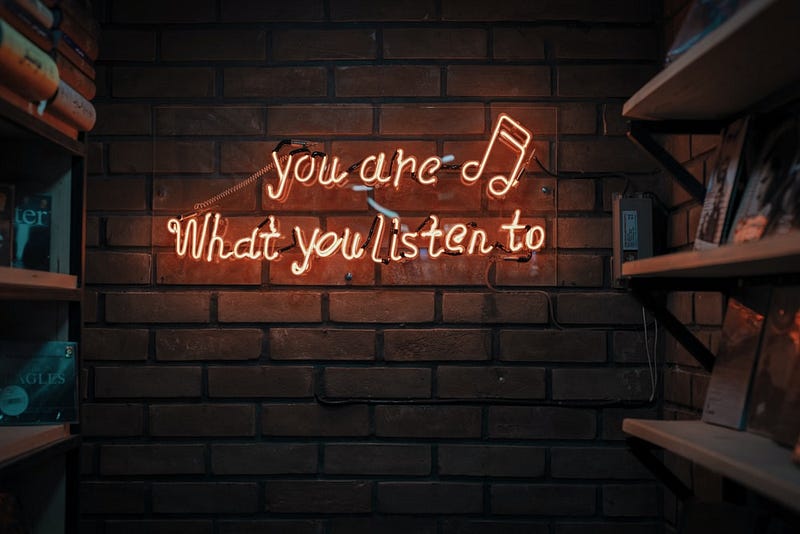
As an introvert, I tend to listen to various music genres that correspond to my current mood. I firmly believe every individual is unique; thus, it must be hard to generalize the research findings.
Nevertheless, knowing this fact can help to strengthen social bonds. By knowing musical preferences, you can make new friends and build connections with similar people.
Music With Lyrics Can Shift Your Focus
Science says music can boost productivity or cause a distraction.
Whenever you hear your favorite song, you will most likely start repeating lyrics, shaking your body, etc. It is a typical reaction to joyful sounds.
Even if you are involved in deep work, music can “wake you up” and shift your focus to something else.
Whenever I work or write, I do not listen to music with lyrics. It is difficult for me to concentrate when I hear a favorite song.
Besides, songs with lyrics unconsciously make you repeat the words. Even if you do not want to do it, your brain is programmed this way. Deep thinking requires more energy for the brain to work, while listening to music needs less brain capacity. This is why your brain wants you to switch activities and reduce energy consumption.
If you are a big fan of music and would like to keep listening while working on something else — try classical music. Research studies state it improves concentration and creativity.
Besides, consider listening to songs in a foreign language that you do not understand. This way, you can keep music in the background and concentrate on your tasks.
Music Can Improve Your Workout Effectiveness
As an office worker, I seek to exercise regularly to fulfill the daily activity norm. Even though I feel super lazy in the evening and sleepy in the morning, I admit the workout's importance.
I cannot imagine my workout without the headset and favorite music playing in the background. I already have a workout program for myself; thus, I usually repeat it unconsciously.
When I exercise with music, I forget about my laziness and pain. Time flies fast. I sometimes do not even recognize how long my workout is.
To verify and back up my observations, I looked up research studies online. Surprisingly, the effect of music on exercising has already been studied.
A study led by the sport psychologist C.I. Karageorghis in 2010 states that music can improve athletic performance in two ways: it can delay fatigue or increase work capacity.
Besides, the right music beat helps to maintain the pace while exercising. One article, published in the Journal of Sports Medicine and Physical Fitness, states that cyclists who followed the music rhythm and pace required less oxygen to do the same work than those who exercised without music.
If you do not like exercising, try to do it again while listening to your favorite songs, podcasts, or audiobooks. You will concentrate on what you hear, and the workout will pass smoothly for you.
Final Thoughts
“A great song should lift your heart, warm the soul and make you feel good.”– Colbie Caillat
Colbie Caillat, an American singer, and songwriter is right. Good music can heal from depression and emotional pain.
Although people have different music tastes, music has the potential to make us feel connected. You do not necessarily have to understand the language to enjoy sounds from all over the world. Music increases empathy, social connection and strengthens cooperation among people.
The same song can trigger different emotions. For someone, it can recall distant memories from the past, while others can associate it with happiness, love, and relationship.
When people want to get to know each other, music is usually one of the first topics to talk about. Consider incorporating music into your everyday life. It might help you become more relaxed, productive, and happy as a result.
You can get full access to every story on Medium for just $5/month by signing up through this link.
Your membership fee will directly support me and other writers on Medium to keep creating helpful content for you. :)


