
4 Strategies to Reduce Your Gym Time Without Sacrificing Results
Research-backed methods to improve exercise efficiency

“I don’t have time to exercise.”
This is a common complaint and a valid one. Work, family time, sleep, volunteer events, and other commitments pile up. Struggling to find time to exercise isn’t synonymous with laziness.
There are many priorities in life and sometimes exercise takes a back seat. It’s often viewed as time-consuming. What if you don’t have an hour a day to dedicate to working out?
Luckily, you don’t need to set aside that much time.
A recent research review in Sports Medicine provides strategies for increasing efficiency in the gym. Another one provides evidence exploring the minimal dose needed to experience improvements in strength, muscle mass, and function.
Let’s see how this information can help you cut down time at the gym.
(This article is not medical advice, it is a summary of recent research along with my clinical interpretation. Talk to a professional about an individualized training approach.)
Strategy #1: Train Less Often
More isn’t always better.
One of the easiest ways to reduce gym time is to go less frequently. Muscle magazines, Instagram influencers, and followers of bro science may tell you to hit the gym nearly every day. That recommendation doesn’t follow the actual science.
A recent systematic review shows the ideal volume of exercise is 12–20 sets per muscle group per week. This can be done in a couple of total body sessions in the gym. But this is ideal, not the minimum dose for results.
Studies have shown participants build muscle with a single training session a week. That single session needs to focus on the whole body and contain substantial volume. But how much time will you save only needing to drive to and from the gym once?
The opposite end of the spectrum is true as well. You can perform frequent microdoses of briefly, vigorous exercise or exercise snacks to improve strength.
Briefly, vigorous exercise is a continuous bout of vigorous-intensity exercise lasting less min. If you use high-intensity interval training, the total exercise time (excluding rest) is less than 5 minutes.
Exercise snacks are multiple short bouts (10–20 seconds) of vigorous exercise that are incorporated into the day with several hours of rest between sets.
The key for both is intensity. If you perform the exercises to failure (or very close to failure), then you can see benefits in strength, endurance, and potentially muscle mass, depending on the total volume.
Once again, volume is key for muscle growth, provided the intensity is sufficient.
When studies compare volume, they are concerned with sets, reps, and load. Reducing your rest time will quicken workouts (more on specific strategies later), however, if you are lifting heavy weights, more rest is needed to recover between sets.
The good news is you don’t need to train heavy to build muscle or strength. Studies show that low-load training is equal to high-load training for building muscle. A moderate load is equal to a high load for building strength. So, if you want efficiency, keep the rest breaks to 90 seconds or less.
If you care about high-load training and improving your one-rep max, you will see results with a single top-end set. Your volume is built through the warm-up (more on that later). Make sure you are moving as fast as you can for every rep. Strength is the maximal force output, which is influenced by velocity.
Okay, we have established you may not need to dedicate 5+ hour-long gym sessions to see results. Let’s look at a few more detailed strategies for designing your programming to get the most out of your sessions.
Strategy #2: Minimize Warm-Up Time
Warm-ups are often over-complicated and drawn out. You don’t need to stretch, foam roll, or perform mobility exercises. If they feel good and you enjoy stretching, be my guest, but know it is not needed.
The goal of a warm-up is to increase your metabolic activity and prepare you for exercise. The best way to do that is to gradually build up the intensity of the exercise you intend to perform.
For example, if I am warming up for a squatting session, I begin with a set of 10 air squats followed by a set of 8–10 with the bar. From there, I gradually add weight and decrease the weight until I reach my working sets. The progression may be 45x10, 135x8, 185x6, 225x4, 275x2, 315x1, working sets.
This approach can be used for any lift.
Strategy #3: Prioritize Compound Exercises
Multi-joint exercises (also known as compound lifts) should be prioritized. They involve more muscle groups, produce greater amounts of mechanical tension, and induce a greater metabolic stimulus than single-joint exercises.
If you aren’t limited on time, single-joint exercises (e.g., biceps curls and knee extensions) are great exercises for adding volume. The caveat to compound lifts is they are fatiguing and require more recovery. You can generally perform more single-joint exercises than compound lifts in a single session and across a week.
The benefit of compound lifts is experienced regardless of the method of resistance. Whether you use machines, free weights, bands, or calisthenics, you will reduce exercise time by prioritizing compound movements.
The beauty of machines is they are easier to perform, making them ideal for novice lifters. It is easier to train close to failure and you don’t need to spend time worrying about technique. The ability to confidently move through a lift may save a few minutes as well.
Strategy #4: Manipulate the Rep Scheme to Increase Volume Without Increasing the Time
These are three strategies for manipulating sets and reps to reduce time in the gym. Studies show they lead to equivalent or better outcomes than traditional rep schemes.
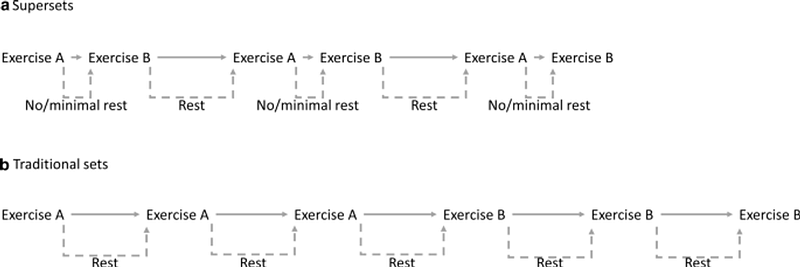
Supersets
Performing two or more exercises in succession with limited or no rest between them. The image below provides a visual representation of supersets compared to traditional sets.
Drop sets
Perform a traditional set, reduce the load (often by 20–25%), then immediately perform another 1–3 sets. Each drop set is performed to failure.
Rest-pause sets
Instead of completing a full rest break, which is typically 1–2 minutes for hypertrophy and 4–7 minutes for strength, rest-pause is the practice of using mini-rest periods within a set.
For example, a traditional approach would involve completing 3 sets of 6 repetitions with 80% of 1 rep max with 2–3 minutes of rest between sets. The rest-pause approach involves completing one set to failure (also 80% of 1 rep max load) with 20 seconds of interset rest interval until a total of 18 repetitions was performed. There is no limit on the number of rest breaks you take. You simply need to hit the desired number of reps.
Previous studies have shown rest-pause not only leads to superior hypertrophy (I’m guessing because the method forces you to approach failure and many individuals train far short of failure), but it also significantly reduces time.
In one study, the traditional group took 57 minutes to complete a session, compared to 35 minutes for the rest-pause group.
Final Considerations
Which strategies should you implement? It largely depends on your goals, resources, and enjoyment.
If you want to build strength and don’t care as much about muscle mass, then drop sets with max velocity or rest-pause may be preferred to supersets. Furthermore, you may strictly focus on compound lifts, completely eliminating single-joint exercises.
If you want bigger quads, you may limit all regions except the quads to compound lifts and add knee extensions to the end of your leg days.
If you hate the feeling of supersets, don’t do them. You have other options at your disposal.
There isn’t a one size fits all approach to exercise, no matter what your goal is. There are some underlying principles, such as training close to failure to maximize muscle growth, but there are many methods to achieve the goal.
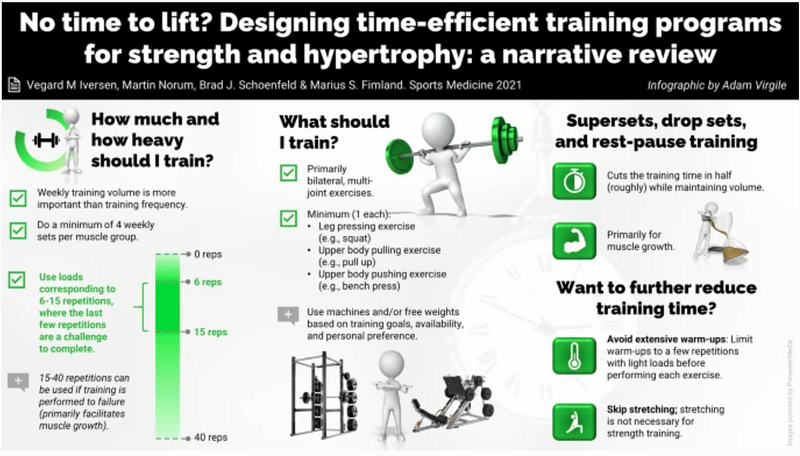
The graphic below provides a nice summary of the results from the Iversen paper.
Keep in mind, some things take time. Earlier, I wrote more isn’t always better.
Sometimes it is.
Increasing efficiency will sacrifice potential outcomes. This is a case of good vs. great. If you want to maximize muscle growth (such as competing in bodybuilding), you will need to spend a lot of time in the gym.
If you enter the endurance world, you will find a similar story. High-intensity interval training yields similar results as moderate-intensity continuous training, despite taking a fraction of the time. However, if you want to be a competitive endurance athlete, you need to log a lot of miles.
At the end of the day, you need to decide what your goals are. Then you can determine the best strategy for you.
For more health and fitness content, check out the Clinical Gap Podcast. I release episodes weekly. For short health and fitness research summaries, subscribe here.