
4 Steps To Turn Your Mind From A Prison To A Palace
Breaking free of excessive anxiety through the power of meditation and quiet contemplation
For most of my life, I found it incredibly difficult to sit quietly and do nothing.
It felt HORRIBLE!
No sooner than I was comfortable in my chair, anxious thoughts would fill my head.
You should be working.
Why are you being so lazy?
The dishes need washing, the grass needs cutting, the hedge needs trimming, this bill needs paying, that thing needs fixing, the kids needs picking up in 20 minutes… ARGHHH!
On and on.
An endless cycle of anxiety.
Eventually it became paralysing.
Does it need to be this way?
Well, kinda…
The anxious thoughts will probably always be there. And let’s face it, we need them to push us to get things done.
But it doesn’t need to be this bad. It doesn’t need to be all-consuming.
We all get anxious thoughts. It’s part of being human.
It’s one of the reasons we’ve survived as a species for so long — we worry about things and then we come up with solutions.
We’re a problem solving species.
But there’s one problem that we don’t seem to be solving at the moment —the fact that worry and anxiety have reached epidemic proportions.
An epidemic of anxiety
Forget COVID.
Anxiety is the biggest global pandemic we face and it’s been getting worse for years.
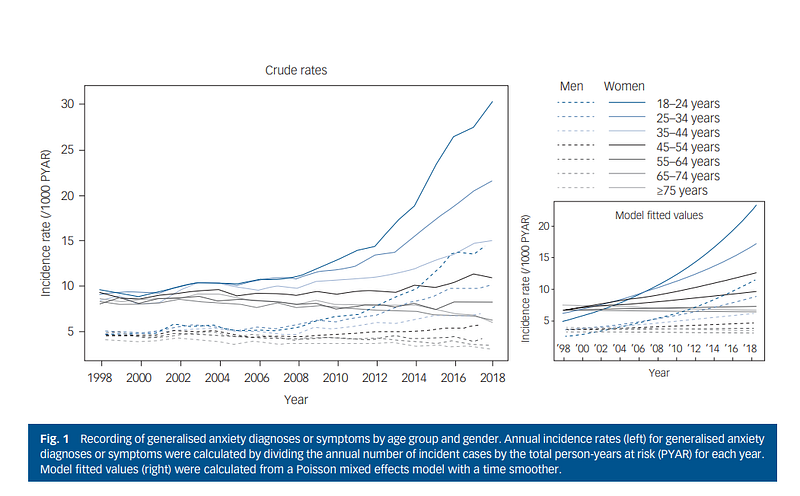
Recent research shows that the incidence rate of generalised anxiety disorder (GAD), an acute form of anxiety that usually needs medical treatment, has risen dramatically between 1998 and 2018.
It has accelerated in recent years. Between 2014 and 2018, the incidence rate in women rose from 17% to 23% and in men from 8% to 12%. Younger age groups are the worst affected.
I was diagnosed with GAD back in 2018 when I was 38 years old, so I’m part of this statistic. Fortunately, a few years of antidepressants, therapy, and a 12-step program I attend each week have helped immensely.
The study suggests a number of potential reasons for the rise in GAD:
- Economic downturn in 2008
- Social media use
- Increased awareness and diagnosis
- Societal changes — less work-life balance, lack of job security, increased uncertainty
- Technological and cultural shifts — rapid rate of change adds to stress levels.
I would add untreated trauma and addiction to this list.
The truth is —although people in peaceful countries no longer have to face war or extreme violence on a daily basis, there is still a battle going on.
The battle is inside.
The battle with the ego.
And it’s a battle you can never win. Instead, you have to learn to coexist with it. Kind of like a ceasefire.
The incessant anxiety of the ego
The ego is relentless, constantly feeding us a stream of thoughts, worries, and fears.
We evolved a strong ego for good reason. It’s there to protect us. When we were fleeing from saber-toothed tigers in the wilderness, the ego alerted us to the danger and sent a much-needed shot of adrenaline into our veins.
The problem is, in our relatively peaceful and sanitised world — the ego often does more harm than good.
Left unchecked, the ego imprisons us in our own minds.
But it doesn’t have to be this way.
We can take back control and turn our mind into a palace of peace and understanding.
The key is following a life of quiet contemplation. Here are 4 steps to help you on your way.
Step 1 — Find the Silence Within
It’s there if you look hard enough. Trust me.
I found meditation really hard at first. I still do sometimes. But nothing worth having in life comes easily.
Now I get frequent moments of stillness throughout the day. I try to meditate two or three times, usually in 10 to 15 minute spells.
My preferred way to meditate (and I’m not saying this is the right way — there are plenty of alternatives) is to use a rapid breathing technique that has been popularised by Wim Hof.
You take 30 deep, rapid breaths, inhaling fully and exhaling without force. After the last exhale, you hold your breath until you feel the urge to breathe again. Then, you take one deep breath and hold it for about 15 seconds before releasing.
This process, repeated for several rounds, can lead to a tingling sensation, light-headedness, and a feeling of euphoria.
Note: Please don’t try this if you have respiratory problems, you’re prone to fainting, or have any other medical conditions, without consulting a medical professional first.
Guided meditations also work well. My tip is to try some different techniques and approaches and find what works for you.
Step 2 — Kindness Starts with You
You know that nagging voice? The one that calls you lazy when you’re just taking a breather?
It’s time to change that script.
Speak to yourself like you would to a friend or loved one. When the self-criticism starts, counter it with self-compassion.
Try being kind to yourself instead. If you’re not used to it, it can feel weird at first.
I’ve worked hard this morning. I deserve this break to meditate.
Let’s go and visit a friend, I deserve to feel the warmth of connecting with someone.
Try to recognise if you’re going into a state of beating yourself up, then switch it around. Think of what a good friend or loving parent would say to you, then repeat those thoughts in your mind.
Step 3 — Connect to Disconnect
Step away from the screen and into the arms of real people.
Get out into your community. Call an old friend. Have coffee with a neighbour. Hug your kids. These connections remind us we’re not alone in our struggles and that there’s a world beyond our anxious thoughts.
Failing all that, stroke a cat or dog. It has been shown to have a big calming effect. My pet beagle is a cuddle-monster, so whenever I’m feeling a bit stressed, 5-minutes of rubbing her tummy makes all the troubles of the world disappear!
Step 4 — Filter the World & Choose Creative Focus
In a world screaming for your attention, be selective.
Cut out the doom-scrolling, the endless feeds of bad news and anxiety-inducing posts.
As a society, we’re addicted to bad news.
The addiction kind of makes sense — bad news prepares you for the worst. You can rehearse these terrible scenarios in your mind and work out how you’d react to them ahead of time. It provides some comfort.
But as with all addictions, the long-term effects aren’t worth the initial “high”. Too much bad news and toxicity lowers your spirit to a point of contraction. You end up in an anxiety loop.
Instead, fill your mind with things that uplift you — music, books, nature. Your soul is too important to neglect.
I took up playing the piano again in 2020 after more than a 30 year hiatus. It was wonderful to start nurturing that part of me again. I also started writing children’s fiction and that has given me a new creative outlet.
If you give all your energy away by consuming negative content, you’ll have nothing left to be creative with.
Being creative is one of the most rewarding things we can do as humans, so why would you want to miss out on that?
Feel free to connect with me on Threads, Twitter (X), or LinkedIn. Or if you like funny, heart-warming children’s books (that grown ups will like too) then check out my book here.


