
4 Simple Ways to Achieve River-Like Flow
Increasing your productivity, motivation, creativity, happiness, and wellbeing has never been easier.

Flow. Deep work. Being in the zone. Tunnel vision.
Whatever you may call it, you have experienced it before. You have been in this state of mind where you are so focused on doing one specific thing that everything else vanishes. You dive into it only to come back up several hours later, not knowing what happened and how time flew by you.
This flow state is awesome. It allows you to completely focus on what you are doing and reach almost superhuman performance. The best thing is, you don’t look at your clock every ten minutes anticipating lunch break, but completely forget time and everything else.
Still not convinced that flow is the best thing since the invention of sliced bread?
Steven Kotler, author of 7 bestselling books, Pulitzer Prize nominee, and Director of Research at the Flow Genome Project (in a nutshell: this guy knows what he is talking about) cites multiple studies that attribute tremendous benefits to being in a flow state. Allow me to present you an exquisite selection:
A ten-year McKinsey study found that flow increases productivity and motivation up to 500%. The Flow Research Collective & University of Sydney saw creativity spike up to 700%. According to the department of defense, learning is enhanced by up to 230%.
Sound too good to be true? Let me put it this way:
Even if you realize just 10% of the promised benefits, that would not only be incredibly pessimistic, but it would still have a huge impact on your work performance.
But wait, the best is yet to come. Even if you don’t care about improved performance, you still want to achieve a flow state as often as you can. According to Steven Kotler, “people with the most flow in their lives score off the charts for overall wellbeing, life satisfaction, meaning, and happiness” So if your goal is to be happy and live a life you enjoy, flow is the way to go.
The only thing you have to do is enter a flow state. And this is where things get complicated.
See, the problem is that you cannot simply say to your brain “Yo buddy, turn on flow, I got a ton of work to do.”
Or can you?
Your Brain in a Flow State
There is a common misconception about flow. A lot of people think that because we perform significantly better in a flow state, we use more of our brain capacity. In reality, it is the exact opposite.
When you enter a flow state, your brain turns off everything that is not needed for whatever it is you are doing.
This mainly concerns your prefrontal cortex. Within this area of the brain, multiple things happen that when turned off, are characteristic for a flow state. Your higher cognitive functions get turned off. Your sense of time gets distorted, which is why when you are in a flow state, five hours often pass by in five minutes. You lose your sense of self, more commonly known as the ego, which means that you also lose your inner critic. You can do, create and achieve without constantly asking yourself “is this good enough?”
The result is, according to Mihály Csíkszentmihályi, professor of psychology and author of Flow, “the optimal state of consciousness where we feel our best and perform our best.”
So back to our question from above. Can you put your brain into flow mode on purpose? And if yes, how?
Flow state is easy to trigger if you flip the right switches.
If you have read some of my other articles, you know that I am all about efficiency. Minimum effort, maximum return. This one is no different.
Believe me when I say that there is a ton of research regarding flow state and even more potential triggers that allow you to enter it.
However, there are some that are more practical and easy to implement and some that are, well, less-suited and more esoteric.
4 Simple Triggers for Entering a Flow State:
1. Removing internal and external distractions
Let’s get the obvious part out of the way. External distractions will disrupt your flow. A buzzing smartphone, e-mail popups, and a cluttered desktop will prevent you from reaching a flow state.
According to research, it takes up to 25 minutes to refocus all of your attention after you have been distracted. So go to the toilet before you start a flow session. Close your windows if you have noisy neighbors. Put your smartphone away — out of sight, out of mind.
Internal distractions, however, are different. Do you know the feeling of having a nagging thought in the back of your head? Like when you have to make an important call later during the day. Or, sometimes, you come across an important idea — a book you want to read or a proposition you want to make in a meeting. If you have too much on your mind, it is hard to focus on the task at hand and reach the flow state. So you have to find smart ways to get rid of these distractions.
My go-to techniques are the following:
- Sticky Notes Sticky Notes is a Windows-embedded app that allows you to quickly create multiple notes or lists. Often, when I am doing research or writing, I come across interesting books or ideas for an article. Alt-tab to Sticky Notes, write down a couple of words and paste a link, alt-tab back. Takes me about five seconds to be back to my original task and keeps the distraction minimal. If digital notes aren’t your thing, keep an on-the-go sheet of paper or booklet with you. Any flashes of genius you have go there.
- Journaling This is more of a prevention than an on the spot cure, but nevertheless, it works wonders. Every night, I take about 5 minutes to unload whatever is on my mind into a small, physical journal. Personal stuff, work stuff, insights I had during the day. I vomit my thoughts onto the paper. By writing things down, you give yourself the assurance that they won’t be forgotten — therefore you can stop thinking of them all the time.
- Meditation practice Focus is a skill, just like cooking, balancing or singing is. As such, it can be trained like any other skill. Meditation is one way to train your focus. By engaging in regular meditation practice, you teach your mind to keep quiet and let you focus on what’s in front of you.
Removing internal distractions is not as easy and straightforward as removing external ones is. Nevertheless, it is a crucial step to take if you want to enter flow.
2. The Goldilocks rule
In the tale of Goldilocks and the three bears, little girl Goldilocks walks through the forest and comes upon a house in which she finds three bowls of porridge. Upon tasting them, she finds the first bowl of porridge to be too hot, the second to be too cold and the third one to be just right.
The whole story does not only make for a great children’s tale but is also the foundation for the famous Goldilocks Principle. This principle states that peak motivation and performance is reached when we face a challenge that is neither too hard nor too easy.
In flow research, this concept is known as the challenge/skill ratio. Imagine you are playing tennis against a four-year-old kid. It would bore you to death within five minutes because out of every 100 balls you send over the net, maybe one would return. The challenge is not nearly hard enough for your skills.
Turn it the other way round and play against Roger Federer. You would lose motivation after the first three balls fly past you faster than you can say Wimbledon. You aren’t proficient enough for the posed challenge.
But, play against someone at your skill level where you have to chase every ball and neither of you can take the lead for too long — that is when you really get into it. The challenge matches your skills — a basic requirement for reaching flow state.
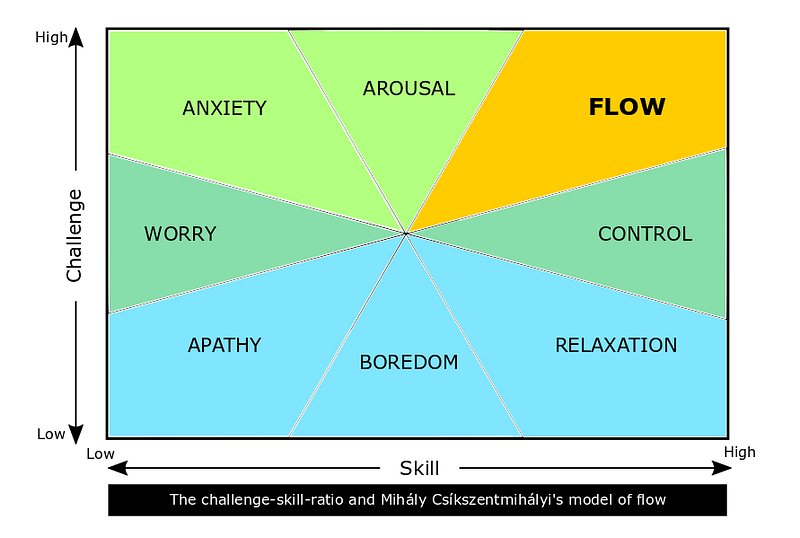
Because improving your skills isn’t something you can do in a minute, you have to adjust the difficulty of the task at hand.
Does it feel too easy and you move towards the area of boredom? Challenge yourself by setting a tight deadline or committing to surpass the given goals.
Does it feel too hard, stress you out, and you feel like you’re not getting anywhere? Lower your expectations, ask someone for help or focus on one part of the task only. Once you’ve won that battle, you can prepare for the next one.
3. Set up a flow script
As I mentioned above, in flow state your brain doesn’t use more of its structures, but less. If you want to make it easier for your brain to shut off anything non-necessary, you can confront it with a pattern it already knows.
This is otherwise known as a flow-script and can be a simple sequence of activities that you perform every time you want to enter a flow state.
Kate Hansen, Olympic luger and youngest-ever world champion, became famous for dancing to get into the zone as part of her pre-race warm-up, which she explains here.
My personal flow script looks the following: I have written out the exact steps I take every time I start writing. Turn on music (I usually listen to binaural beats). Open the document and read through the writing or bullet points I have already. Crack my neck, close my eyes and take a couple of deep breaths. Open my eyes and start typing.
Following this exact same pattern allows me to quickly dive into the zone every time.
When you set up your own flow script, there are a couple of things you should keep in mind:
- Keep it short. Your flow script shouldn’t be much more than five steps. I know that there are athletes out there who have hour-long flow routines. Even if you decide to give that a go, start small. Once you have your basic routine down, you can gradually add more to it.
- Focus on your emotions. Not only going through the steps in a mechanic way but focusing on what you feel makes forgetting everything around you a lot easier. When I turn on music, I not only press play and move on to the next step but rather listen to it for a couple of seconds, paying attention to how the different tones make me feel. The more you practice mindfulness, the easier it will be for you to listen to your emotions.
- Write it down. It can be hard to remember every single step and what you want to be focusing on, especially in the beginning. So take a sheet of paper and write down the exact steps one by one. Next to it, put down what emotions you want to pay attention to. Follow this exact routine every time, like clockwork, and you’ll see that it will become easier and easier for you to enter the zone.
4. Clear goals, clear vision, clear flow
Flow state can be compared to driving with Google Maps or a sat nav. It tells you when to change lanes, when to turn left or right, and when to pay attention because there is a traffic jam. In short, all the thinking is done for you, and all you have to do is drive. If you reach a crossroads and have to discuss where to go with your passengers, your flow will quickly dissolve.
The same is true for flow in the workplace. If you want to maintain flow and keep working, you need clear goals and vision. Without, your mind starts wandering and looking for other things to do. Goodbye flow, hello procrastination.
To avoid this, your goals should be as clear and simple as possible. Even though your overall goal might be to set up the marketing for your new product, this isn’t clear enough. Instead, break this down into smaller goals, like deciding on a marketing channel, creating a landing page, and coming up with a budget. Then, go through them one by one.
When I write, I have one super-simple goal. Write 1500 words. That’s it. I jotted it down onto a sticky note and stuck it to my screen. When I edit one of my articles, I go through five sub-goals in the same order every time: Check grammar, check sentence structure and number of adverbs, adjust the title, add emphasis (like bold text) and finally add images.
Write down your goals, go through them one by one, and you will never break out of flow.
Practice Makes Perfect
“Knowledge is nothing without action. Nothing changes until you do something. What you do will directly determine what you learn.” — James A. Belasco
Flow is a powerful tool. The ability to consistently enter and keep flow states will affect your productivity, creativity, motivation, happiness, and wellbeing like no other.
However, entering a flow state is not as simple as flicking on a light switch, although the above techniques will make it a lot easier for you. But to master this process, you have to not only read about it — you have to practice. Over time, you will find it easier and easier to dive into the zone. And let me tell you, once you get to the point where you can consistently enter a flow state, your life won’t be the same anymore. Use these four flow state triggers the next time you can and watch the magic unfold.
Take action. Without it, your knowledge is worth nothing.
P.S.: If you like my style of writing and don’t want to miss out, feel free to subscribe to my tiny little newsletter. No spam, no weird stuff, no requests to wire money to an offshore bank account. Just a simple notification whenever I publish a new article and a lot of love. Thanks!


