
4 Simple Steps to Create Habits
Without an ounce of motivation

A reader asked me:
Why do I always fail to maintain new habit I took up? How can I keep motivated?
Here comes my answer…
“Motivation is what gets you started. Habit is what keeps you going.” — Jim Rohn
See, you fail, because you have very little idea about what you are doing. Motivation has very little to do with habits. As Jim said, it’s only the starting point. Habit, on the other hand, is something lasting.
I you depend on motivation to build a habit, you are like a swimmer who jumps into the water in hope that the momentum of the jump will carry him on up to the end of the one-mile race; with no additional move of his muscles!
Fickle motivation has very little to do with life in general. Imagine a guy saying: “I married a girl and for the first few days, it went well but then my motivation faded and I gave up.”
You immediately feel there is something wrong with the guy, not his girl. You simply don’t approach a marriage with such a mindset.
You don’t approach habit building with such a mindset.
You need first to educate yourself about habits. Read this answer: How do you build a habit?
It compressed years of my experience in developing habits into 4,000 words. You will know the basics.
Then focus on your mindset.
1. Fix your time perspective.
A few days? Get real! There was a study done that concluded that developing a habit takes from 18 to 254 days. If you are not prepared to stick with your new habit for at least 18 consecutive days, you aren’t talking about habit at all. I don’t know what it is, maybe a fun side activity done in your spare time, but anything shorter than 18 days certainly is not a habit.
The median for developing a habit in that research was 66 days. It means half of the people had an established habit after 66 days. But here is the other side of the coin: half of the participants of the research didn’t have a habit built at 66-day mark yet.
If you want a habit, you should aim for at least 254 days to be on a safe side.

Speaking of certainty, I consider the results of that research not relevant to a general population. The initial setup was in favor of developing habits. The scientists who designed the research simply knew what habit is and how you go about developing it and planned their experiment accordingly.
Most folks have no idea about habit development, as your case aptly proves.
So, if you are serious about habit development, you should aim for keeping the habit for the rest of your life. That’s “safe” when it comes to habit building in my dictionary.
2. Find your “why”.
Let’s say you’ve said you want to flatten your belly. Did it get flat after a few days? Didn’t you want to have a flat belly anymore? What happened?
Your why doesn’t have to be grand. It has to be a constant motivator for you. When I decided to lose weight my “why” was a pain of my back. I injured my spine when jumping into a swimming pool when I was 16 and when I gained some weight it put too much strain on my back. Sometimes the pain was almost paralyzing. I decided that enough is enough and started a few habits that improved the situation.
You see? It wasn’t any grand reason like “I wish to be there when my grandkids arrive to this world and see how they grow up.”
Your reason has not to be grand, but it has to be intimately yours.
3. Focus on consistency, not on the results.
Habits are so desirable, because they provide results in an automated and compounded way. But those results are the effect of consistency. Without consistency there will be no automation nor a compound effect.
If you focus on results, on this flat belly or losing weight, you will probably fail, because…
It TAKES TIME to achieve RESULTS!
It took me five months to lose several pounds of excess weight. It took me 11 months to achieve my weight goal. Since then I’ve been maintaining my dietary and fitness habits to maintain my weight.
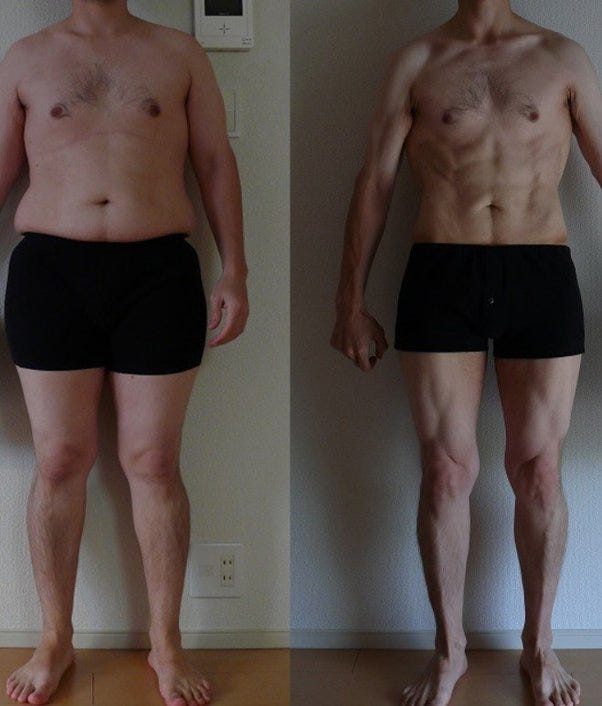
At the beginning you need to focus on consistency. Once your behavior will be automated, the results will automatically come.
Once you fix your mindset, it comes to technical details.
Set stupid small requirements for your habit. Set a reliable trigger for it. Track your habit, in fact, develop a habit of tracking your habit. Build your streak. Don’t break a chain. Focus on doing your habit just one day at a time. And again and again. Rinse and repeat. Analyze your tracking data and adjust your discipline if needed. After some time scale your habit up: from one sit-up to 10, from 10 to 100, from 30 seconds to 5 minutes. Keep tracking and observe if the bigger commitment don’t endanger your consistency. If not, keep doing what you are doing and scale up with time.
Originally published in Quora.com.


