
4 Science-Based Books to Help You Achieve Your Goals This Year
Get everything you need to set your goals, upgrade your mindset, focus on what matters and stay consistent.

As a Mindset & Productivity Coach, my job is to help my clients achieve their goals. Over the last years, I’ve read hundreds of books about goal achievement in an effort to find the best tools and strategies to use in my coaching programs.
I don’t make these recommendations lightly. These are the 4 books I keep reading again and again because their methods are proven and their core message is powerful.
All of them are backed by science and filled with incredible stories from real-life people that have used the information in the books to achieve their goals and transform their lives.
1. ‘Your Best Year Ever’ by Michael Hyatt
“Great results don’t just happen. You don’t usually drift to a destination you would have chosen. Instead, you have to be intentional, force yourself to get clear on what you want and why it’s important, and then pursue a plan of action that accomplishes your objective” — Quote from the Book
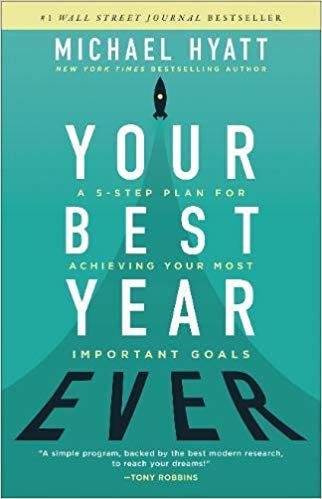
I’ve rarely come across a book that offers a complete framework for achieving goals instead of just covering one aspect like goal setting, confidence, focus or building habits.
In the book, Michael Hyatt shares his simple, proven 5-step program to help you:
- Set goals the right way
- Upgrade your beliefs to match your goals
- Analyze your past to uncover valuable insights for the future
- Master your motivation
- Take consistent action
The process is backed by the latest research about performance and the author’s real-life experience of helping thousands of people apply these steps successfully (the process he shares in the book is the same as the one he teaches in his online program 5 Days to Your Best Year, which over 25,000 students have completed).
Thus, the book is a perfect read to get started on your goal achievement journey. It gives you a great overview of all the steps you need to take to get where you want to be — plus some extra motivation from the stories.
Here are my most important take-aways:
- Progress starts when you get clear on where you are right now. The book starts with determining your Life Score, which forces you to take an honest look at every area of your life. Getting clear on how my entire life is going and how I want it to look like helped me set my goals in a much more intentional and holistic way.
- Goals and habits go together. Most goals can be broken down into daily or weekly habits. For example, if you want to run a marathon, you need to make it a habit to run multiple times a week. Another example: If your goal is to increase sales revenue, you need to make it a habit to call or contact a certain number of clients a day. By attaching habits to your goals, you make them 10x more actionable.
2. Essentialism by Greg McKeown
”Only once you give yourself permission to stop trying to do it all, to stop saying yes to everyone, can you make your highest contribution towards the things that really matter.” — Quote from the Book
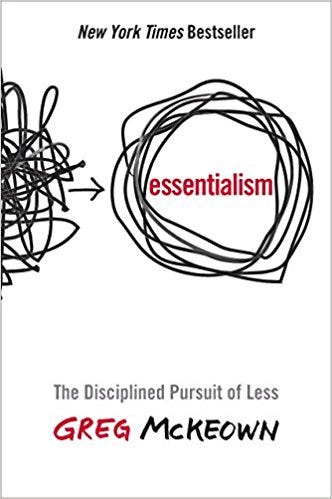
Essentialism is one of the books I have re-read many times. I also have the audiobook version and like to listen to a chapter whenever I feel I am getting off track with my focus. The book always reminds me of one simple thing that has transformed my life:
Focus on what matters most and ignore the rest.
According to Greg McKeown, becoming an Essentialist is the key to lasting happiness, success, and fulfilment:
When we want to achieve a goal but we don’t see the results we want to see, it’s often because we simply don’t prioritize the goal enough and get lost in the sea of 1000 other “important” things. Or, we do manage to focus on the goal, but we are doing 1000 different ways to get there instead of focusing on the single most effective path.
The same thing applies to happiness: When are unhappy in our lives, it’s often because we don’t spend our time in a way that aligns with our deepest values. When we don’t have time to do the things we truly enjoy and spend time with the people that are important to us, our lives become nothing more than a series of tasks that need to get done.
Thus, Essentialism is a transformational read for anyone struggling to find the time to work on their goals, prioritize the right things and say “NO” to the things that don’t matter.
Here are my most important take-aways:
- Do less, but better. We need to stop believing that everything is important and start realizing that only a few things truly matter. We need to stop thinking that we can fit it all in and accept that there are real trade-offs we need to make in our life. We need to stop doing what’s most urgent and start getting the right things done. And finally, we need to stop trying to “keep it all running” and start taking the time to evaluate what is truly important to us and take the necessary action steps to eliminate and streamline everything else.
- We always have a choice. Stop saying “I have to do x” and start saying “I choose to do x”. This simple change in words will help you realize that you are the author of your own life and everything in your life is a result of your choices. Stop letting everyone else prioritize your life and start to take control of how you spend your time and energy. A life-changing tip: Start making ‘no’ your default answer instead of saying ‘yes’ to things. Saying yes to something actually means saying no to everything else that could be more important to you.
3. Rewire Your Brain by John B. Arden, Ph.D.
“Repetition rewires the brain and breeds habits. In other words, the more you do something, the more likely it is that you will do it again in the future. That’s why baseball players go to batting practice, golfers go to driving ranges, and piano players practice for hours on end.” — Quote from the Book
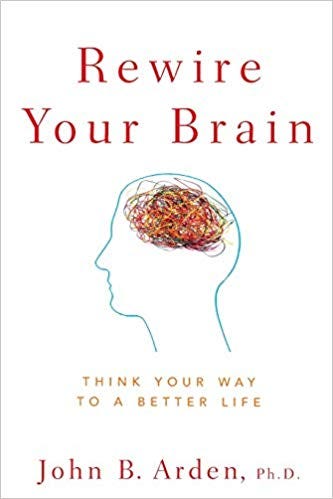
If there is one thing I’ve learned over the last years as a coach it’s that going against the programming in our brain is like walking through mud — it takes a lot of effort and is painfully slow.
Most people don’t realize that when they don’t see the results they want, it is because of mental blocks that hold them back. Your brain is like the operating system of you. It is based on all your previous experiences and conceptions of how things are — who you are and what is possible.
A computer can only do the things that are coded in its operating system. It can’t run software that doesn’t match the operating system. It’s the same with our brain: you can’t do things when your operating system does not match the new reality you want to create.
When I read Rewire Your Brain, I was psyched — finally a complete, science-based guide to changing the programming in your brain so you can achieve anything you want. What makes this book special is that it not only explains the science in a way that normal people can understand but also offers a practical step by step guide for applying what you’ve learned.
In the book, John B. Arden introduces the acronym FEED which stands for the 4 steps you need to take to rewire your brain: Focus, Effort, Effortlessness, and Determination. The process is extremely simple but not easy: at its core. FEED is about repeating a new behaviour until it becomes second nature.
Using the FEED process you can rewire your brain to achieve your goals. Here are some examples:
- Rewire your brain with a new healthy habit like working out daily or choosing a healthier option for breakfast.
- Change an unhelpful default reaction to a trigger in your life: For example, rewire your brain to stop using food as a way to numb your feelings. Another example: Stop going into a negative spiral whenever you are criticized and instead, treat yourself with kindness and use constructive feedback to improve yourself.
- Exchange the self-limiting stories and excuses you are telling yourself for empowering affirmations and self-talk in order to gain the necessary confidence and motivation to take action.
Here are my most important take-aways:
- Neuroplasticity means that our brain is not hard-wired and we can change our programming by creating new connections through repetition. Science has only discovered this concept in the last twenty years — previously we thought that the brain is hardwired and thus pre-determined to function a certain way. There are two major findings of neuroplasticity: “Cells that fire together, wire together” and “Use it or lose it” — this means that the brain is constantly making new connections to build new habits and the more often these connections are used (fired), the stronger the habit gets. But when we no longer do something, the connection starts to weaken and eventually break. This is why rewiring your brain for a better life is all about repeating good patterns.
- You can use the acronym FEED to rewire your brain: 1. Focus on the new behaviour you want to instil which activates your frontal lobes and kickstarts the process of neuroplasticity. 2. Make an Effort to perform the new activity which lights up the part of your brain used to make new synaptic connections. 3. Stay with the new behaviour until it becomes Effortless and feels almost automatic. Because your brain works according to the Law of Conservation of Energy, it makes it easier for you to perform an activity in the future if you have repeated it many times in the past. 4. Stay Determined by doing the activity again and again. If you stay in practice, it will be effortless for you to keep going. But if you stop, the connections in your brain will break and you’ll have to start all over again with building your habit.
4. Willpower Doesn’t Work by Benjamin Hardy
“If we do not create and control our environment, our environment creates and controls us.” — Dr. Marshall Goldsmith
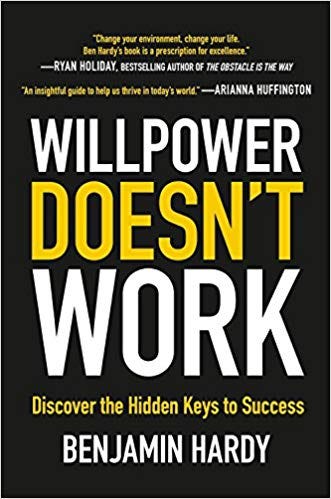
If you want to achieve your goals this year with absolute certainty, good intentions won’t be enough — you need to make your success inevitable. And Benjamin Hardy, PhD’s book will help you do that by teaching you how to optimize your environment in a way that not only supports your goals but makes their achievement an absolute certainty.
Here are my most important take-aways:
- We only have a certain amount of willpower every day. Ever wondered why you manage to eat healthy all day or week and then in the evening and on the weekends you give in to fast food and sweets? That’s because you’ve spent all day/week resisting temptations — the burger on the lunch menu, the doughnuts next to the coffee machine in the office, etc. On top, you are using up your willpower to get yourself to do things like going to the gym, pushing through your workload when you are tired and keeping your emotions in check when you get really triggered by your boss. Thus, when you arrive home or it’s finally the weekend, you just don’t have it in you anymore to stick with your good intentions to eat healthy and order take-out instead or treat yourself for dessert while watching Netflix. Thus, if you want to achieve your goals, you can’t rely on your intention to stay disciplined all day because your willpower tanks will simply be depleted.
- Your environment shapes your behaviour. That’s the core message of the book. Benjamin Hardy explains that because relying on willpower does not work, you need to engineer your environment by removing the triggers for unwanted behaviour and creating new triggers for the behaviours that lead to success. In the book, he shares great examples of how to do that: remove all bad food from your apartment, hang out with people that match your goals and put yourself in situations that force you to rise up to the occasion.
About the Author
Liz Huber is a Mindset & Productivity Coach and the Founder of the Confident Coach Club. Sign-up for her email list to receive a weekly digest of her best content and the free ebook “6 Mental Blocks that Keep You Stuck in Life”.


