
4 Reasons You Should Use Microsoft Excel Or Google Sheets To Keep A List Of Your Stories
There are multiple reasons to do this that will help with decisions on later articles
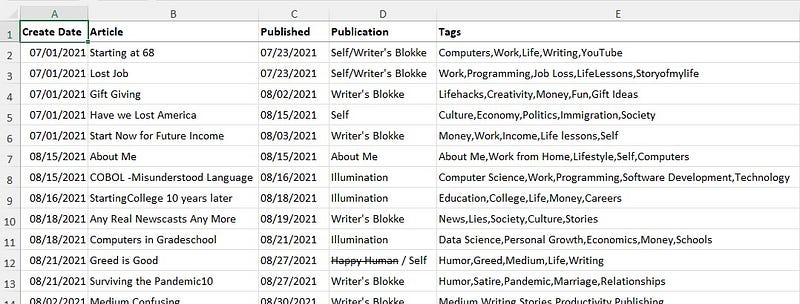
Most of us use or have used a spreadsheet at some point in time. Using a spreadsheet should be a part of your writing routine. Use the sheet to list the articles you wrote and any information that may be important to you.
Reason 1 — Research
If you notice my spreadsheet in the image above, I have a column for the article name. This is not the full title; it is just the keywords that are related to the story. This is for a search task you may want to perform.
I have many more stories than what shows in the excerpt above and I will be adding a lot more. As time goes on and I have an idea for a story, I may ask myself if I have ever written about the subject before. A quick search will answer my question. Even though you found you did write a previous story, maybe an update is due.
Reason 2 — Dates and Publications
When did you create an article? When was it published? I have these columns as that was what I wanted to keep track of. Why? Because as time goes on and I have enough for research purposes, I may add a column to tag my best-performing articles.
What if I find the highest performers were from a certain publication? I would most likely use this information for articles that I think would do well no matter which publication I choose but may do better in a particular one.
Reason 3 — Other writing sites
Do you write articles on other websites, or maybe your own blog? Add a column or two so you can keep track of where you submitted the articles. Have a date column for each website so you know if you used an old article or a new one when you submitted the story to the alternate site.
Add a column for earnings. Again, attach it to each column you have for each website you submit the articles. You do not have to do this for every article as that may be too much to keep track of. Just enter the dollars for your top earnings.
Reason 4 — Tags or keywords
I keep a column that shows the keywords I used for a story. I can then have a reference for tags I have used in similar stories. But maybe the article didn’t do so well and I may want to change a few tags for my next article.
You can also search for particular tags that you used as you gain more experience with SEO (Search Engine Optimization).
Conclusion
Don’t make the spreadsheet too cumbersome to use. Even though we want to make money, you are a writer and you don’t need to be an accountant for this.
The more outside tasks you must do for your writing time makes it less enjoyable to write. So do not go overboard with it. Just start out small and then add to it as you find you would like to keep track of other information about your writing.
Writing is about being creative with content, but there are other considerations when it comes to being successful.
If you would like to read other stories for productivity in writing I have written, click on the link below.


