
4 Lessons I Learned From Writing a Letter to My Future Self Every Year
Why the habit of writing to your future self can reshape your perspective.
June 3rd, 2015 is the date of my discovery of the website FutureMe, and the beginning of another weird habit of mine.
FutureMe is a website that allows you to send an email to your future self on a date of your choice. So, that day on June 3rd, 2015 I sent a letter to myself for June 3rd, 2016. One year later, I did the same. And so the following years.

Before we begin, there are two disclaimers I intend to make:
- I’m not affiliated in any way to FutureMe.
- The following lessons are drawn by my own experiences. Your lifestyle may be different from mine and my considerations may not necessarily be valid for you too.
Let’s begin.
Lesson #1: There Is a Different Person on the Receiving End

It started as a fun experiment, but then it became much more.
I have the habit of journaling daily, but writing to your future self is fundamentally different than journaling.
When you journal, you mostly write for yourself to clarify your thoughts. In some ways, it’s a form of meditation.
When you write a letter to your future self, it’s like you are literally writing to another person. During the next year, two things will happen:
- You will likely forget most of what you’ve written, so it will be like receiving a letter from a different person.
- You will gain a lot of new experiences, perspectives and memories. You will be another person.
That said, it literally feels like writing to another person. A pen pal who takes an insanely long time to answer back.
It’s a bit like time travel. If you could either talk to a copy of your current self or go back in time to talk to your past self, what would you choose? You would probably talk to your past self. You would have a lot more to talk about.
There is a huge plus about writing to your future self rather than to another person: since it’s not you, but it’s still you, you can share your deepest and darkest secrets.
You can literally vent and talk about anything. There are many things I’m uncomfortable to talk about with other people, but I can openly share with my future self.
Reading your own past letters may make you laugh and cry the hardest. You may not believe me now, but it’s surely something that I would like you to experience.
Lesson #2: One Year Passes Much Faster Than It Seems

This may not come as a surprise. But when you will start writing for your future self, you will notice that time passes even faster.
You may actually notice that it accelerates. Each year passes faster than the previous one. The first letter took forever to come. Until last year, I was eager and impatient to receive my letters. This year I totally forgot. When I saw it, it got me. So soon?
There are two aspects to consider about the “time flies” effect:
- First, the psychological one. The acceleration of time is obviously a psychological phenomenon. It happens because, as we get older, we also get “used to life”. We have fewer and fewer new experiences, so time seems to pass faster.
- Second, we think that a year is a long time that we perceive fast, but it’s actually a short time that we perceive slow in the first years of our lives.
In the first years of our lives, we have to process a huge amount of experiences. We perceive time very slowly, and we get used to it. We learn that a year is objectively a long time and never unlearn this.
On the scale of a lifetime, a year is short. You can’t do much. How much do you think you can accomplish in a year? Anything worthwhile takes way longer than that:
- Want to start a new career? Work at least 5–10 years before you start making some serious money.
- Want to raise a child? Wait 18 years before he or she becomes independent.
- Want to launch a successful startup? Wait at least 3 years before it can break-even.
- Want to invest in real estate? Start thinking on a scale of decades.
I could go on, but you shouldn’t be surprised if your life isn’t much different than it was 1 year ago. If you want to see noticeable differences, wait at least 5 years.
Of course, there are the so-called quantum leaps, events that completely transform your life. But they are uncommon. You may have one, two, maybe three quantum leaps in your life, but not many more. Surely you can’t expect them every year.
We overestimate what we can do in a year, although we usually underestimate what we can do in a lifetime. Writing to my future selves gives me a sense of urgency, and helps me put things in perspective.
Lesson #3: We Overestimate Plans and Events, We Underestimate Trends

So, what do I write in these letters? There are three main sections:
- One for anything I want.
- One for predictions for the next year.
- One for comments on the predictions of the previous year.
What I’m noticing every year is that I make many mistakes in my predictions. I only get a few of them correctly.
The weirdest thing is that I have no bias towards optimism or pessimism. I made both optimistic and pessimistic predictions, where the optimistic ones turned out worse and the pessimistic ones turned out better.
Some optimistic predictions:
- Plans for my personal projects. When I predict to complete a project within a year, I often end up quitting. If I don’t quit, I usually procrastinate so much that it’s still undone after a year.
- Plans for my study and career. Turns out, I’m too optimistic about my study and career. When I was a university student, I slightly overestimated how fast could I finish my exams. In more recent years, I always thought that my career would advance faster in a year than in reality. Last year, I wasn’t really convinced that my startup would eventually fail.
Some pessimistic predictions:
- That my social life wouldn’t improve. I thought that university was the apex of social life, and when you graduate, you don’t have many chances to meet new people. Luckily, I still do every year. And I am an introvert.
- That I wouldn’t improve my habits and wouldn’t learn to leave my comfort zone. Every year I get a bit better at leaving my comfort zone. Every year I add new good habits to my life. My proudest achievement related to habit building is the implementation, during the current pandemic, of a consistent morning routine of working out, meditating and journaling.
Some correct predictions:
- That I would be single. I’m not giving too much weight to relationships in this stage of my life. I’m obsessed with my work and success. I acknowledge it’s a bit unhealthy, but hopefully I will change that at some point.
- That I wouldn’t be fulfilled. Don’t get me wrong, I’m not depressed or something. I like my life. But I know that I could get more from it. And I’m still far from reaching a work-life equilibrium (see previous point).
While I have no bias towards optimism or pessimism, you can notice other types of biases and trends in my predictions. You are likely to have similar biases in your own predictions.
First, I tend to be too optimistic about my long-term plans. Come on, we all know that plans never work. I’m now so convinced about this, that I recently went almost completely plan-free.
I don’t make plans anymore. I take directions, but I don’t have real objectives. You may think that this approach makes no sense for a person willing to sacrifice relationships for career and success, but it does. I will probably make another story to convince you otherwise (but I don’t… plan about it).
Second, I tend to be too pessimistic about my ability to improve my everyday life. We may be biased to think that, in a certain period of time, improvements come from events, not from trends. In reality, it’s usually just the opposite.
This is why I’m focusing much more on my habits rather than my goals. Take, for example, the fact that I’m writing on Medium. I hope I will be successful on Medium one day. But I’m not making plans about how many followers to get, or how much to earn in a given period. I just write. I write the best I can think about, then see what happens.
Lesson #4: There Is Always a Black Swan
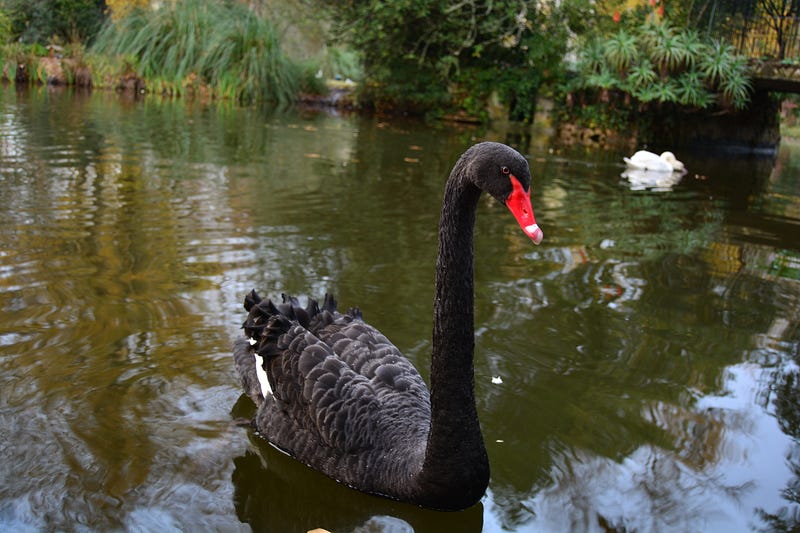
Every year I get a bit better in my predictions. I try to be more pessimistic about my plans and more optimistic about my trends.
But no matter how unbiased I try to be, there is always, and always will be, one major thing that will be completely unpredictable.
- This year, it was the pandemic.
- Last year, it was my first startup (I was like, fuck it, let’s see what happens if I do it for real this time).
- The previous year, a friend of mine tried to kill himself.
Each one of these events shaped my life in its own way.
Broadly speaking, there are two types of unpredictable events:
- Those you can’t predict because you don’t have enough information. For example, I can’t really predict whether I will be making more money next year, whether I will still be on Medium, or whether I will have a girlfriend. So I consider any scenario with a given likelihood.
- Those you can’t predict because you don’t even think about them. For example, I won’t even consider the possibility that, in a year, I will be a successful actor, become a drug addict, be murdered, witness an alien invasion, or have sex with Lana Rhoades.
These last events are called Black Swans. Black Swans, like those I listed before, happen relatively often, even once a year. I would have never predicted to be quarantined, to launch a startup or to talk my friend out of suicide.
This point may seem contradictory to lesson #2, in which I argued that there isn’t too much that changes in a year. Black Swans are different from quantum leaps, and have to be put into context:
- Black Swans’ effects can be indirect and distributed over time. For example, the fact that I launched a startup and failed didn’t change my life overall, but it taught me lessons that I will apply many times in the future.
- Black Swans’ effects are usually more negative than positive. It means that they actually slow things down instead of making them faster. This may sound depressing. But it’s true, these events fuck up your plans. Without Black Swans, you could actually finish a project in a year. One of the main reasons why plans fail is because there are things you can’t predict. Very often, they are negative.
So, if Black Swans are unpredictable and mostly negative, what can we do? Writing to my future selves taught me that there is at least one major Black Swan each year, so I have to be prepared. I have to be prepared for anything. I can’t list all the possible Black Swans, but I have to know that something will happen, something will try to screw me up, so I must give myself some margin to handle these things.
By margin, I mean money, time and mental strength for hard times. Time so I can talk with my depressed friend. Money so I can work on my startup. Mental strength so I can handle my lockdown well. You can’t predict what will happen, but you can predict what you will need to handle it.
Writing to my future self every year taught me a lot. Most of all, it changed my perspective and made me more conscious of what I can actually achieve in a given amount of time.
I suggest you give it a try. It only takes one hour or less every year.