
4 Lessons I Learned From Kobe Bryant
We All Need a Life-Guide
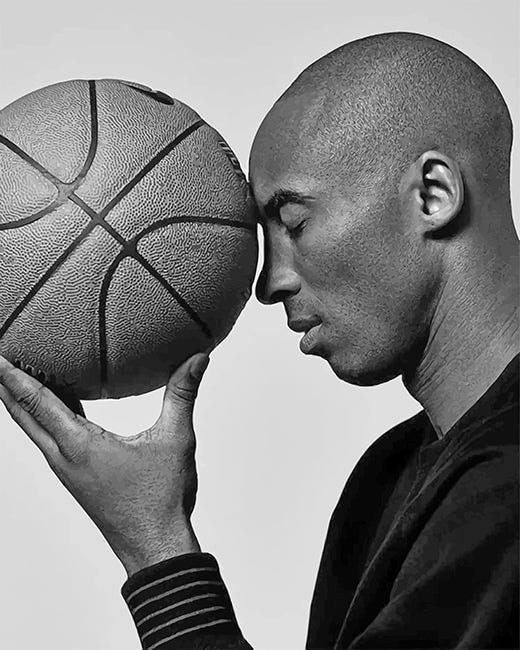
I love Kobe Bryant more than some of my family members.
I know that sounds ludicrous but hear me out.
If it weren’t for the Lakers and Kobe, I probably wouldn’t have a bond or relationship with my grandpa or dad.
Both men are amazing humans but lack social skills (as I did for most of my life). The Lakers were and are conversational crutches.
I text my grandpa often about the Lakers to this day. When I was in elementary school, my step-aunt was graduating high school. My grandpa and I went to her graduation with walkman radios on our heads (basically portable radios for the youngsters who don’t know) and looked ridiculous in the stands.
I was at his house a month ago, and we talked basketball for hours. The rest of my family left his house after dinner, but I stayed and talked with him until almost 10pm — way past his bedtime.
I lived with my dad and stepmom from eighth grade through high school. My stepmom would grudgingly watch every Laker game with my dad and me.
We watched Kobe’s historic eighty-one-point game, the Lakers game seven victory over their rivals — the Boston Celtics, and every game in between.
My dad and I would send the house in an uproar during and after the Lakers games. We’re usually very calm, introverted people. But our demeanors do a 180 when we’d watch the Lakers. Yelling, screaming, arguing, and complaining were normalities from 7pm — 10:30pm.
My stepmom passed a week and a half ago. Upon reflection, I realized my fondest memories of my stepmom and dad are of us watching Laker games together. My stepmom texted me after Kobe’s last game: “Just watched the game. Thinking of you.”
4 Lessons I Learned From Kobe Bryant
“The most important thing is to try and inspire people to be great at whatever they want to do.” — Kobe Bryant
But Kobe did more for me than strengthen my bond between my family and me.
Kobe Bryant was my idol. And we all need a role model, a guru, a life-guide to show us the way.
Every main character in a movie has a guide. Luke Skywalker had Yoda, Batman had Alfred, Robin had Batman, and I had Kobe.
A role model is supposed to be someone you “model” or copy to achieve the same or similar results. What you learn or emulate in your model are thoughts, perspectives, and behaviors. So here are 4 lessons I learned from my model, my guide — Kobe Bryant:
1. Work Ethic
“I have nothing in common with lazy people who blame others for their lack of success. Great things come from hard work. No excuses.” — Kobe Bryant
Blake Griffin — NBA All-Star — tells a story about his first practice on Team USA in 2012. He recalls Kobe appearing slower and less quick and mobile.
He thought to himself (because he would never say this out loud to Kobe or his teammates), “he’s finally slowing down. Maybe this is the end for Kobe.”
After practice, Griffin was conversing with his teammates when he learned the reason for Kobe’s performance that day at practice: The night before, Kobe went on a 40-mile bike ride from 11 pm — 2am. Woke up at 5am and worked out alone until 7am. Went to the team practice at 8am.
Dwayne Wade — 3x NBA Champion and soon-to-be basketball hall of famer — tells a similar story of the 2008 Olympic team.
Wade said when he and the rest of the team woke up at 8am for team breakfast, Kobe’s knees were wrapped in ice. He did his personal workout before breakfast while the team was sleeping. He also did an individual workout after the team practice.
My favorite story comes from Jay Williams — an ex-college basketball star at Duke and ESPN analyst.
In 2004, Williams was a rookie and felt like he needed to prove himself to his teammates and peers, so he’d show up to the arena hours before anyone else and get some shots up before the game.
When he arrived at Staples Center and walked towards the court, he heard the bouncing of the ball. He thought, “that’s weird. It’s four hours before game time.”
When he walked through the hallway, and the court appeared, he saw a Kobe Bryant drenched in sweat.
While going through his workout, Williams would occasionally look over at Kobe to study his drills. But the entire time, Williams was wondering: “when will this guy get off the court?”
After two hours of drills, Williams walks off the court. Kobe continued to workout.
After the game, Williams asked Kobe why he worked out for as long as he did. Kobe’s response:
“I wanted you to know that no matter how hard you work, I’m willing to work harder.”
Basketball was my life in high school. It was my escape from socializing (because I had social anxiety). It was the only way I happened to make friends. It was my release from the pressures of being a teenager. The court was my first home.
I played basketball every day in high school because I wanted a college scholarship. There would be days I didn’t feel like playing or working on my skills. But there’s no way I couldn’t when I watched Kobe.
He was my fuel, my coffee in the morning. The stories of his work ethic and then watching his dedication translate into the best player on the court grabbed my laziness from my soul and dunked it into the trash.
I didn’t accomplish my goal of becoming a college basketball player. But the work ethic was a trait that transferred into other areas of my life.
To overcome social anxiety, I spent days and nights reading books and watching videos about social skills, dating, and relationships. Despite my knee-shaking fear, I’d talk to any and everyone I could when I worked at Starbucks and while I was at school or the gym.
To finish school and live on my own, I had to work and go to school full-time. I didn’t have a day off. I’d wake at 5:30am and work until 3pm. Then have school from 6pm to 10pm.
I write every day to become a full-time writer. There are moments I doubt and question my aspiration, ability, and discipline. It’s in these moments when my uncertainty and laziness are at its max, I ask myself one question:
“What would Kobe do?”
2. Perseverance
“I’m here. I’m not going anywhere. No matter what the injury — unless it’s completely debilitating — I’m going to be the same player I’ve always been. I’ll figure it out. I’ll make some tweaks, some changes, but I’m still coming.” — Kobe Bryant
He did suffer an injury that ended most players’ careers. But Kobe came back and shocked the world when his averages were unaffected.
Kobe was having one of his best seasons during 2012–2013. He was averaging more points at thirty-four years old than he was at twenty-five.
During the last game of the season, Kobe tore his Achilles — the worst injury a basketball player could suffer.
After only seven months of rehab (most players need at least an entire year or more) and, at the age of thirty-five, Kobe returned to the court, averaged twenty-four points a game, and guarded the best players on the other team.
But Kobe’s lowest stint throughout his career began in 2003. Kobe was arrest for sexual assault.
My world felt like it was crumbling and shriveling, not because I feared he’d go to jail, but because I knew, even at a very young age (eleven), that the media and fans were going to destroy his name.
Miraculously, his legal issues didn’t affect his performance, even on the days he had to go to a court in Colorado and then play in Los Angeles or another arena in the United States.
He ironically made a game-winning shot against the Denver Nuggets after going to court. But his best and most heroic performance came in 2004.
Kobe woke up at 4am to be in Colorado at 11am. He was in court until 2:30pm. Hopped on a flight and arrived at Staples Center at 5:30pm. The game started at 7pm.
Exhausted and emotionally drained, Kobe had one of his best performances against a team that was supposed to beat the Lakers that year — the San Antonio Spurs.
Kobe led the Lakers on a comeback victory scoring forty-two points. That performance, because of context and circumstances, is considered one of Kobe’s best games.
But the most challenging pain to triumph was Kobe’s “breakup” with teammate — Shaquille Oneal.
The pair won three championships in a row from 2000–2003. This accomplishment still hasn’t been achieved by teams with more talent than a Shaq and Kobe-led team.
But the pair never got along on and off the court. The Lakers traded Shaq to the Miami Heat during the summer of 2004. Shaq blamed his departure on Kobe. And the media followed suit.
Kobe was considered a “ball hog,” selfish, and overrated for five years.
Five years!
Five years of media abuse, fan heckling, and public reticule.
Public opinion prevented Kobe from winning awards that he should’ve won. Kobe should’ve won Most Valuable Player (MVP) in 2006 and 2007. But media and sports writers vote on the award, and we all know how that goes.
But Kobe always used hate as fuel.
Public opinion of Kobe altered in 2009 after Kobe won his first title without Shaq. Kobe won the title again the following season in 2010.
During a press conference after winning the 2010 title, Kobe was asked “what’s the significance of winning this title?”
Kobe responded with a smirk,
“I have one more (championship) than Shaq.”
Overcoming social anxiety and improving my social skills was the most challenging journey I’ve ever embarked on.
Unlike Kobe, I didn’t have any external turmoil; my turbulence and criticalness were all internal. And my self-criticism forced me to fear and avoid dating and socializing.
I knew I had to make a change when I realized it wasn’t normal not to have kissed a girl in high school, and when my limitlessness, anxiety, and depression peaked during my freshman year of college.
Intuitively I knew what I need to do to overcome my fears. I couldn’t out-think them. I couldn’t use a tip, trick, or tactic to overcome them. I had to tackle them head-on like Kobe.
I still remember the first time I approached a stranger.
A girl in my geology lab class kept staring at me, which I interpreted as flirting or interest. As she was leaving when class ended, I chased after her and told her she was pretty. My whole body was shaking as if I was the only person in the world experiencing an earthquake.
We ended up dating for a bit, but nothing serious came from it. But silencing my inner critic after a lifetime of abuse and approaching her was my 2010 championship moment.
3. How To Handle Fear
Kobe has made the most game-winning shots in NBA history.
When asked how he handles the fear and pressure of late-game scenarios, he answered:
“Everything negative — pressure, challenges — is all an opportunity for me to rise.”
It’s a biological drive to avoid fear. Interestingly, Kobe ran towards, not away from it.
His perspective on fear made him feel excited about high-stake pressure moments — the same moments many players would shy away from and cause them to underperform.
I wake up every morning fearing my laptop. I fear leaving my writing vulnerable to the world. I fear gaining readers and the pressure to deliver high-quality content. I fear, if I fail, I may not know my next path.
But Kobe’s outlook on fear has influenced mine. Fear is an opportunity for growth, an opportunity to see where we are along our journey and course-correct if needed.
Fear manifests as doubt, anger, and procrastination. The better I handle fear, the more confident I feel as a writer, teacher, and human.
4. Respect as Artistic Oxygen
“I watched every single game, every move. He made me a student of the game.” — Demar Derozan on Kobe Bryant
Kobe wanted respect. Not respect as a human, but respect as a basketball player.
He wanted to be known as the best player ever. Kobe didn’t want to be Michael Jordan — who many consider the best player of all time. He wanted to be viewed as better, hence why he wore number 24 — one above Jordan’s 23.
“I don’t want to be the next Michael Jordan, I only want to be Kobe Bryant.”
Fame, money, women, and love for the game were never his motivations to workout three times a day, to sleep only three to four hours a night. He wanted, specifically, his peers — other players — to view him as the greatest of all time.
“It’s the one thing you can control. You are responsible for how people remember you — or don’t. So don’t take it lightly.”
On the surface, Kobe’s intent may appear egoic or self-centered. But Kobe was an artist. And acknowledgment and praise is oxygen for the artist.
Michael Jackson wanted to be the best performer. He’d practice his dance moves for many hours a day. He’d repeat particular moves and routines for weeks and months to perfect them.
Eminem is the best hip-hop artist of all time and won Billboard’s Best Artist of the Decade (2000–2010). His motivation has always been for other rappers to view him as the best lyricist of all time.
My inspiration is identical to Michael Jackson, Eminem, and Kobe: I want to be one of the best writers ever.
My metric isn’t sales or fans because a marketer can achieve high book sales and followers. I write for the comments, the praise, the acknowledgment of the words, sentences, and paragraphs. I write for the highlights, the underlines, the moments where a reader stops and feels the impact of the prose. I write to trigger awareness, move energy, and make others feel.
I wouldn’t say my writing is “artistic” — poetic, visual, or graceful. But neither was Kobe’s art.
And as you’ve learned through watching him or reading this article, art and impact wear many masks.
Skill trumps talent any day. The greats are such because they mastered their craft. To be known as a great, a legend, we have to play basketball, dance, sing, or write for purposes beyond a hobby or escape.
Respect for our “art” must be the bullseye we aim our darts at. Praise and acknowledgment from the greats before us and in the making, must be the artists’ fuel for mastery.
Kill Your Darlings
“A pedestal is as much a prison as any small, confined space.” — Gloria Steinem
No human is perfect — Kobe included.
This fact is difficult to accept, for you’ve seen the impact he’s had on my life. But there’s danger in putting a noun — person, place, or object — on a pedestal.
You leave yourself vulnerable to disappointment, defensiveness, and inauthentic thoughts and beliefs.
I used to be friends with Cole and Dylan Sprouse from the Disney show The Suite Life of Zach and Cody, and the movie starring Adam Sandler — Big Daddy.
Their status got them invited to many Laker games and the opportunity to talk with members close to the team. One associate told the Sprouse twins Jerry Buss loved Kobe but believed him to be selfish and challenging to manage. The source (associate) isn’t wholly pure or as solid as if those statements were made to the Sprouse by Buss himself.
But the news left me depressed.
“Are the rumors correct? Is Kobe as selfish and self-centered as they make him be?”
Kobe’s in the GOAT (Greatest Of All Time) conversation. But not as frequently as I’d like.
I’ve gotten into heated arguments with friends, family, and coworkers about Kobes status among the greats. I believe him to be the best, and you better hope like hell you believe the same otherwise I’ll become a fire-spitting dragon.
I once had a three-hour debate with two of my roommates — one being my best friend. Debates are healthy if you’re able to leave it and move on. But I can’t do that when defending Kobe.
After the conversation, I angrily went into my room and searched stats for another hour or two to prove my point. I didn’t reignite the conversation with my roommates, but I rehearsed the second debate in my head for the rest of the night, sleeping very little.
Upon further reading about leadership, I realized Kobe’s leadership style wasn’t as effective as it could be. If I were to follow in his footsteps as a leader, I’d probably be disliked and alone as he was.
No human is perfect, so we shouldn’t strive to be their clone. But we can extract lessons from the greats to become one ourselves.
So I’m Bryce Godfrey with Kobe sprinkled on my heart.
The Inside & Out email list will help you achieve your internal and external goals.