
4 Lessons From RevenueCat’s 2024 State Of Subscription Apps
In 2023 RevenueCat published a state of the apps report. And I briefly skimmed it but didn’t see much value in it. Although I did write an article titled Why The Subscription Economy Is The Best Thing To Ever Happen To Software which heavily relies on it. It debunks some misconceptions that people may have about the subscription economy such as:
the myth of the stupid consumer. This is the myth that consumers are fundamentally stupid so if you put a subscription in front of them they’re too stupid to know that this subscription will keep on charging them. And over time they will subscribe to more and more things and pay ridiculously large amounts of money each month.
Look, I wish this were true, it would make my life so much easier. But it’s not. Consumers are pretty smart. Consumers know that if they subscribe they are going to be charged over and over again. And because of this the conversion rates for subscriptions are very low. How low? Under 2% according to RevenueCat’s 2023 report.
Other than that though I didn’t look too much into the report. But this year the RevenueCat report is a lot longer and more detailed. And there are some really interesting tidbits in it.
1. Android Users Are Cheap
So I always heard that this was the case but I didn’t have any strong evidence. Well in RevenueCat’s 2024 report they clearly show the difference between 14 and 60-day life time value (LTV) (a bit of an oxymoron, but whatever) for apps on Google Play and apps on the App Store.
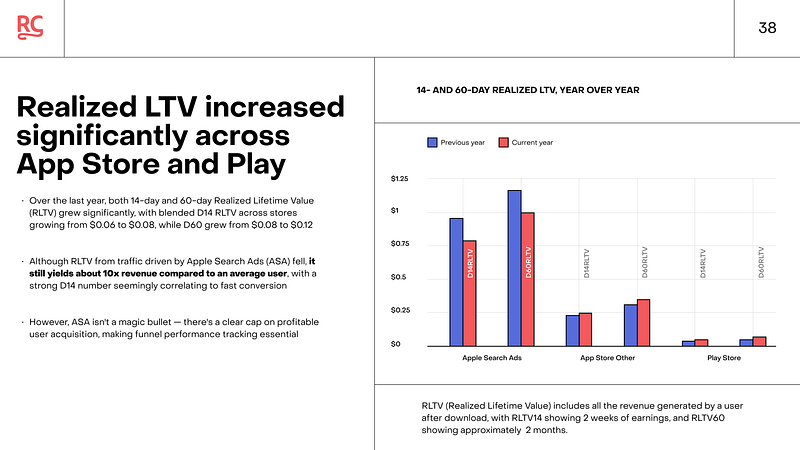
And in it you can clearly see Google Play pays almost nothing. Just eyeballing it, it seems like the App Store pays 4x more.
A bit of a shame. I like some things Google is doing like the adaptive colours and non-linear font scaling. Oh well. If there is a silver lining to all this Google’s search algorithm is impossible to game because they’re Google. I wrote about this in a piece titled Google Is Not Getting Worse, People Are Just Getting Lazier:
Google is a trillion dollar company. How much money do you think they spend on improving search, one of their core businesses? A lot of money. And Google has spent a lot of time finding all these black hat techniques to game their search results. So much so that one of the common questions people have about SEO techniques is, “Will Google realize what I’m doing and penalize me.” And guess what? Most of the time the answer is ‘yes’. Google is really really smart.
And it appears they’re using a similar algorithm in the Play Store.
Apple on the other hand is not so smart. So you don’t have to fear an Apple search engine coming any time soon. They only index three things: your title, your subtitle, and your tags. Your description is not indexed which means if you talk about a feature there no one is going to be able to search for it unless it’s in the other three. Talk about lazy.
Also interesting, and maybe even more noteworthy, is that overall LTV is increasing which is interesting. Especially as it seems like conversions and retentions are down across the board. It’s possibly due to the price of subscriptions (like everything in the economy) going up.
Except for Apple Search ads. Apparently Apple search ads conversions gave over a $1 LTV last year. Wow, I should have used Apple Search ads. But it looks like the quality of traffic you get from them is going down. It’s still pretty high though. Maybe I should get into Apple Search ads.
2. Retention Is Down And Monthly Plans Are In
Another chart shown (which is actually a bit worrying) is this one showing that retention is down across the board.
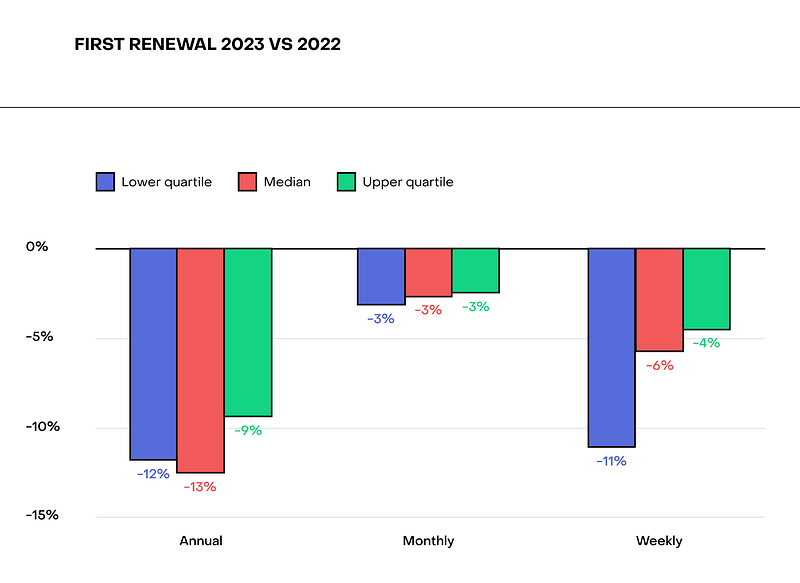
And by quite a lot, 3–13%. However it looks like monthly plans took the smallest hit. This is not to say that monthly plans are the best plan for making money. Two years ago an annual subscriber was more than twice as likely to still be around compared to a monthly subscriber at the end of the year and it looks like this is still the case.
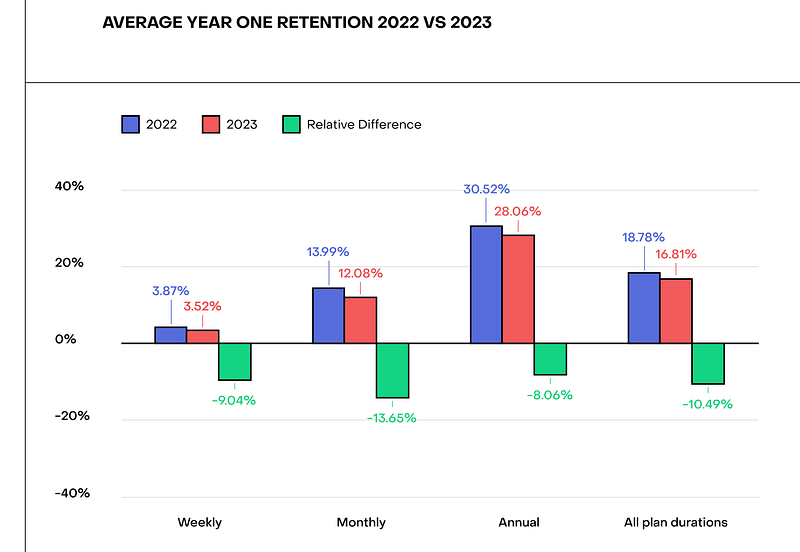
However it looks like monthly plans took a slightly smaller hit. Yes, in percentage terms it’s larger, but this is a percentage of a percentage which is just meaningless. In actual terms monthly plan retention after one year went down by 1.81% while in annual plans it’s down 2.46%.
I’ve been growing increasingly skeptical of annual plans lately. These aren’t random people choosing annual plans, these are people who are already confident in the app. So it should be no surprise that the number of people that opt for annual plans is incredibly low. And I’m starting to think the high price of an annual plan is scaring people off. I’ve been thinking about simply not having an annual plan option and these RevenueCat numbers reinforce my suspicions. Although the only way to know for sure is to do an AB test.
Also interesting is that many monthly users that cancel end up coming back.
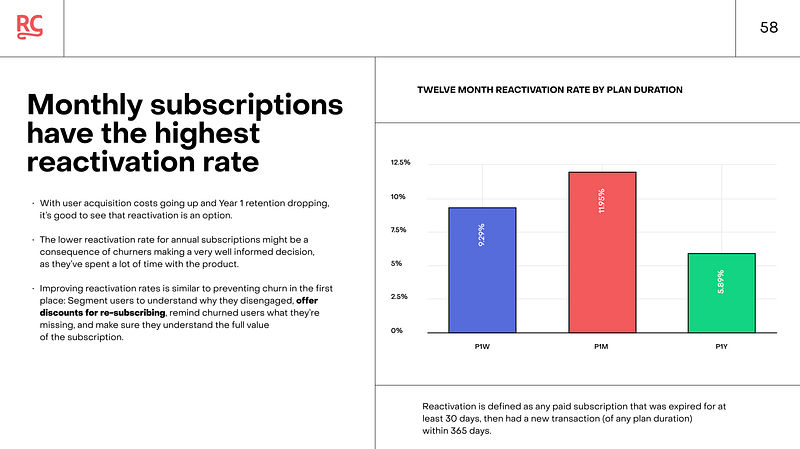
And it looks like monthly plans have the highest reactivation. Interesting. Seems like monthly plans are going to be big in 2024.
3. Most Apps Will Only Make $50 In Monthly Revenue
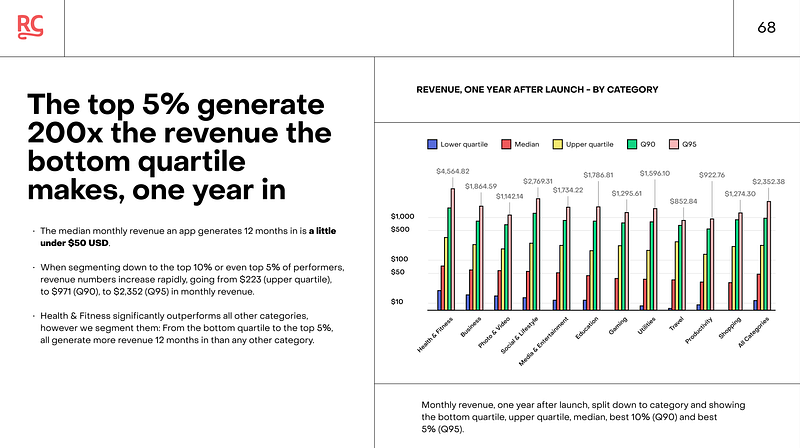
The median monthly revenue an app generates 12 months in is a little under $50 USD. (Emphasis, unfortunately, not mine)
This statistic… it hurts a little because that’s roughly what my apps have been doing. If anything they’ve been underperforming a little.
However it just takes time for the algorithm to pick up your app. My language learning app Litany (iOS, Android) made like nothing its first year but has been gradually been increasing. Likewise Stratum (iOS, Android) has also made very little but is also slowly increasing. And I have a good feeling about Stratum. I’ve recently tweaked the App Store keywords and added a new onboarding screen.
But it is reassuring that apparently once you do make 1K in monthly revenue it gets easier. I’m guessing because the money you make grows exponentially, not linearly. This seems to be what is happening with Litany at least. The amount of users and revenue I get from it is going up exponentially. Very slowly, but exponentially.
4. Maybe I Should Do A Trial Again
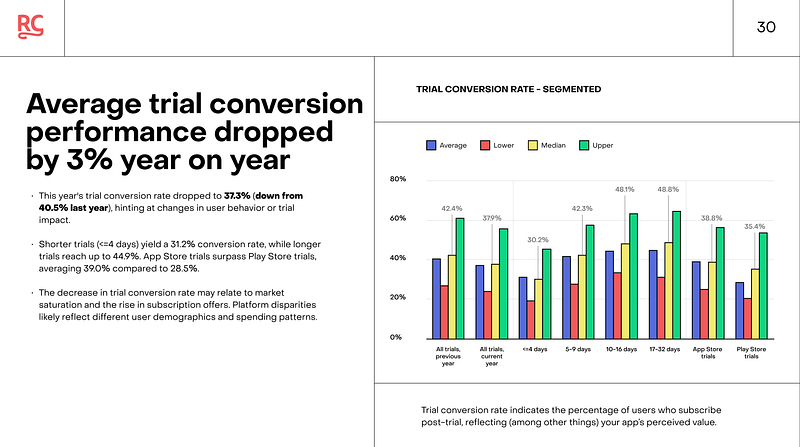
There’s also this slide which shows an astounding 48.8% of people convert to a paying account after a trial.
I actually originally had a traditional trial but I disabled it because I realized that people would sign up for the trial and then immediately cancel.
Now I do what I saw in Readwise Reader which is you do a ‘trial’ but it’s not done through the App Store. You just code it to give the user all the features for the first few days of using the app.
Also that trial is only 7 days. It looks like if I increase it to 14 or 30 days it might increase retention.
However it looks like trial conversions have dropped slightly in 2023. A bit of a theme in this report.
Also there’s this quote:
“Short trials are the equivalent of a speed date”
Reflect for a moment on your product. How long is your trial? Do you have one?
It’s impressive to admire the audacity and the boldness of a month-long trial. Offering a trial for an entire month? That’s a company staking everything on their product’s allure. Thirty days give users ample time to discover kinks or grow disenchanted, but Media & Entertainment are confident. They know the content (and entertainment) they’re providing are sticky enough to hold you.
Compare this to gaming apps, who adopt a ‘love at first play’ ethos. Their trials are the equivalent of a speed date: brief yet intense, betting on that initial rush of gaming adrenaline to get users to swipe right on a subscription. It’s a fast-paced courtship that relies on the allure of instant gratification — get in, get hooked, get the full version, all before the novelty wears off. Where does your product lean?
You know what? I am very confident with my app’s quality. Maybe I should offer a longer trial.
So I was originally negative on this report. It seems like everything is down. Conversions are down. Retention is down. And it highlights how the top 5% of apps generate 200× more revenue. Way to rub salt in the wound.
But it’s also a little inspiring. It highlights ways to improve. One thing I should also mention is this headline statistic:
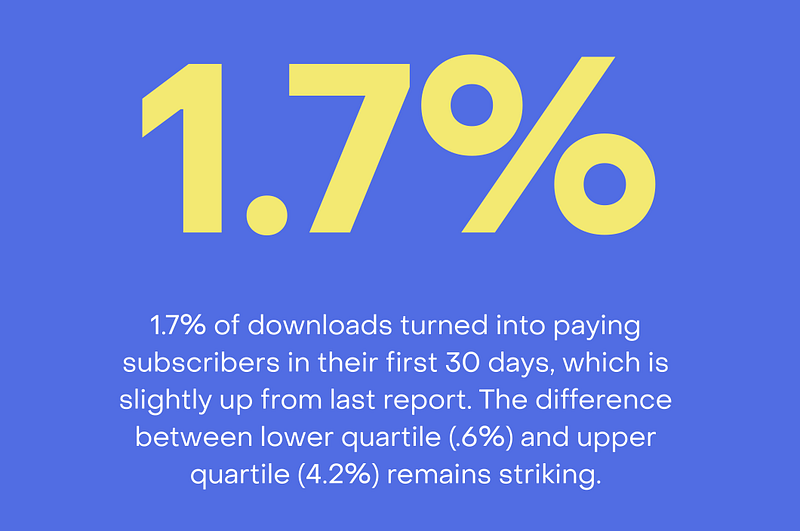
1.7% conversion. But that’s not the whole picture. The lower quarter’s conversion rate is only 0.6% while the highest is 4.7%. So if you have an average conversion of 1.7% you can over 2.5× it. That is huge. And what if you have a below average conversion rate? You can over 7.5× it.
And this report shows you how. This report shows you there are levers you can pull to try to tweak the conversion and retention rates. And that is inspiring.
If you liked this post and would like to stay updated with my future articles consider using my RSS app Stratum on iOS and Android. Also check out my language learning app Litany (iOS, Android).