
4 “Can(s)” in an ideal learning environment — experience at NUS
How lucky I was that I have got a chance to study at National University of Singapore (NUS) for one semester. I was nominated by my university (University of Social Sciences and Humanities — Vietnam National University) and accepted as well as sponsored tuition fee by NUS through ASEAN Credit Transfer system (AUN-ACTs).
Learnt in two different environments from two countries, I realized many factors which NUS has to become the best university in Asia (according to Time higher education ranking 2016 and QS ranking 2016) and also which Vietnamese universities are lack of. There are four elements to form an ideal learning environment, to me: Facilitating self-learning, being able to approach research materials worldwide, diversifying learning methods, and offering favorable facilities (here I am going to introduce a model of learning environment).
You can learn yourself everywhere
It is not easy to find a learning environment suiting your demand in term of the noise, light, heights of table and chair, etc. But NUS offers a wide range of self-learning areas anywhere in school. All corridors are designed with many wood tables and chairs as well as charging stations for students. Even many public laptops are accessible in some particular places for students to study or work as fast as possible.
Besides, the university also has a system of self-learning and teamwork room equipped with public computers, or Macbooks and printing systems. Collaborative rooms are divided into many spots for different groups working with touch screens or white boards. Moreover, strong wifi system of NUS is open 24/7 in every corner and accessible by student’s ID.
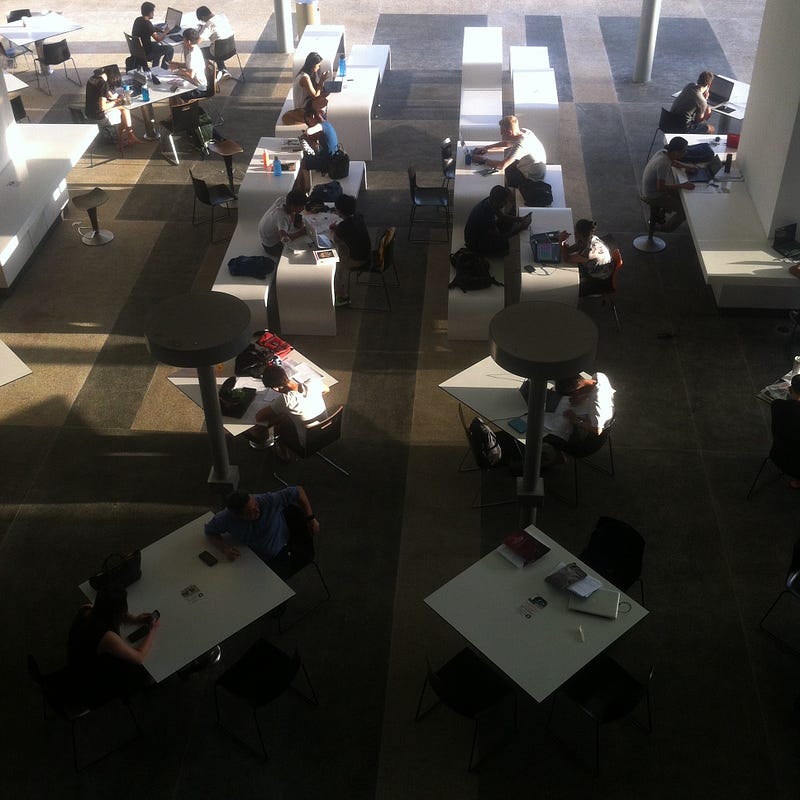
Meanwhile in Vietnam, school is lack of learning rooms, even study spots; its wifi system does not work properly when cafe shop is expensive and noisy.
I believe an ideal learning environment should facilitate and improve self-learning ability in every individuals. You can learn from lecturer, from friends but self-learning is one of the most effective methods in absorbing knowledge which suits your own demand. Only you know what you are lacking of, what insights you need for work, for future career, then improve it.
You can approach international research materials
What is differences between vocational training school and university? One of the most basic differences is research. Both vocational training school students and graduates are able to work in the same company. But graduates are expected to contribute more by research work. You not only work to continue operating world’s industry but also research in order to realize, examine and solve tons of macro problems that the world are facing.
When I was learning module called “Scientific Research” in Vietnam, I was in trouble to find documents or materials supporting my topic. Those materials are served only for school members or registered schools because of copyrights. Therefore, we just only found a little related Vietnamese research work, which is also limited, and could not reach international standard research. We are not sure about the research’s history, theory, and method although yes, we have learnt in lecture but there is no certainty that the lecture was 100% true. If we do not have the base, how can we conduct a real proper research? It also leads to consequences that students’ unfamiliarity with research and a low number of students’ research work.

In contrast, with a NUS ID student, I could access over 90% those materials since NUS is a registered member. Honestly, this is not a problem to large universities worldwide who open their awareness to research’s importance and neccessary. Well-known international ranking systems always include numbers of research work as well as numbers of their citations in judgement factors. That is why NUS are on top of Asia’s university ranking in three consecutive years (2014–2016).
But in Vietnam, somehow, they do not have abitility to provide student that vital chance despite of their recent awareness by trying to become a “research” university in 2020.
You can learn various learning methods
There are two ways of learning that new to me in NUS: Lecture — Tutorial and E-learning.
Lecture — Tutorial is not new in Singapore. A module is divided into two classes: lecture, as usual, where students study in a hall and lecturers teach; another is Tutorial, where a large class is divided into many parts and led by a tutor. If students get an overview of lesson in lecture, then in tutorial, they can peek some main points as well as get acquainted with examination forms by presentation, teamwork, etc. This kind of combination helps student not only deepen their knowledge but also improve soft skills.
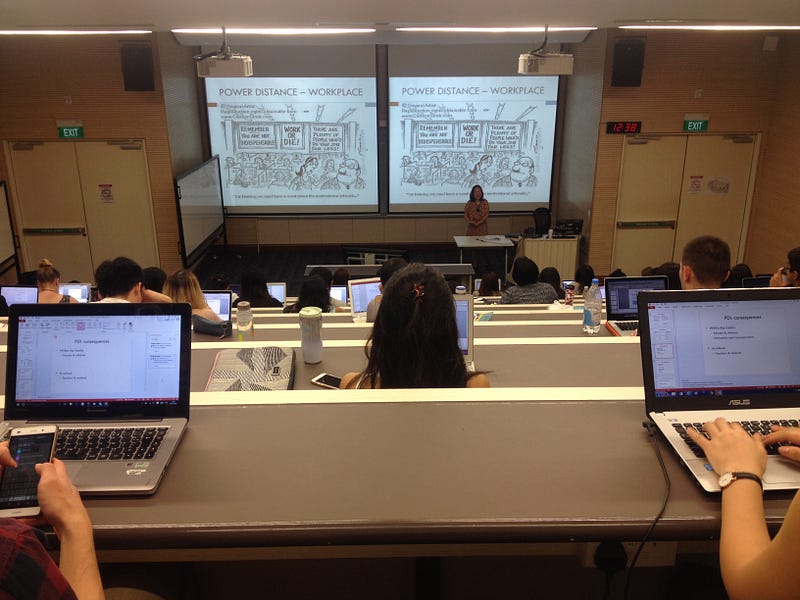
E-learning is totally different. Lecture is replaced by a video including lesson slides and lecturer’s instruction. Therefore, students can choose their suitable time and place to study. Self-learning is also enhanced. Then, according to what they learnt, they are required to prepare answers for related questions and go to Tutorial, where a part of class will discuss about webcast lesson. Everyone must raise their voice to contribute to class meeting by own experience.
Both above methods connect students to lesson, to classmate and to lecturer.
You can learn — live — play in one place
Residential college is not new in the US, but new in Asia. University Town, a campus in NUS, maybe the first residential college in Asia, where students can learn — live — play in one place.
It provides students learning environment as a school as I described above. It contains restaurants, fastfood store, convenience store and supermarket in UTown to serve students. And it built dorms in UTown, and swimming pool, sports hall, anteroom, dance practice room, etc.
Original work in Vietnamese: http://news.zing.vn/toi-di-hoc-truong-dai-hoc-so-1-chau-a-post658339.html


