
My Supercalifragilisticexpialidocious Boost Advice
Getting boosted might seem random — but it doesn’t happen without these things…
In my whopping 5 weeks of being a boost nominator, I’ve already noticed that I’m having the same thoughts repeatedly with pieces that I opt not to boost. I’m building a master file of them — muah ha ha!
I need a page to send to people who ask me for boost advice, so I don’t keep typing out the same thing until my fingers become clubbed from keyboard impressions.
So here it is.
I recently worked closely with an author on a piece, editing it for boost nomination. We’ll call them Shmoodles. Shmoodles was so close to writing boosted pieces regularly — but consistently had a few things that needed tweaking. Much of the below is what I worked with Shmoopsie on (and a few other important bits). For a piece that did indeed get boosted in the end.
And it was work. Well, Shmoople’s work, my potato-headed advice.
Shmoozles put significantly more effort into this piece. It wasn’t easy — but the results, were absolute fire. And I’m hoping to recreate that here. Schmoozles started with an outline I gave them, like a boost-friendly updated version of that essay format we used in high school. I have that outline below, but first…
My Supermegafrickingbadonkadonky Advice for Shmoopsie
*Note: this advice is mainly for personal essays and factual articles — for things like poetry and fiction, *shrug*, write good n shit? I looked for advice on poetry and fiction boosting, but found nothing. It’s highly subjective. Good luck (but cool, like how Liam Neeson says it).
Topic Resonation
In my utterly unvast experience, boosted pieces feel like the author really connected with them. I asked Shmootles to ask themselves, ‘Why is this so important to me?’ You might know why, but readers don’t. And how can they connect with it if you haven’t?
For example, let’s say it’s an article on a parenting style. Maybe it's important to you because you struggled with how your parents raised you, or your partner was raised differently than you and you experience the outcomes. The reader needs to know why it’s important to you.
To put it another way, don’t show intellectual interest in a topic, ask yourself why it interests you so much, how it makes you feel, your experience(s) with it, etc. Put that in the piece and it will open up another level of depth to it.
The personal why is critical.
Originality
When you find a topic that moves you, do some competitive research. Is it ultra-unique? If not, how can you write one that’s better and different?
4–7 Minutes
I most commonly see boosted posts between the 5–7 minutes mark (sometimes 4 minutes). Shmoowizzle’s original piece was 9 minutes. Ain’t nobody got time fo dat. Well, not many. They got it condensed down to a solid 7 minutes. A lot of articles on Medium could stand to be 20% shorter. Cut the fluff, kill the darlings, and make it impactful.
For the length of boosted articles, ADEOLA SHEEHY-ADEKALE of the boost pub Modern Women says:
“As far as length goes, I’d say 6–8 minutes is the goldilocks zone. Much less than that and you haven’t really had a chance to get into your subject and much more than that and you risk your reader losing concentration.”
So, 6–8 minutes for personal essays does sound reasonably accurate. Humor pieces for example can be 4 minutes (long humor pieces are harder to keep the flow going in my experience). It needs to make an impact, regardless of length. Keep the pace moving.
But every minute of the piece needs to be important, and engaging. Edit shrewdly and ruthlessly. If a sentence or paragraph doesn’t move the narrative forward — scrap it.
“I think of it as making a pie crust. You always have too much crust and have to whack it off with a knife. Better to have too much crust to whack off than not enough.” — Shmoopsie, on reducing fluff with editing
Images
For images — evoke emotion with them, and make the header image count. Schmoodle’s initial image just wasn’t striking. It was updated to something that had more emotion tied to it.
If your piece is over 5 minutes, consider using a second image (but one that’s equally as effective/moving). A 7-minute piece? You could use three.
Add Alt Text to your images. I’m not sure if this is a hard-and-fast rule — but the curators like it. Also, it improves the reading experience for our vision-challenged friends.
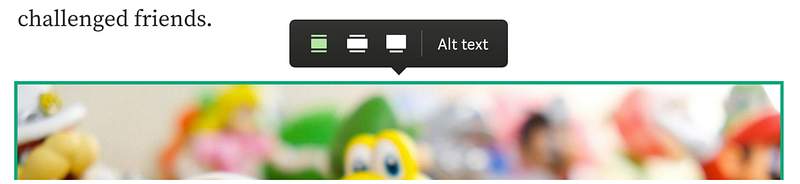
Click on the image in your draft, then “alt text”. Enter a description of the picture and bingo-bango, you’re done.
Reader Experience
You have to think of your reader’s experience. You’re writing for you, great — but if you want anyone to give a shit about reading it, you have to write it with them in mind. What do they get from it?
Don’t tell the audience things — show them. Use sources to back up claims, and illustrate the lesson through your personal experiences. And again, cut the fluff; leaving in unnecessary points isn’t respecting your readers’ time.
Shmootzie had a sentence that started with “We all know that…”. How does that make you feel as a reader though? It gets their backs up. I got nailed by an editor for this before. It stung so hard I’ll never forget the advice they gave me. ‘The audience doesn’t like being told what they know, especially if they don’t know it’.
Shmooties also had a lot of questions for the reader in her first draft. This can jar the reader from their experience by creating too many thought tangents. Questions are a powerful tool but they hit harder with less frequency.
Format the piece to make it easy to read. Shorter paragraphs of varied lengths, subheadings, etc. Also, I haven’t seen a boosted piece yet with emojis.
CTAs. Sigh. People don’t want to feel like they’re being sold to. Nor do they want you begging for claps. Ditto for asking basic-bitch questions at the end to get them to comment. People will do this naturally when the writing speaks for itself.
Tags
Choose at least a couple of big tags. For example “life lessons”, “diversity”, “relationships”, “finance”, etc. Having at least some bigger tags will make your boost go further. Curators know this, and look for it.
Hullabaloo Headlines
My buddy, and fellow boost nominator, Walter Rhein made a point recently about headlines in his Substack (it has killer advice):
“A few weeks ago I mentioned that I suspected I’d been messing up my titles. After writing that post, I made sure to use CoSchedule to analyze my submissions. I aimed for a score in the 80s, though I think at least one 79 might have slipped in there. Anyway, since I started doing that, every single one of my stories received a boost.”
He’s been a writer for a long time, like me. We all need reminders sometimes to refocus on headlines. This is yours.
My Wibbly-Wobbly, Timey-Wimey Outline
Why the gibberish Doctor Who subheading? Well, this outline is just something that I noticed applies to a decent chunk of boosted posts. It won’t apply to every topic, for every author — and substitutions can and should be made.
But it’s a rough guideline, soooo…better than nothing?
Here it is:
- Killer headline (and subheading)
- Powerful emotive intro (Stat-based/summation/main interesting point/joke/anecdote — that will get their attention)
- Personal connection using a narrative style
- Stats / details of the issue or topic
- Why it matters
- Possible solutions / your analysis
- Outro — Recall why it’s important to you and your personal narrative
- Powerful emotive ending
That gibberish gobbledygook outline above made sense to me and Shmoozles. Maybe it will for you too.
If you’re hoping that a piece will be boosted, put some time into the details. Shmootles spent hours and hours on her piece. They paid attention to the images, headline, formatting, emotion, and connection to the piece. Then spent a lot of time ruthlessly editing, over multiple days. Editing is critical — posting immediately after writing rarely assures quality, and this is coming from someone who struggles with this.
Details and nuance require attention. Exceptional quality takes time.
~Robin Wilding, reporting from…an empty sack of taters she’s thinking about turning into a dress.
You’re not sick of me yet? Amazeballs, here’s more: