
3D Agile Leader Model — Value Creator: Value Focus

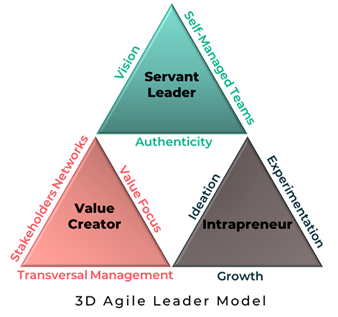
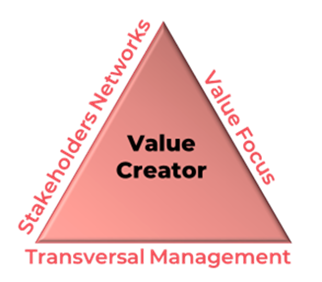
3D Agile Leader Model proposes that the three dimensions required of a “solid” agile leader — Servant Leader, Value Creator, and Intrapreneur — are the three critical roles a manager must assume in order to become an agile leader. Each dimension comprises three themes. The second dimension is Value Creator, and Value Focus is the second theme of this dimension.
Based on comprehensive knowledge of the various stakeholders and their expectations, an agile leader must further leverage his value-oriented mindset to recognize the diverse categories of value that his organization can create and match them to the right stakeholders.
Four categories of value
A typical organization generates four broad categories of value. A value creator needs to constantly ask himself which category of value he and his team are creating in any initiative they undertake.
* Business value: concerning value that directly leads to an organization’s flourishing business, including financial value (profit), increased customer satisfaction, growing market share, value chain effectiveness, etc.
* Learning value: covering value that provides an organization and its employees with opportunities to learn and improve, such as employee skills development, and the organization’s internal process development, etc.
* Strategic value: referring to value that an organization is able to benefit from in the long run, such as the organization’s robust brand reputation, the strategic alignment between a project and the organization’s long-term vision, etc.
* Relationship value: comprising value that helps an organization to build good relationships with other stakeholders, for instance, nice customer experiences of a service, environment-friendliness of a product, and reliable relationship with the suppliers, etc.
There is no need to define these value categories in strict terms, as the definitions can vary depending on the industry, the nature of the business, and so on. What matters is that we regularly ask ourselves what value we can create, for whom, and how much, the ensemble of which gives rise to another critical issue — the trade-offs between the different types of value.
We obviously cannot create the same amount of value to everyone. Trade-offs have to be made to craft balance. For example, if a software company happens to have an opportunity for immediate profit gain by selling pizzas, should it go on to sell pizzas? Other than the financial value this initiative can generate, will it bear any impact on the company’s image or its brand reputation? Certainly! Is it aligned with the company’s strategies or vision? Probably not!
Another example involves a tougher decision. A coffee house is in the dilemma of choosing between two different sorts of coffee containers — disposable plastic coffee cups and real coffee mugs with less ecological footprint. What is the best option for the coffee house, taking into consideration the interests of all stakeholders such as its fickle customers, suppliers, and community? What are the required cost and future benefit that can be both tangible and intangible for each option? There’s no easy answer to the questions. It’s up to the value creators to prudently evaluate both the pros and cons of each option so that the company can measure up to every stakeholder’s expectation while reaching its optimal equilibrium in the complex operating environment.
Non-added value activities
While searching for new sources of value creation can be a strenuous task, there is another way to tackle the problem — removing waste or none-added value activities from our working processes.
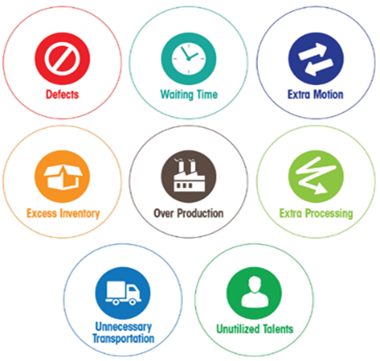
Lean methodology is a great tool whose core principle is the removal of waste within operation, based on the firm belief that one of the heaviest drains on productivity in any business is waste, and by eliminating waste, work processes can be optimized and true value can be added in each production phase. Lean waste can come in the form of time, material, labor, or the utilization of skill-sets. It includes any expense or effort that is expended but does not contribute to the creation of a valuable product that the customer is willing to pay for. In total, eight types of waste are recognized in Lean methodology:
1. Defects: It’s something that shouldn’t be there at all — it’s a flaw in the product. For example, a bug in a software, a stain on a shirt in a clothes store, or a button on a microwave that doesn’t work.
2. Excess processing: It’s something we do that doesn’t provide additional value. We often call that gold plating — a gold plate is being produced while a steel plate would have been just as good. For instance, excessive paper work or data entry, poorly planned work processes that cause extra steps along the way, and so on.
3. Overproduction: Too much is produced and the additional quantity doesn’t provide value. It’s like extra food in our refrigerator that we have to dispose of when it turns bad. Prevalent examples of overproduction include components produced before the next step in the process is ready to receive them, products stacked in the warehouse unable to be sold, etc.
4. Waiting time: Someone somewhere is waiting for some information in order to continue to work. It’s a waste of time, such as waiting for others to respond to an email, having documents waiting for approval, and waiting for the computer to load a program, and so on.
5. Inventory: Some components or parts of a product are sitting somewhere in the process, waiting to be picked up in order to produce the finished product. It’s an incurred cost whose associated value hasn’t been captured yet, including the costs of inventory maintenance and extra materials that take up workspace, etc.
6. Transportation: The product is there, but it still has to be moved somewhere in order for it to be bought or for the value to be delivered. Examples of transportation waste include moving hospital patients from one department to another, sending overstocked inventory back to a warehouse, and so on.
7. Motion: It’s like transportation but at small scale within the business facility or the office. For instance, walking to a far-away printer twenty times a day to pick up printed paper, or searching for supplies in a messy cabinet. Motion type of waste may look insignificant, but can amount to a huge waste of time and energy on a daily basis.
8. None-utilized talent: This last type of waste is commonly observed in many knowledge-based organizations, where talented people cannot deliver to their full potential. The main cause is related to poor management, for example, failure to involve experienced people in product design and development, inadequate team training that doesn’t allow teams to create synergy, etc. Non-utilized talent is probably the biggest waste at workplace — just imagine how much more value can be created by the innovative brilliant minds of all the talented employees.
The value created based on full comprehension of stakeholders is different from the value generated by removing wastes with Lean methodology. The former is more creative type of value that involves new products, products improvement, and so on; whereas the latter is a process optimization type of value, generated by doing the same but in a faster and cheaper way.
Related articles and book:
3D Agile Leader Model — Introduction of the Three Dimensions
3D Agile Leader Model — Value Creator: Stakeholders Networks
3D Agile Leader Model — Value Creator: Transversal Management
Agile Leadership Explained: We Can All Be Agile Leaders and Change the World Together! (Kobo)
Agile Leadership Explained: We Can All Be Agile Leaders and Change the World Together! (Amazon)
Sources:
Collet, B. (2019). Agile leadership. (Online course). https://www.udemy.com/course/agile-leadership/
Agile Leader Academy. (n.d.). The Agile Leader Self-Assessment. https://www.onlineassessmenttool.com/the-agile-leader-self-assessment/assessment-99121