
30 Fascinating Facts About Humans That You Probably Didn’t Know
The brain is capable of 10,000 trillion calculations a second, young people smell worse than old people, and much more
One of the most fascinating creatures on earth is the human, so us. Here are 30 fascinating facts about us.
With a computation rate equivalent to about 10,000 trillion calculations per second, the human brain is by far the most powerful computing machine on Earth. It is so powerful when it comes to computation, that back in 2014, Japanese researchers found that the K computer, one of the world’s most powerful computers, took over 40 minutes to replicate just one second of brain activity from one percent of the brain. The reason our brains are so superior to every other species is simply that, firstly, we were blessed with hands and wrists which allowed us to use tools, but secondly and just as importantly, we learned to communicate with each other, which by default, allowed us to learn to communicate with ourselves, which by default, allowed us to become conscious thinking beings, which by default, allowed us to gain the required self-awareness to use those tools to create technology.
Ever felt like you were getting stared at intensely by a baby or preteen child, it’s because whereas adults typically blink 10 to 15 times a minute, babies and infants only blink between 1 and 3 times a minute, with preteen children varying between 3 and 10 times a minute. Nobody knows why this is but the reason we blink is believed to be because it helps keep our eyes lubricated, so it is likely because kids simply don’t need to keep their eyes as lubricated for whatever reason. Lots of other species also blink, with the benefit of blinking believed to be it allows the eye to move and so look around with greater ease. In terms of blink rapidity, humans are pretty much in the middle range, some animals blink less some blink a lot more.
It is estimated by researchers that most humans can see around one million different colours. Some argue the number may be higher; however, because a healthy human eye only has three types of cone cells, each of which can only register about 100 different colour shades, which amounts to about a million different combinations when combined, the consensus is one million. However, we are way down on the colour detection scheme compared to some other species, for example, the king of the colour seeing world is the mantis shrimp. It has sixteen cone cells, and as such can detect well upwards of ten times more different colours than a human.
The universe is believed to be 13 to 14 billion years old, planet Earth is believed to be 4 to 5 billion years old. Humans, on the other hand, are believed to be only 200,000 to 300,000 years old. It’s believed we evolved into our current form in Africa, and the consensus is that we evolved from a species called Homo erectus — who only came into being a few million years ago when they learned to stand upright (Homo erectus means upright man). It’s believed that we separated from chimps somewhere between 6 million and 10 million years ago which is why we still share 98.8 percent of our DNA with them.
There are 3 million differences that separate one person's genomes from everyone else’s, however, because there are 3 billion letters that make up the human genome, that means all of us are 99.99 percent identical to each other DNA-wise. The craziest fact is that in the last 6–10 million years since we evolved from our chimp lineage, only 15 million of our genomes have changed. Yep, it takes a long time for our genomes to change. Because of this, if you were able to trace your lineage far enough back, any two people on Earth would be able to find that they had a common ancestor. That means we are all related to each other, and this is regardless of ethnicity, place of birth, everything. Some may have to go a very very long way back to find that link, but the link will exist all the same.
Evolution is slow, really slow. It’s believed that humans now evolve faster than other species, but even still, it is believed it takes over 25,000 years for our genetics and instincts to catch up with our environment. That means our instincts are designed for a world 25,000 years in the past — a point where we did not even have agriculture. It will take us another 10,000 to 15,000 years for our instincts to catch up even to the dawn of agriculture — 10,000 years or so back. So if you ever feel like you are not suited for the world as it is, you are right, our instincts are outdated and will take a long long time to catch up. But the plus side is some believe that we are starting to learn how to evolve at a faster rate, despite this, that faster rate will still be likely super slow. Just faster than other species.
One of the reasons humans have evolved to be the dominant species on the planet is our unique trait of being superb long-distance runners. When it comes to endurance a.k.a. long-distance running, literally, humans are by far and away the dominant species. We can run for longer than any animal on the planet. Our secret weapons are our sweat glands, which allow us to run and cool ourselves simultaneously, and our long legs and upright posture, which allow us to take steady and consistent strides. The advantage long-distance running gives us over our prey is that we are able to use a hunting technique known as persistent hunting — this is where we chase an animal until it literally dies from exhaustion. So our ability to run for long distances with ease turned all animals into easy prey, and so helped us become the dominant species on earth.
Humans are not just the best long-distance runners, they are also the best all-rounders. So our muscles have the best balance between strength, agility, explosive power, and speed. In terms of the most powerful muscles in our bodies, the calf muscle is the muscle capable of exerting the most force, while the jaw muscle a.k.a. the masseter, is capable of exerting the most pressure. The tongue is the most versatile, while the single biggest muscle in the human body is the gluteus maximus a.k.a. the buttocks. On an individual level, many species may have superior versions of each of the latter, but none can match our combination, hence, why we are able to adapt to any environment in a way that other species simply cannot.
The combination of the human wrist joint and the human hand is the most complex mixture of joints not only in our own bodies but in the entire animal kingdom. The dexterity which the human hand and wrist joint gives us is one of the main reasons we have evolved to become the dominant species on Earth. Make the human hand and wrist joint even just half as functional as it presently is, and we would never have evolved to be who we now are. Literally, the complexity is so immense that the wrist joint is the one joint that has not yet been fully conquered in the world of medicine, so if it is damaged, we don’t yet know the right way to properly fix it.
The way men and women have evolved to complement each other compared to the way the sexes in other species have is second to none. Basically, the unity between men and women and the way they work together has led men to evolve all the tools needed to be the ultimate protection machines, making them the dominant predator on the Earth by a long way, and has led women to become the ultimate childbearing and caring machine. This is why we are now such complex beings i.e. because men created the safe space for women, women were able to evolve a body capable of allowing us to be highly complex beings. This extreme level of unity between the sexes is not seen in any other species. So literally, men and women agreeing to work for each other in the name of the greater good, has been one of the key factors behind our evolution into the dominant species on earth.
Humans are the only eusocial species on Earth. Eusociality is where people agree to work for each other rather than by themselves or just with others. For example, wolves work by themselves but in groups. So they hunt together, but they don’t hunt for each other. Humans, on the other hand, work for each other in groups, one gets the food, the other gets the water, the other protects the camp, the other raises the children et cetera et cetera. This simple human evolution, agreeing to work for each other rather than just with each other or alone is the sole reason why we have everything we have today. That’s why working for each other is still the most important thing any human on Earth can do, because the moment we stop doing so, is the moment we lose everything.
Rather crazily, we still have the same number of hairs on our body as you would expect to find on an ape of a similar size. That means the reason we don’t look as hairy as apes is not because we have less hair, but because our hair is now much finer. It’s believed that the process of going from thick hair to fine hair happened approximately a million years ago but as of yet, there is no consensus over why it happened. However, the leading theories are that it happened for two reasons, firstly, as we became long-distance runners evolution would have favoured the ones with thinner hair i.e. it is easier to stay cooler while running when your body isn’t covered with thick hair. That means gradually, we evolved to have thinner and thinner hair until eventually we got where we are now, and all because those with thinner hair made better long-distance runners. The second reason it is believed our thick bodily hair is for communication and mate attraction purposes. When you are not covered from head to toe with thick hair people can see your facial expressions along with your skin texture and physique, things which are beneficial for communication and mate selection. It’s believed men shaving their faces — and increasingly much more — and women now shaving close to everything is an extension of this evolutionary path.
Humans on average have between 2 and 5 million sweat glands on their bodies, and on a hot day if we partake in continued physical activity we can lose upwards of 10 to 14 litres of sweat — size-dependent i.e. bigger people sweat more than smaller people. That’s more than any other animal. Some studies have even shown that it is even possible for us to lose upwards of 3 litres of sweat a day just sitting around doing nothing in a comfortable temperature — again, bigger people will sweat more than smaller. All in all, that means by default we are the sweatiest and also the smelliest of all the animals. Not just that, our body odour changes with age. Yep, there is an “old people smell”, a “baby smell”, a “teenager smell”, a “middle-aged people smell”, and more. However, whereas studies show we can identify the body odour of the elderly as belonging to the elderly they also show we are terrible at identifying the body odours of the young and middle-aged as belonging to the young and middle-aged. Despite this, studies show that we actually rate the body odours of the elderly as being less intense and less unpleasant than those of the young and middle-aged — likely because we sweat less with age. Meaning studies show that, despite the popular belief that the elderly smell the worst, it is actually young people who smell the worst. This means rather ironically, young people are the smelliest group of animals on the planet. Luckily, the shower has since been invented so we don’t get the worst of this any longer.
There is evidence that shows that human bodies actually emit light, just not of a wavelength that we ourselves can see. Meaning everybody literally glimmers. Though humans are not alone on this front, it’s believed that it is likely that all living entities emit a form of light.
For a camera to match your eyes, it would need to be 576 megapixels (32K resolution). To put this into perspective most phones only have a 12-megapixel camera, and the most powerful camera in the world is only capable of shooting at 400 megapixels. However, it is believed that we will soon have a camera capable of shooting at the same resolution as our eyes. Despite this, most believe there is not much point in going past 132 megapixels (approximately 16K resolution) as due to the information intake limitations of our brains it is not likely people will note any perceivable difference beyond that point, and most will struggle to notice any perceivable difference beyond 33.2 megapixels (8K resolution).
People are approximately 1 to 2 centimetres taller in the morning than they are in the evening, the reason is gravity. Lying down and sleeping relieves the pressure that gravity inflicts upon our spines, which makes us taller in the morning. However, because the weight of gravity weighs down on our spines over the course of the day, the joints become compressed, and so by the evening, we will have shrunk. On a side note, this is why people get taller when they go to space, without gravity weighing down on us the joints in our spines expand allowing us to reach our full heights and remain there.
Human females are the only mammals on earth that have permanent breasts. All other mammals only have breasts when they are feeding a child. It’s believed that breasts as a permanent feature came about as a result of humans evolving to walk on two feet. They are a means of telling men that women are of pregnancy age, so their primary purpose is as a tool to attract men for means of procreation. So when in heat, instead of presenting their rear ends — like other mammals — women would present their breasts instead. So if you ever wondered why both men and women alike can’t help but look at breasts if there’s even a hint of them on show, it is by evolutionary design. Male crotches are the same, if ever there is a hint of a bulge on a man, all eyes will immediately identify it so as to check whether he is of age and in a babymaking mood or not. Meaning yep, our eyes are hardwired to zone in and check out male crotches and female breasts and rear ends to see if it’s babymaking time.
On average, people burp between 3 and 6 times after eating or drinking. Also, on average people fart between 5 and 23 times a day. Many people try to hold in their burps and farts — especially their farts hence the wide variation in average farts per day. However, there is evidence that doing this is bad for us. When we hold in wind, pressure starts to build on the gas in our digestive system. As a result, we typically experience feelings such as pain, bloating, and discomfort. We also may feel some bubbling or gurgling as the gas moves around the digestive system. As a result of holding in wind for too long, some people have ended up in hospital. Yep, it really is better to just let them out, just try to do it quietly, and if you let out a smelly one, feel free to tell people it’s not your fault, you had to do it for health reasons.
Coughs are explosive, with the average cough being able to expel over 3000 droplets at a velocity of upwards of 50 mph. However, a cough is nothing compared to a sneeze which is able to expel 100,000 droplets at a velocity of upwards of 100 mph. Because of this, trying to hold in a sneeze can be dangerous and people have torn open their throats doing so. Basically, if you try to hold in a sneeze, you risk trapping air in your trachea, and if you trap enough air and try to force it inwards rather than outwards, due to the intensity of pressure buildup from a sneeze, you risk ripping a hole in the soft tissue of your throat. That means trying to hold in a sneeze is not wise.
77 percent of the global population has black hair, 20 percent has brown hair, a little over 2 percent has blonde hair, and only 1 percent has red hair. Scotland is the country with the most redheads, with 13 percent of the population having red hair, just above Ireland with 10 percent. In terms of hair colour diversity, on the whole, humans do not have a great deal of diversity. However, if the focus was only on Caucasian people, that changes. No one is quite sure why Caucasian people have evolved to have such diversity when it comes to different hair colour. However, the consensus is it is born out of a difference in sun exposure. So Caucasian people over a number of millennia got less sun which caused different mutations in them than is seen in people born in places where the sun is more intense.
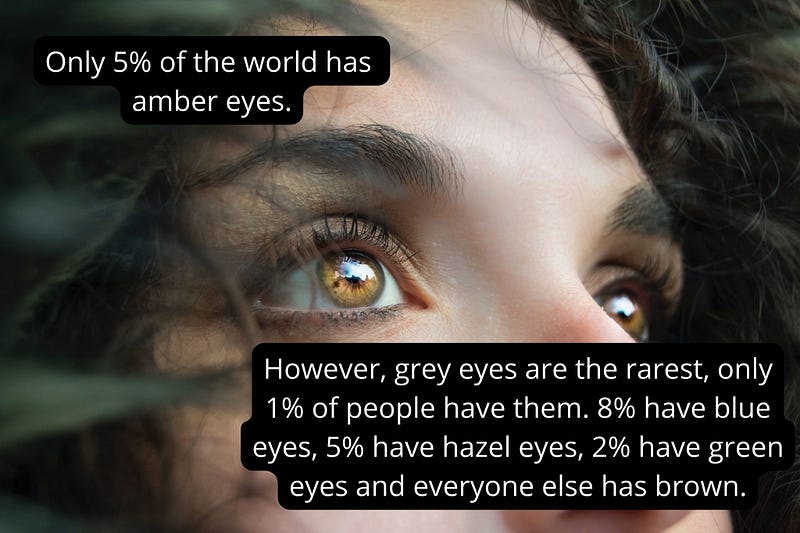
There was a time when all humans had brown eyes, but then 6,000 to 10,000 years ago a mutation occurred in one person. That mutation gave that person blue eyes. “Originally, we all had brown eyes,” said Professor Hans Eiberg from the Department of Cellular and Molecular Medicine. “But a genetic mutation affecting the OCA2 gene in our chromosomes resulted in the creation of a “switch,” which literally “turned off” the ability to produce brown eyes.” This switch is very specific, so much so, that every person with blue eyes has it. Because it is so specific researchers state that it is clear that every person who has it is in all probability linked to the person who first had blue eyes. The consensus is the mutation was likely just one of those random things that happen as a result of continuous gene mutation. But, it was likely influenced by the lower melanin levels Caucasian people tend to have due to living in an area where the sun’s rays are less powerful and prominent.
79 percent of people have brown eyes, while the rest either have blue, amber, hazel, green, or grey. But because there is no benefit to having one eye colour over another, it is believed that in all probability due to globalisation, all eye colours other than brown will gradually disappear from the populace within the next several hundred years or so. Blonde hair and red hair will also likely start disappearing. Basically, through evolution we constantly experience genetic changes, the ones that prove advantageous we retain, the ones that prove disadvantageous, we get rid of, and the ones that prove neither advantageous nor disadvantageous tend to fade away in favour of what was already there before. In this case, brown eyes were there before and because there are still more people with brown eyes on a global scale and there is no advantage to having blue eyes or blonde hair et cetera over having brown eyes and black hair — the most populace hair colour — brown eyes and black hair will be the winner. This will only change if globalisation is done away with or if designer babies become a thing, or if the sun stops shining with the intensity that it does across the planet, which if happened, would likely cause the mutations that lead to different hair and eye colours to happen in everyone.
Facial hair is technically pubic hair. No jokes. That beard, that moustache, the hair is pubic hair. Technically speaking any hair that grows in a place it didn’t before puberty is pubic hair. That means your armpits are also pubic hair. But, what is unique to humans is the fact that where we have pubic hair, especially in the nether region's area and on men’s faces (yep, sorry, like said that is pubic hair), we have more hair there than all other species, including chimps. That means our hair became thinner all over our bodies, except in our pubic region areas, where it became thicker. Nobody has any idea why, but it means we have more hair in our pubic areas than all other species on the planet.
Humans are fundamentally biological procreation machines, and every single thing we do, from cultural practices to individual actions (barring psychopathic actions et cetera), will fundamentally be with the intention of improving our survival chances by ensuring we have the right amount of children and that we give our children the best survival chances possible. The crazy thing is, even if we don’t think what we are doing is for this purpose, it will be. Even crazier, even if we think some actions feel like they are impossible to benefit these purposes, if they are actions that are continually repeated throughout history, then they will benefit these purposes. We literally only stop a behaviour when a superior one that can replace it is found, and a superior behaviour is marked as something that helps us better serve the said goals i.e. the continued survival and evolution of the human race. Every other living entity in existence is exactly the same. That means humans, on this front, are the same as everything else that lives. The only difference is, we are the only species that are able and thus do question why we wish to do this and thus why wish to live and are even alive.
Humans are the only species who are capable of crying. Many animals do have tears, but those tears serve only to lubricate the eyes. This is not because animals do not feel, it is because humans are the only species where it is to their advantage rather than disadvantage to express emotion. This is one of the reasons why we have evolved to have a relatively hairless face, so we can express our emotions. So animals can’t cry or express emotion in the way humans can because it might get them killed. Sad, I know, and a great shame because crying can be highly beneficial. Studies suggest that crying stimulates the production of endorphins and feel-good hormones. That means crying floods us with feel-good chemicals. So we typically feel happier after crying than we did before, this is one of the reasons why people can cry tears of joy, it is also why even if we are crying tears of sadness, afterwards, typically we feel less sad than we did before the tears.
Numerous species are capable of producing identical twins, but just like in humans, such occurrences are rare. No one is sure why they are rare, if there is a benefit to identical twins or if they are just something that happens now and then, but, crazily identical twins are so genetically alike that if they go on to have children with their partners, their respective children will not technically be cousins, genetically speaking, they will be half brothers or sisters. That means if two identical twins chose to have children with the same person, technically speaking the children would be full genetic siblings. This is because identical twins are born from the same egg, and so on some levels are genetic clones of each other. This is inevitably why they have pretty much superpowers when it comes to communicating with each other.
The African elephant may have the strongest sense of smell by a long way, with their sense of smell being over twice as strong as even dogs. But the human sense of smell is still a powerful thing, and it is estimated that we are able to detect over one trillion different scents, with some arguing that the number may be even higher.
Humans are the only species in existence who expect their children to live rather than die, and this is only a recent occurrence, prior to the 1800s, humans expected the majority of children born to die. That means the most important innovation of the last 200 years, the innovation which arguably has allowed all the evolution of the last 200 years, is actually the healthcare industry. By stopping children from dying in such numbers, it firstly gave men the freedom to stop having put so much effort into protecting and allowed them to expand into other areas, and it secondly, once contraception was invented, which allowed us to compensate for the fact that children were now expected to live rather than die, allowed women to enter the workforce. In combination, that has allowed us to turbocharge on the evolution front. If we had not learned the power of keeping children alive, the majority of the last 200 years of evolution would likely never have happened. Yup, that’s the power of saving lives. Something only humans excel at.
When it comes to life-saving interventions, women and children along with the elderly are well over twice as likely as men are to gain aid from bystanders, and in 90 percent of the cases, it is men who provide that aid. But, in the animal kingdom children may have a chance of being saved by their mother or members of a pack if they are in one, but adults rarely have a chance, and the elderly have no chance. That means humans are the only species who actively and consistently try to save everyone, and it is believed our desire to start saving people’s lives has been one of the main driving factors in our evolution. The reason, not just because it meant we had a better chance of all surviving, but because it’s been shown that the more we try to save lives, and the more lives we save, the more we understand the importance of life. That means the more lives we save, the more important life becomes. And humans have learned that lesson more than any other species. Hence, why we save so many lives and value life to the level that we do.
That’s all from me, thanks for reading! If you enjoyed this post, you may also enjoy the following:
34 Fascinating Facts About Nature That You Probably Didn’t Know
30 Things That Happen To Our Bodies As We Grow Older
28 of the Best Riddles That Will Test Your Intelligence to the Limits
To learn more about me see this link, to view my YouTube content see this link, to support me click the link below:


