
THIS IS US
The Soothing Break of a Self-Care Matinee
On the benefits of catching a movie alone in the dark
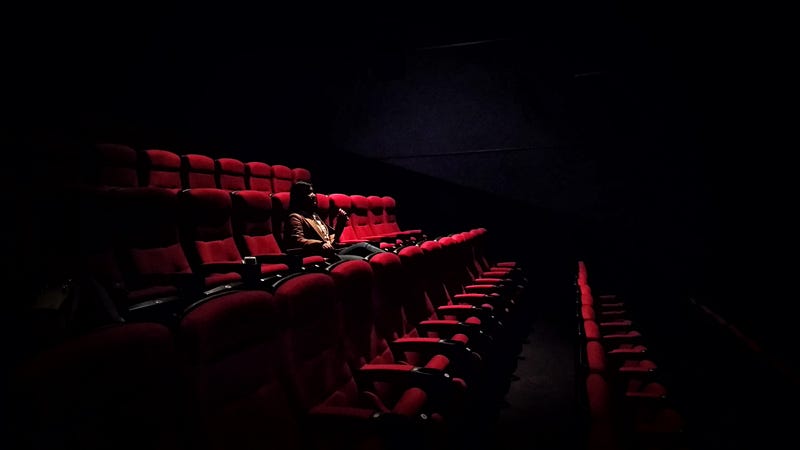
Last week I was on a reporting trip that spanned Colorado and Texas, catching up with sources whose lives I have followed and reported upon for years. Their stories are inspiring, complex, and each center upon trauma. So often, I find myself covering the ways institutions enable and cover-up abuse, and it’s vital to ground these big, systemic problems in the felt details of real people’s lives.
I’m able to keep an objective but empathetic distance in my work when these deep dives come weeks or months apart. I know enough to be aware of vicarious trauma, or even the simple exhaustion of doing extra-long shifts without the breaks required when home with kids in the evenings, forced into some work-life balance. More than anything, I need to keep my wits about me so I can carefully handle conversations with sources. It cannot be about me.
Even as each interview ran hours — as I was delighted to see how my sources’ lives were becoming more stable, more content than when I first met them — I felt invigorated. There was a unique joy in only having work to do, after pandemic years of juggling work plus kids plus care coordination for my parents plus the press of plague.
My husband was managing everything at home. I had given fair warning all around that I’d be away and unable to be reached for long stretches of time. If there was an issue with my parents, I’ve finally reached a point where I can trust the staff at their nursing facility to take care of it.
My phone started lighting up with calls, as it does, during one of my interviews. I felt obligated to explain why I kept hitting ignore as “Dad’s Cell” repeatedly flashed — he gets anxious, calls, forgets, calls again. I’d crossed two time zones to better understand my source’s story. She needed to be my focus.
Once we were done and I was in my rental car, I let my everyday reality crash back in. After a few blocks, I pulled off and listened to my voicemails: My father was angry, he was waiting too long for his nurse to respond to the call button, he wanted me to call the cops because a man with dementia kept wandering in, he wanted me to call before he and my mother die.
I forced a long breath in and out of my lungs. No one was in any imminent danger of death; I understood the manipulation in the words. I wheeled my rented Kia back on the road, not sure where to go. I’d hoped to start writing out a few scenes, but the creative part of my mind had shut down. I’d contracted panic via the voicemails even though I knew rationally there was no new emergency. I get these calls most days.
Down an unfamiliar road, I spotted a Tinseltown movie theater and smiled. I hadn’t seen that brand name in years, not since I was a young teen and my big brother would get me out of our chaotic home by springing to take me to the movies. In the darkened theater, any sudden loud noises were part of a plot, something that I could process. I always loved stories, the escape.
But I drove on, grabbed lunch, and tried to get some work done. I had such a rare opportunity for uninterrupted work, I needed to take it. My phone rang.
My mind started racing over what the worry might be now, and I got myself twisted up mentally in all the things I cannot change, what I will not accept I cannot change, and fear over all of it.
I opened a tab to look up movie times. There was a showing of the latest Spider-Man over at the Tinseltown. I packed up my stuff and called my parents back on the way.
I tried to comfort my father but he insisted they needed to move back to their last nursing home, where they’d been miserable, where the angry calls were double in number and even worse in desperation. “We were so happy there,” he said. It’s not a lie exactly. He’s just forgotten. Now they are closer to my home, a proximity that comes with more regular obligation, but less frustration due to more responsive staff.
I never wanted this role, certainly not for the man who terrorized me throughout the first two decades of my life. He’s forgotten that part, too.
I spoke to my mother briefly. She remembered I was away for work. That bit was a blessing. So many times in recent months she’s forgotten: moments from her life, her grandkids’ names, who I am. Not only did she remember me but something I’d told her. She’s doing a bit better since the move.
I’ve never gone to the movies on my own before. I’ve been a freelancer for over a decade but the flexible part of my work schedule has been applied to wrap time around my kids’ needs. At Tinseltown, the cashier turned her screen inside her plexiglass booth so I could see and asked which of the available seats I’d like. So far, I was the only customer. I chose one right in the middle.
Before the lights went down, there were three of us total in a spacious theater with reclining seats. Spaced with empty rows in between each of us, it was the socially-distanced moviegoing experience I’d craved since the worst of the Covid-19 spikes in 2020. I wore my mask between bites of popcorn, still confused by the CDC’s recent guidance and careful, as I’d be traveling to visit yet another source, then back home where I’d see my family and my fragile parents.
I’ll try to avoid spoilers, but I think it’s fair to say a major theme in Spider-Man: No Way Home is the impact of being lost to other people’s memories. The threat of being forgotten hangs over the whole film. Just as different choices, different circumstances, inform each potential version of the self, there’s something about being known and loved that shapes us, tells us who we are.
In the dark, surprise tears began to roll over my cheeks, wetting the edges of my mask.
I probably wouldn’t have moved my parents the many hours closer to my home, upturned my own family’s life, if my mother hadn’t forgotten me. Their last nursing home had gone through a series of lockdowns as Covid-19 spiked. It had been too long since I’d seen her in person. Months. I had a mask on when I arrived, but briefly dropped it below my chin when no note of recognition crossed my mother’s face. The woman who once carried and nursed me didn’t know who I was.
Later, she’d politely introduce me to my father, “This is my husband.”
She’d been so alone there, in her own room, refusing activities, picking at her food, shutting off the lights, and sitting in the dark. Of course, she lost sense of who she was, too.
In the dark, in the movie theater, I wept. I cried over my mother’s slip-slide from my world, the frustration of calls and calls and calls, my father’s screaming voice I’d long ago fled and that didn’t remember it had already screamed just minutes ago, so much, years ago.
I sobbed silently out of sight from the other two souls in the theater. There was a delicious aloneness about it.
But then, I got caught up in what was currently before my eyes. Clear-cut villains with one bad element that simply needed carved out. Evil with the potential for good. Noble characters urgently trying to do good things. My mind refocused, clicked over to another story. Spider men slipped masks off and on, learned from one another.
By the end of the movie, my popcorn was gone and my own mask had started to dry out.
Part of my job is hearing other people’s stories, trying to glean details I can fact-check to understand how systems sometimes fail to protect those they should and nurture those who do harm. Their stories live in my mind, but I have to stay a step or two back in order to see them as part of a larger tale.
But I will admit, it is a notch more difficult right now, as my own old stories keep pinging every time my phone rings. I didn’t understand that until I granted myself permission to take a couple of hours away from everything.
Just as my big brother once sensed that I needed an out, a place to contextualize by diving into some other story, I just got a dose of the same medicine with an afternoon spent with Spider-Man. I may need to prescribe more matinee movies to myself in these next few months and years, a treatment of solitude and story, an escape into adventure that can help reframe the slips of other memory playing on loop.