
How to Fix Racial Inequities in the U.S. Health System
Three experts discuss why health care needs a paradigm shift — and how to get there
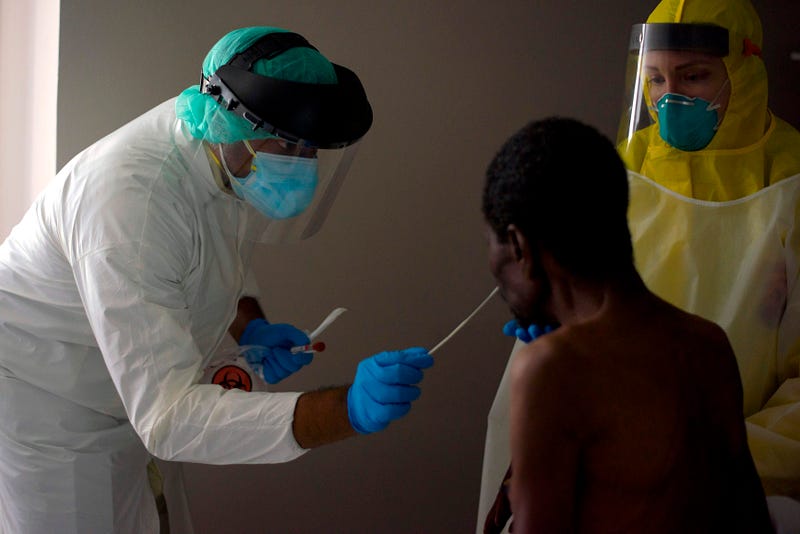
Covid-19 has illuminated the stark racial inequities that exist in the United States’ health care system. The risk of dying from the novel coronavirus is up to nine and eight times higher for young Black and Latinx Americans, respectively, compared to white Americans. Experts say this disparity is in large part explained by the fact that people of color are more likely to work in jobs deemed essential during the pandemic, often with minimal protections against the virus. Other factors at play are limited access to health care and higher rates of pre-existing conditions due to chronic stress and systemic racism, placing them at an increased risk for severe infection and death from the virus.
In June, three physicians and public health experts — Aletha Maybank, MD, MPH, chief health equity officer for the American Medical Association; Jonathan Metzl, MD, PhD, professor of sociology and psychiatry at Vanderbilt University; and Fernando De Maio, PhD, professor of sociology at DePaul University — penned a piece for the Journal of the American Medical Association about the inequities that exist in health care and how to resolve the injustices with an anti-racism lens. Elemental recently followed up with them to discuss how the country got here and how to begin fixing the problem.
The interview has been lightly edited for length and clarity.
Elemental: I realize this is an entire field of history, and numerous books have been written on the subject, but, briefly, how did we get here? How did we get to these dramatic racial inequities that we’re seeing in the health care system?
Aletha Maybank: Because it’s a pandemic and the inequities exist in so many different places and so many different cities are affected at one time, it now has been made visible to people who haven’t been paying attention. But those who are in health equity have known this for generations. W.E.B. Du Bois wrote his book The Philadelphia Negro and pointed out that there are inequities that existed between ex-slaves and whites in the city of Philadelphia. But because of white supremacy, his work was made invisible over many, many years.
It wasn’t until the 1980s or so that there was this resurgence of interest, in part because the federal government conducted a study to look at the health of people across the country, and the study basically showed that Blacks had worse health than whites and were dying at earlier rates. This really started the national attention and resources for what they called the Office of Minority Health. And it’s from that recent point in time that we have seen more attention on the governmental level, especially in the public health space, and more action in the health care space and interest in these inequities and why they exist. But they have been ever present.
What’s become really important is that the narrative around why they exist is continually evolving, and it’s become more explicit. So initially in the 1980s, folks would talk about individual health behaviors, and it was the fault of people — they weren’t eating well, and they weren’t exercising, or they weren’t doing this or that. Then the narrative evolved to look at systems and policies to see how those were impacting people’s health. Then it evolved to talking about social determinants of health and these conditions related to transportation, housing, economics, wealth, all of those things that are very important to determining health. Now, the extended narrative is saying it’s not just these social conditions, but it’s those structures and it’s the policies and the laws rooted in economics through our historical lens of white supremacy and racism that actually produces these inequities.
What types of interventions have been initiated in the past to try to remedy these problems, and have they been successful? If not, why?
Fernando De Maio: One of the most interesting parts of the Affordable Care Act was that it mandated not-for-profit hospitals to conduct these periodic community health needs assessments. It really forced hospitals to grapple with structures in their communities that shape food access, that shape transportation, that shape the lives of their patients. There’s been this reawakening in communities of the structures that shape population health patterns across the health care system.
Jonathan Metzl: What the Affordable Care Act also did, at least in the beginning, was it created avenues for rewarding building communities — at least that was the idea of what the ACA was going to become over time if it was allowed to do it. The ACA also started to level out health insurance rates and the relationship to health outcomes. For example, in 2010, 33% of Latinx people in this country didn’t have health insurance, by 2016 that was 18%.
There have also been Band-Aid approaches. There are organizations that prescribe blankets for people who don’t have heat or prescribe food. But what you’re doing is you’re just giving a temporary fix to a bigger problem.
Aletha Maybank: The challenge is how to get health care systems and physician leaders to really think structurally, which means they need to think in advocacy and big P policy space, and how are we advocating at this higher level to really change structures? A lot of the solutions that we think through are still very downstream, and it’s a challenge at this moment in time — an opportunity and a challenge — to help support the health care community and public health community to shift and to think and act more upstream.
The other part that is really important is centering racial justice and doing anti-racism work. You can do structural competency work and still not be anti-racist. We have to make sure that we’re marrying the two and we’re doing this structural competency work through an anti-racism lens or else we will perpetuate and exacerbate the inequities.
Structural competency is a phrase that pops up a lot in your article and during our conversation. What does it mean?
Jonathan Metzl: It’s a bigger critique of what’s called cultural competency in medicine. Doctors are taught a very individual approach to addressing things about racial bias, the assumption being that if you address your own unconscious bias and you understand something about the culture of the patient, that’s enough. And those are important, but if the patient is suffering from systemic racism — in other words, housing discrimination or inability to get food or being passed over for a job that might have had better health care, all these other bigger factors — your individual sensitivity is not going to matter.
So how can we shift the paradigm in medicine from paying attention to the cultures, which are important, to making doctors aware of structures? It’s everything from recognizing what the structures are, but also a humility to recognize that not everything is a medical problem. Sometimes things like health and illness are the result of these bigger systems, and doctors need to collaborate to really address them and to imagine future interventions. When the pandemic hit, especially when the inequities started to show up, it was very clear that it was reflecting our disordered structures.
Now the other huge overarching question, how do we fix the system? What needs to change at the individual provider level, at the hospital level, at the health care level, at the governmental level? What are some of the inroads that we can start to make now that the public is finally waking up to this problem?
Aletha Maybank: Medical education is a big place to start, how our doctors are trained. One of the challenges is a lack of understanding about what creates health in this country, in terms of not just focusing on the health care systems and hospitals and doctors’ offices, but looking beyond that. What’s absolutely critical is that we acknowledge that physicians are leaders in propelling these narratives forward. If physicians are trained differently to have a broader understanding around what creates health, that will inform how physicians engage and how they push systems and structures moving forward as they finish medical school.
Jonathan Metzl: The reason we rallied around this term structural competency is that when you start to see health disparities and inequities as being structural, you realize that a structure is something that humans built, and they built it based on their decisions about what to fund and what to not fund. For me, there’s something daunting about that because these structures then can become totalizing. But there’s also something almost optimistic about it, because if we build structures then we can unbuild structures, and we can build other structures.
First, what we need to do is to think about what are the structures that impact health. It’s about housing. It’s about access to medical care. It’s about what kind of jobs people have and what protections they have at those jobs. Those are all daunting tasks, but they’re all fixable tasks.
Also, because medicine doesn’t know a ton about food distribution networks or communication, it’s time for medicine to create alliances with other structural expertise. Medicine needs to create more bridges between the clinic and the community to help build the many ancillary structures that support health.
So what would an ideal hospital or clinic or care plan for a patient look like? If someone was really doing this right, what offerings would be on the table, and how could they address their patients’ needs more holistically?
Fernando De Maio: West Side United is a good example of this, of taking a structural approach to overcoming a historic life expectancy gap. It’s a coalition of health care institutions, faith institutions, educational institutions, and community-based organizations here in Chicago with the explicit goal of reducing the life expectancy gap between The Loop and the West Side of the city, which stands at 14 years right now.
They recognize that the solutions to that gap don’t exist necessarily just within the walls of the hospitals. It involves economic revitalization of communities that have been marginalized for many, many decades. It involves overcoming historical violence and mistrust with the police department. It involves nurturing new capacity for people to lead long and healthy lives. It’s recognizing the huge loss that we have, the loss in human life and capacity and talent and the culture from premature mortality amongst our poorest populations.
So the way to overcome that gap is not necessarily to build another hospital on the West Side of the city, but to invest in communities, to give people proper employment, security, food distribution, and a more equitable approach to life.
Aletha Maybank: To me, what it calls to action is the health care system valuing the expertise of the people who live within the neighborhood. Quantitative data is absolutely important for us in the science space, it’s important for us to know and be able to measure. But the stories are more important to really contextualize that data and to shine a light on how the data was collected and the questions that were being asked.
This is a way for the health care systems to value the expertise that already exists and to share the power and decision-making ability with the communities. But these efforts take lots of time, attention, and investment. Hospital systems have to shift resources in order to do this, and that’s the big part of equity — it’s the ability to shift resources at the neighborhood level, but at a state level and at a national level as well.
You’ve talked about the upstream changes that people can make, not just at the community hospital level. What would that look like? And also acknowledging that money and time are limited resources, what would you prioritize to do first to have the most impact?
Aletha Maybank: Everybody in this country should have health care. That’s the equity way, as a start. Covid has highlighted that big time — that your employment is attached to your ability to have health care, and then as soon as you lose that employment, which many people did, they lost their health care, too. It really shouldn’t be that way. We need to have a better way of ensuring that everyone has access to health care in this country.
Fernando De Maio: I would flip that question around. The world, the country is richer than it’s ever been before. It’s not a matter of scarcity of resources to tackle these problems, it’s a lack of political will, and it’s a lack of recognition that this is really fundamental. We lose economically and socially from health inequities. The economic gain from more equitable distribution of health would be tremendous.