
Reengineering Life
Millions of Genetically Engineered Mosquitoes Are Headed for the Florida Keys
The insects are designed to control diseases like dengue and West Nile
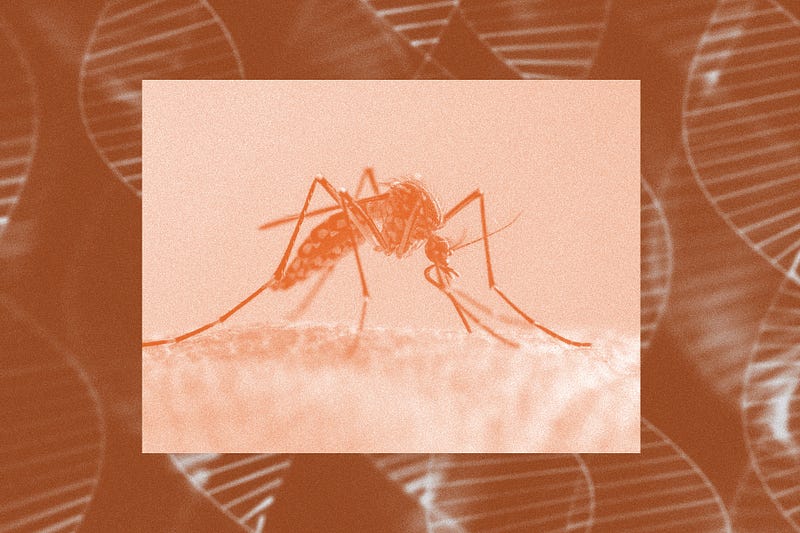
Reengineering Life is a series from OneZero about the astonishing ways genetic technology is changing humanity and the world around us.
In the first test of its kind in the United States, millions of genetically modified mosquitoes will be released in the Florida Keys sometime in the next two years.
Local officials greenlit the plan in a 4–1 vote on August 18, despite long-standing objection from some residents and environmental advocacy groups. The engineered insects are designed to wipe out Aedes aegypti mosquitoes in an effort to eliminate the diseases they carry. The U.K. company that makes the mosquitoes, Oxitec, had been trying to get an open-air release approved for the past 10 years.
The resulting offspring don’t survive until adulthood and therefore can’t reproduce.
The U.S. Environmental Protection Agency approved the pilot project in May, followed by the state of Florida in June. But Oxitec still needed to get local permission before the mosquitoes could be released at a site in Monroe County, home of the Florida Keys.
Oxitec’s mosquitoes, which are all male, are engineered to have a “self-limiting” gene. When they’re released into the wild and mate with females, they pass on the gene to their offspring. The resulting offspring don’t survive until adulthood and therefore can’t reproduce. Oxitec believes that releasing enough of these designer insects will cause the local mosquito population to eventually die off.
Male mosquitoes don’t bite — only females do — so the EPA and Oxitec say the engineered mosquitoes don’t pose a threat to people. But opponents worry about the possible health and environmental effects of releasing genetically modified organisms into the environment.
Climate change is expected to bring more diseases like dengue and West Nile that are spread by the bite of infected mosquitoes. Florida currently uses aircraft to spray large amounts of insecticides to control mosquitoes, but the chemicals kill only about 30% to 50% of the local Aedes aegypti population and the effectiveness can wear off over time. The Florida trial will test how effective Oxitec’s approach is at eliminating the pests.
Amid the ongoing coronavirus pandemic, the Florida Department of Health has so far confirmed 47 cases of dengue fever this year, as well as 44 cases of West Nile virus. Both are spread through the bite of female Aedes aegypti mosquitoes. The dengue cases are all clustered in Monroe County, where the genetically engineered mosquitoes will be released. The field test will happen sometime in 2021 or 2022, but the exact time and date are yet to be determined.
Dengue often presents as a severe flu-like illness that can come with severe muscle aches and pain, fever, and sometimes a rash. Symptoms appear within 14 days after being bitten by an infected mosquito. Most people infected with West Nile virus, however, never get symptoms. If they do, they may experience a headache, body aches, joint pain, vomiting, or diarrhea.
Over the past decade, Oxitec has tested its mosquitoes in Malaysia, Brazil, Panama, and the Cayman Islands. In a recent field test in the Brazilian city of Indaiatuba, the company claims its mosquitoes were up to 95% effective at reducing local mosquito populations compared to untreated control sites in the same city.
But in a study published in Scientific Reports in September 2019, a group of independent scientists found that some offspring of Oxitec’s GM mosquitoes survived and produced offspring of their own. The paper raised concerns that the company’s technology could create hybrid wild mosquitoes that worsen the spread of diseases they’re meant to prevent. Oxitec denied the claims, and in March the journal issued an addendum to the original paper.
When Wolbachia-carrying males mate with females in the wild, the bacteria prevents the resulting offspring from hatching.
Oxitec’s technology is one of several approaches being explored to eliminate disease-carrying mosquitoes. Verily, the life sciences unit within Google’s parent company Alphabet, is also working on its own mosquito control technique. Over the past few years, Verily has released millions of lab-bred male Aedes aegypti mosquitoes into several neighborhoods into California’s Central Valley in hopes of reducing their numbers. Infection with dengue or West Nile virus is uncommon there due to the dry climate, but if the approach works it could be used in other places where mosquito-borne diseases are a bigger threat.
Verily’s mosquitoes are not genetically engineered. Rather, they are bred to carry a common insect bacterium called Wolbachia that blocks them from reproducing. When Wolbachia-carrying males mate with females in the wild, the bacteria prevents the resulting offspring from hatching.
Oxitec has already been carrying out open field tests of its genetically modified diamondback moths at Cornell University in New York. These moths are engineered to have the same self-limiting gene as the mosquitoes. Wild diamondback moths feed on crops like cabbage, broccoli, cauliflower, and canola, and are estimated to cost farmers $4 billion to $5 billion each year.
Oxitec’s proposal to test its GM mosquitoes in Florida has been met with considerable opposition. A petition opposing the release of the mosquitoes has garnered nearly 240,000 signatures. Critics say the mosquitoes could harm Florida’s ecosystem, though an EPA risk assessment found that Oxitec’s technology poses no risk to humans, animals, or the environment, including endangered species.
The Florida vote last week could open the door to designer mosquitoes elsewhere in the United States. In May, the EPA also approved a field test in Harris County, Texas, where Houston is located. State and local approval has not yet been granted there.
“There is no agreement in place or plans to move forward with the project at this time,” a spokesperson for Harris County Public Health told CNN. “Our focus is on our efforts with the Covid-19 pandemic.”