Fuel Can’t Take Us to the Stars but We Can Still Conquer Them
It’s not rocket science
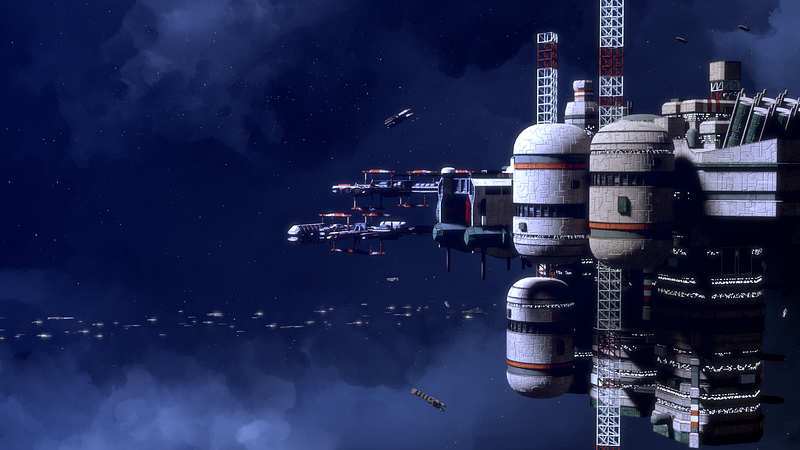
Launched in 1977, Voyager 1 captured our imagination when it reached the edge of the Solar System in 2012, but it will take another 40,000 years to arrive at the closest star, traveling 35,000 miles per hour.
Understanding why this is requires that we delve into the most overlooked fact about space flight: we burn almost all our fuel escaping the gravity well of our planet, therefore our spacecrafts must coast along the rest of the journey, relying on gravity assist from other planets to increase their speed.
Is it possible to bring more fuel? Yes, but then even more fuel is required to deal with the additional weight — that’s the essence of the rocket equation. Even building a ship in space (to leave Earth’s orbit with a full tank) will still require thousands of years to reach our closest neighbor.
Is there a better fuel? Yes, it is possible to explode nuclear bombs behind our starship to accelerate it forward and to slow it down at the end of the journey. Outlandish but doable. Nevertheless, imagine if we could do away with fuel and find other ways to accelerate a ship with our current technology.
The Breakthrough Starshot project plans to take advantage of this property to accelerate a coin-sized probe embedded in a sail to 20 percent of light speed (0.2c) by hitting it with a precisely aimed laser array from the ground.
Reinventing propulsion
When my physics teacher first explained that light behaves both as a particle and as a wave, I was more confused than a psychohistorian dealing with single individuals. Enough to say that, as a particle, light carries momentum that can be transferred to an object. The Breakthrough Starshot project plans to take advantage of this property to accelerate a coin-sized probe embedded in a sail to 20 percent of light speed (0.2c) by hitting it with a precisely aimed laser array from the ground.
The low cost and weight of the probe, the need to release it in space with a rocket, and the many risks along the journey, dictate that we launch thousands of them at a time and use a single laser burst to send them on their way.
Propelled by 1 gigawatt of energy — enough to power a city — these tiny space crafts will be on a one-way trip to Alpha Centauri and beyond because there’s no mechanism to stop them. Within twenty-five years (twenty for the trip and four for the message to reach Earth) they’ll be able to report back with pictures and telemetry of Proxima Centauri, our next-door neighbor.
The idea of emulating gravity by spinning an object was first conceived by the father of the rocket equation, schoolmaster and physicist Konstantin Tsiolkovsky, in the late 19th century.
The immediate question that comes to mind is: “Can we power an actual ship with a bigger laser array?” Yes! The sun generates in 1 second nearly 500,000 times as much power as the entire human civilization consumes in a whole year.
While it might be hard to wrap our minds around these numbers, it’s enough to say that solar panels in space can generate tens of times more power than on the surface of Earth. Nevertheless, a laser array large enough to propel a starship will be so large that it must be built in space, using raw materials mined from the moon and other celestial bodies.
“After deploying the aft shield, a massive array of solar-powered lasers fired on it, slowly accelerating the Interstellar-1 half a meter per second every second towards the α Cen system. It would spend the first 3.8 years accelerating to 0.2c” — Excerpt from my novel K3+
Designing an interstellar RV
Human beings have existed for about 200,000 years, but our dependence on Earth’s gravity and atmosphere dates back to 600 million years of multicellular life evolution. Every system and organ in our bodies is dependent on these conditions. A spacecraft on a decades-long trip must provide enough comfort for people to thrive physically and mentally.
A starship carrying millions of humans at 20 percent of light speed must decelerate gently. One of the best and brightest ideas is inspired by an invention thousands of years old.
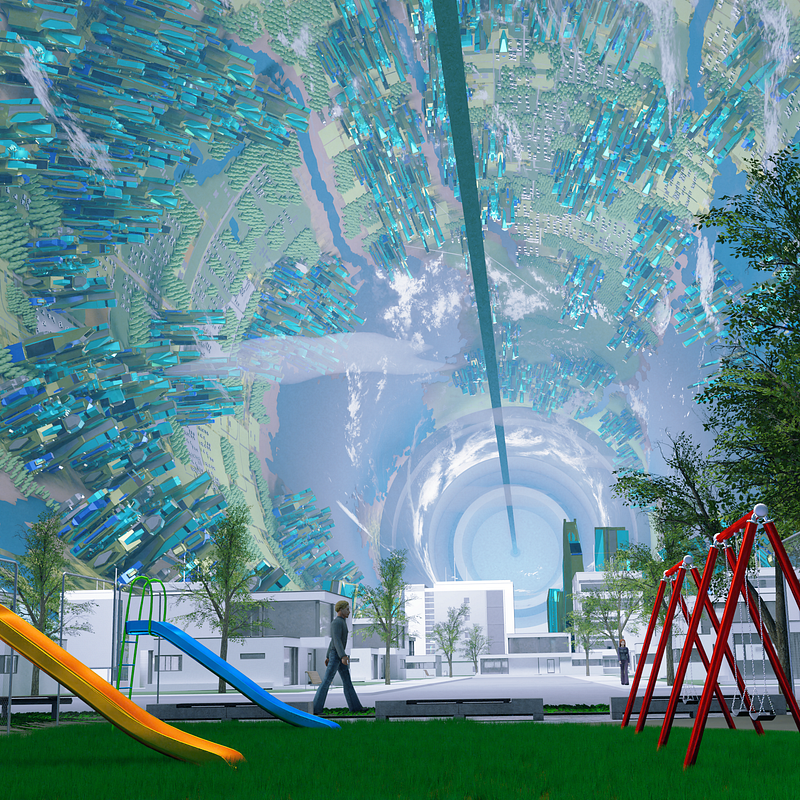
The idea of emulating gravity by spinning an object was first conceived by the father of the rocket equation, schoolmaster and physicist Konstantin Tsiolkovsky, in the late 19th century. In the 1970s, American physicist Gerard O’Neill designed the first permanent cylindrical colonies that recreate Earth’s gravity by spinning. With 21st century technology and materials, we can build an O’Neill cylinder large enough to house millions comfortably.
With a few adaptations that include propulsion, additional shielding, and power generators, rotating habitats make perfect spaceships as they are designed to comfortably house humans for long periods — with a few idiosyncrasies.
“The forward acceleration, though gentle, will make it feel as if the floor is slightly tilted, 2.9 degrees to be precise. It doesn’t sound like a lot, but trust me; it’s enough to make you stumble when you’re not paying attention!” — Excerpt from my novel K3+
Shielding from cosmic rays and space debris
Interstellar space is mostly empty. But there are loose particles, dust, micrometeoroids, and bigger chunks of rock. Traveling at 0.2c, not only will these particles generate plenty of heat, a pebble with a few grams of mass will impact with the force of a small nuclear bomb.
A simple solution is to encase the starship in a layer of ice a hundred feet thick to absorb direct micrometeoroid impacts — low-tech but effective. A mile-tall cone made of ice can shield the front of the cylinder by minimizing collisions with objects in its direct path by deflecting them.
The ice will also protect the passengers from cosmic rays and can be promptly discarded when reaching the destination to feed the ship systems with power from the star.

Hitting the brakes in a starship
The most daunting challenge is slowing down the ship at the journey’s end without fuel. A starship carrying millions of humans at 20 percent of light speed must decelerate gently. One of the best and brightest ideas was inspired by an invention thousands of years old.
Projecting a gigantic magnetic field in front of the ship will act as a sail allowing drag from loose particles to slow down to orbital speed around the target star. This magnetic sail will also take advantage of the stellar wind to provide attitude control once in orbit.
“The thought of the magsail failing to deploy and not being able to stop the ship at Proxima terrified Federico. The Interstellar-1 would wander through space for eternity, but they wouldn’t last that long. Running out of hydrogen and unable to power the life support systems, they would die of asphyxiation. However, it was a silly concern; everything in the ship had a ridiculous number of redundant backups, not to mention enough spare parts to rebuild it many times over.” — Excerpt from my novel K3+
Ever since the 1950s nuclear fusion always seems to be just decades on the horizon, but this time might be for real.
Powering a ship in interstellar space
It might still be necessary to carry some fuel on the ship to supply energy to its systems during the decades-long interstellar voyage. Even with highly efficient technologies, providing life support, lighting, and food for millions will consume fair amounts of power.
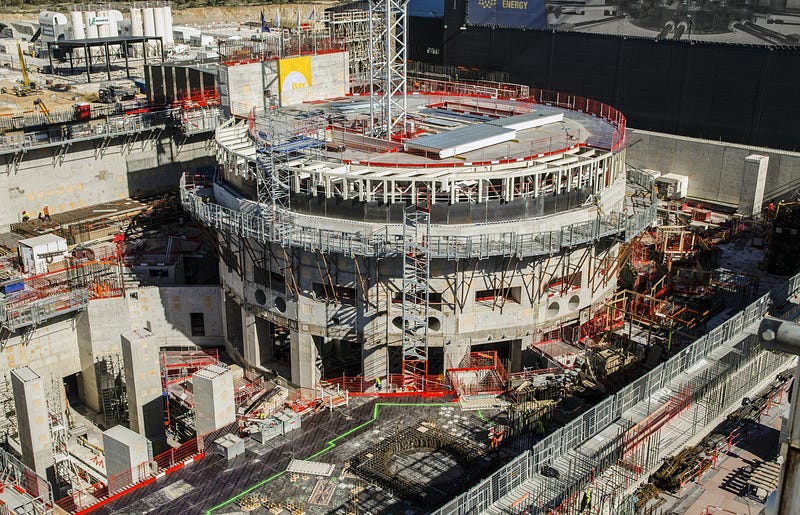
Ever since the 1950s, nuclear fusion always seems to be just decades on the horizon, but this time might be for real. The amount of fuel for a fusion reactor, providing power for millions of colonists in interstellar space, can be easily accommodated inside a rotating habitat without taking valuable living space. And the future might bring even more exciting fuels like metallic hydrogen or antimatter, packing even more energy per cubic foot.
Colonizing the stars
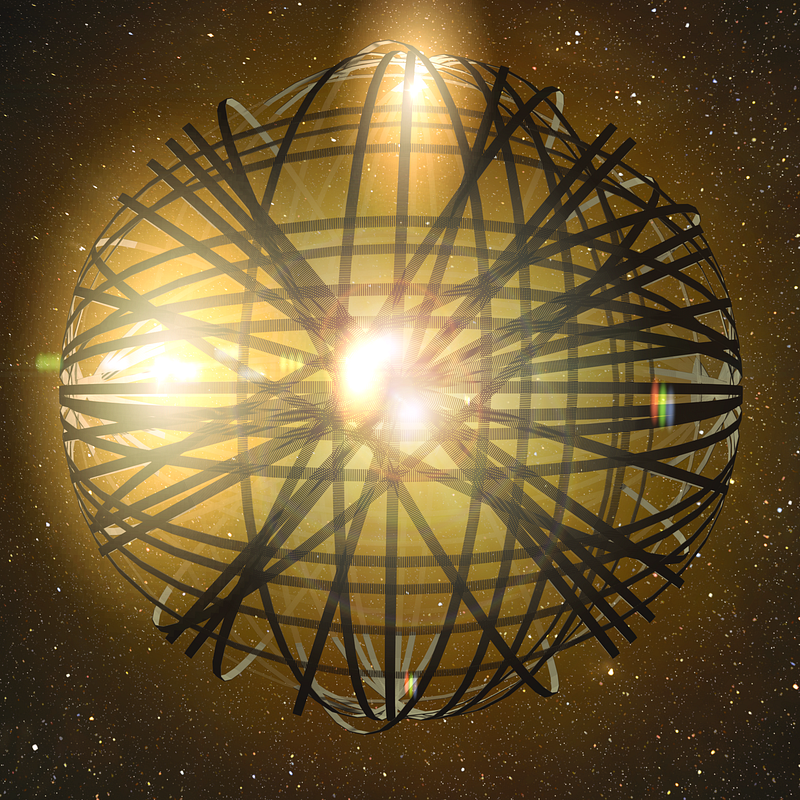
It might be that no other planet in the galaxy can sustain human life. After hundreds of years of waging war against the local life, descendants of the first settlers might find it easier to stop terraforming and build more rotating habitats (like the ship they came in) around their star to live in perfect Earth-like environments.
Limited by the tensile strength of materials like zylon and kevlar, we can build island-sized rotating habitats, but these constraints won’t last forever. In the coming years, we’ll develop far stronger materials — likely carbon-nanotubes based — enabling the construction of continent-sized colonies, each capable of housing billions.
These colonies will allow us to settle all viable stars in our galaxy, regardless of whether they have rocky planets. A yellow dwarf like our sun can house more people inside rotating habitats than all habitable planets in the Milky Way.
We don’t need to reach for the stars yet, as there’s plenty of room and resources to grow in the Solar System. It’ll give us time to find answers to some of the challenges to interstellar travel.
Want to know more about space colonization?
My new dystopian novel K3+ is the story of Earth’s demise and humanity’s rise to become an intergalactic empire. A roadmap for colonizing space and save humanity, the science-grounded story interweaves cutting-edge technologies and spellbinding fiction.