

39. Slowdown landscapes: The defiant garden produces social justice as well as strawberries
Small green pieces of urban farms, repairing vacant lots in in Los Angeles and Brooklyn
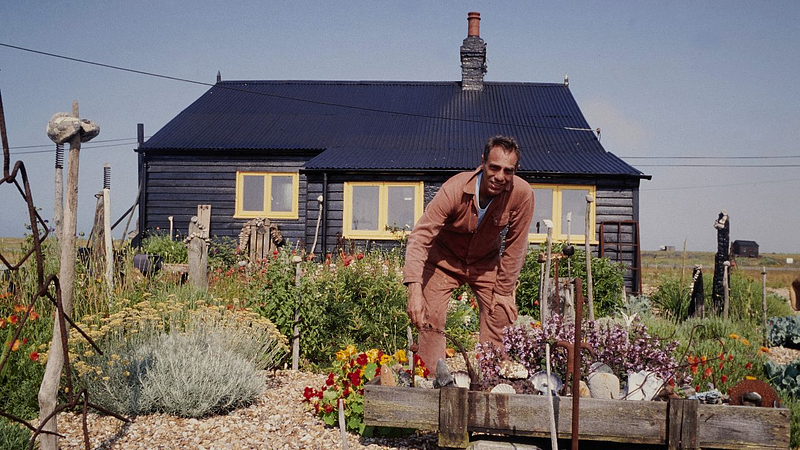
Lest the remove to Jarman’s small pieces of isolated beach suggests a self-sufficiency too easily elided with individualisation, a form of privatisation even, the emphasis on loosely joined becomes a fundamental patterning dynamic.
At core, we understand that all these systems and cultures are connected — that ‘off-grid’ is not possible, technically and politically. This, too, should be understood as a participative process. As Latour writes, in his plea for us to focus on the Terrestrial plane: “each of the beings that participate in the composition of a dwelling place has its own way of identifying what is local and what is global, and of defining its entanglements with the others.”
“The only real things in life are food and love in that order.” — David Hockney
So caring for a garden, whether literally or metaphorically, is quite different to an individualism that exemplifies much of the Acceleration. Equally, the way that gardens, in the richest sense of the concept, pollinates or spreads roots, cannot be an autarkic self-sufficient bioregionalist vision either. Again, this recalls Val Plumwood’s firm critique of a simplistic bioregionalism as creating ‘shadow places’, in which footprint is simply exported, as if there was such a thing as an ‘externality’ in a world where everything is connected; or as Timothy Morton put it “‘somewhere else’ is just the same place, you’re just moving some kind of pollution around within a system.”
There are natural connections, then, and also connections in terms of practice, of perspective. Through this lens, Jarman’s beach is connected directly to Ron Finley’s work, planting and cultivating gardens in South Central Los Angeles. With a gardener’s spin on De Monchaux’s vision of a distributed infrastructure, Finley has calculated there are 26 square miles of vacant lots in the city, or around 20 Central Parks. These forms of gardens necessarily embody the care-ful slowness that we must find a way of working with. Although Finley clearly describes how they might scale, growing tomatoes is not exactly a ‘fail fast’ ‘blitzscaling’ dynamic, particularly when attempted in a converted LA parking lot.
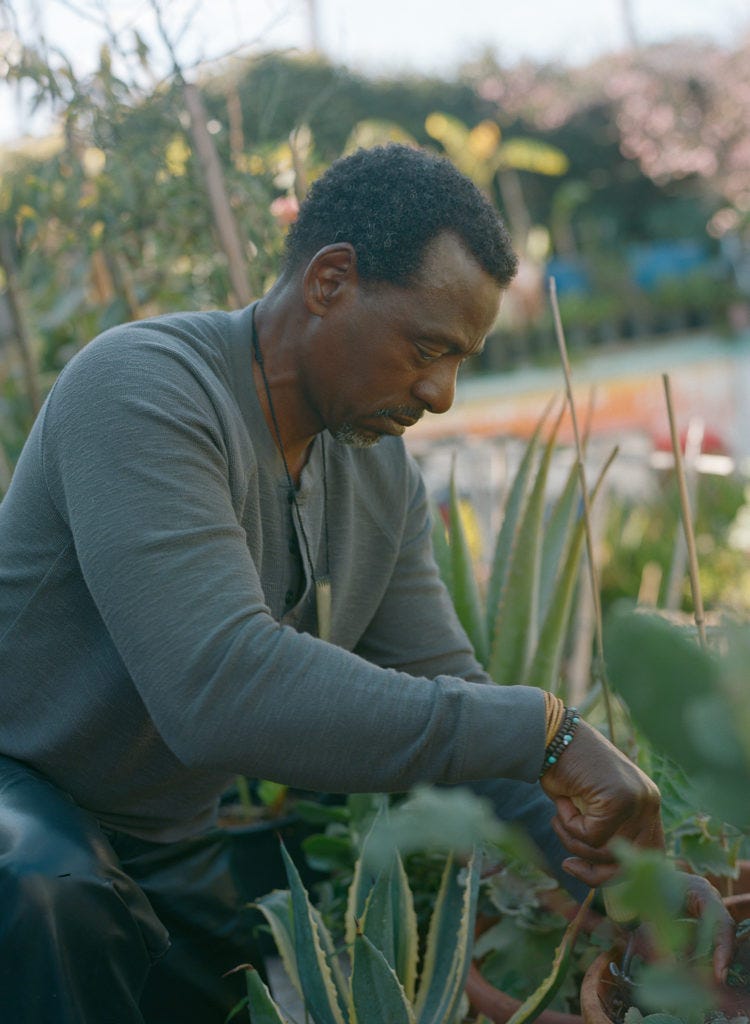
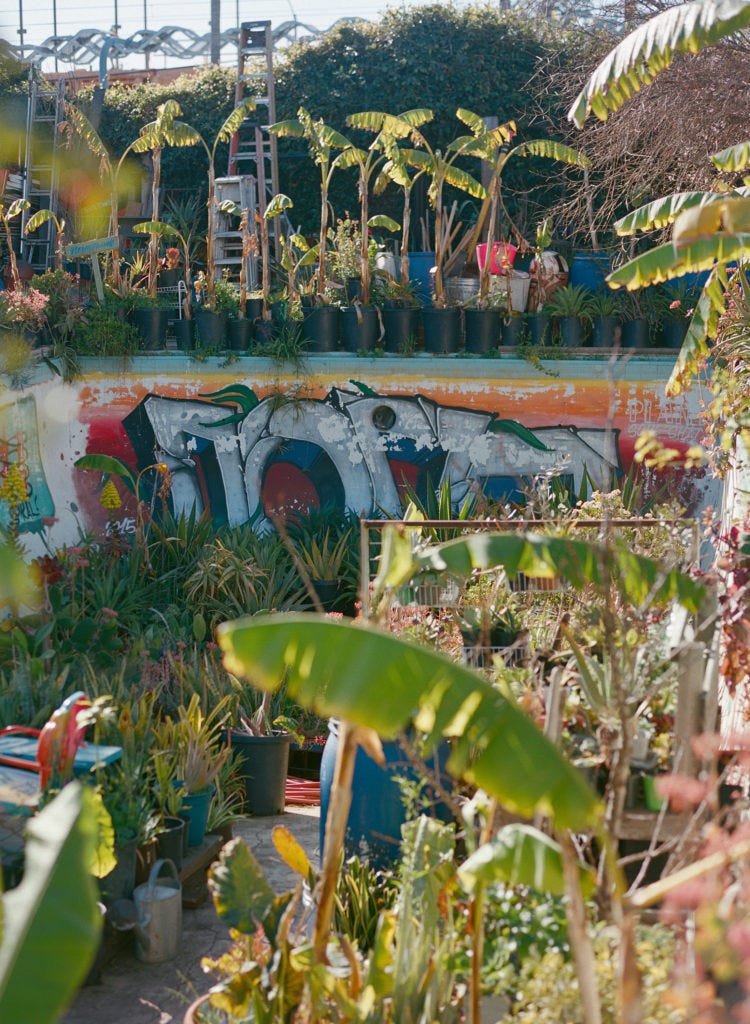
But as with Jarman’s garden, gardening in South Central LA is more than about the production of tomatoes. As Finley says “gardening is the most therapeutic and defiant act you can do, especially in the inner city.” (Though he does add, “Plus, you get strawberries.”)
“Just think about even one percent of us starting to grow our own food. Think how much money that would take out of the system, from healthcare to grocery stores. People growing their own food is dangerous [to the status quo].”—Ron Finley
Clearly these gardens, and the spaces they retrofit, are about politics, race, and culture, as well as environment. These landscapes cannot be captured simply by their pattern of spatial distribution, as if on a typical map spread out in an urban planning office, but the condition of their lived experience in a place; what these spaces do; how they act; and how you are involved, and embedded, within them.
Finley’s struggle with the city’s authorities to pursue these landscapes is instructive. As he says, those 26 square miles is “enough space for 724,838,400 tomato plants. Why in the hell would they not okay this?”. Yet he was issued with multiple warrants for arrest, simply for “growing food on a strip of land (the city) could care less about”, before the authorities began to accept his work.
Similarly, civic organisations like Growing Home in Chicago have cultivated over 800 community gardens and urban farms in some of the most deprived areas of that city. For Klinenberg, these are preeminent examples of social infrastructure, with proven ‘co-benefit’ results across multiple forms of value. He describes significant research by Charles Branas, John MacDonald, and Eugenia South which indicates “not only that small green spaces in poor urban neighbourhoods improve public health but also how they do”.
(See also Soul Fire Farms and Oko Farms in Brooklyn, two community farm projects described in Deem Journal. Soul Fire Farm’s founders produced the book Farming While Black, which points to a decline of African-American farmers in the USA from 14 percent of all growers in 1920 to less than 2 percent today, with a corresponding loss of over 14 million acres of land. The book describes how, and why, to reverse this.)
There are significant doubts as to the productive potential of urban farms, often expressed by a traditional Accelerationist lobbying function solely predicated on productivity increases, profit and export potential, rather than sustainability and equality—or indeed food itself. This is not to say that distributed urban farms, as a variable load, may not require a baseload delivered by a larger agriculture, just as the active transport of walking and cycling ‘sits on top of’ a baseload of larger public transport. The questions concern the relative balance of these curves, not one versus the other.
The potential ‘baseload’ that these small green pieces could produce is still enormous, whether vegetables or social interaction, reduced stress or increased livelihood. How enormous has to be worked out, along with the unintended consequences of such approaches. There are indeed strong critiques of these ‘small pieces, loosely joined’ approaches to farming in particular, such as Greg Scharzer’s No Local: Why Small-scale Alternatives Won’t Change the World, which has little time for these localist, independently-owned initiatives. Yet as with the earlier example of Trisha Greenhalgh’s and Harry Rutter’s assessment of the walking school bus, it is perhaps in the combined holistic value that the numbers work—or at least, the numbers, and the stories, fundamentally change.
When Klinenberg wrote Palaces for the People, he noted there are also plenty of empty lots in Chicago, too; around 20,000 of them, and “most of them concentrated in poor and segregated areas (which) could use more small scale green spaces.” The sheer cost of that space—across every metric from crime to jobs to inequality to maintenance costs to environmental degradation—is rarely factored as input potential into a different equation predicated on the diverse values of sustainable and equitable urban farming.
The form of value produced by such gardens is also diverse. Back in the UK, and to the earlier discussion of ‘upstream’ strategy and policy, it’s been estimated that for every £1 spent by the NHS on gardening projects, £5 can be saved in reduced health costs. For Sue Stuart-Smith, “gardening brings together the emotional, physical, social, vocational and spiritual aspects of life, boosting people’s mood and self-esteem.”
It’s clear that, although tomatoes cannot fundamentally change anything by themselves, these small pockets of green space for food production, placed carefully and supported by active local participation, contain some of the seeds required to change the broader preexisting conditions that both COVID-19 and Black Lives Matter have exposed so vividly.
“It’s time to talk about why Black people face higher rates of COVID-19 infection and death: Because we’re far more likely to live in food deserts, and near dumping grounds, power plants and large-scale animal farms, all of which saddle us with preexisting conditions like asthma, diabetes and heart disease. Those are the same preexisting conditions that authorities attempted to blame for the deaths of Eric Garner and George Floyd. ” — Mary Annaïse Heglar
Next: 40. Slowdown landscapes: Meadow
Previous: 38. Slowdown landscapes: Gardening tools, for convivial conservation
Intro to third batch: 19. The waters draw back, only to return
Intro to Slowdown Papers: 1. Writing the coronavirus to memory
Index: All Slowdown Papers are here