
Past Is Prologue
Archaeology’s Lessons for Confederate Monuments
It’s easy to understand what monuments want us to remember — and harder to see what they wish we’d forget
The murder of George Floyd has breathed renewed urgency into calls for the removal of Confederate symbols from public display. These outcries are by now familiar, echoing the pleas to abolish Confederate flags from statehouses following the AME church massacre in Charleston, South Carolina, and the protests surrounding the Robert E. Lee statue in Charlottesville, Virginia. Activists’ efforts to cast Confederate monuments as symbols of white supremacy have been met with claims of their historical value and defenses of Southern heritage. These disputes play out in public hearings, newspaper editorials, YouTube comments, and especially on social media, where memes mocking the sensitivity of the left or the ignorance of the right continue to circulate (fig. 1).
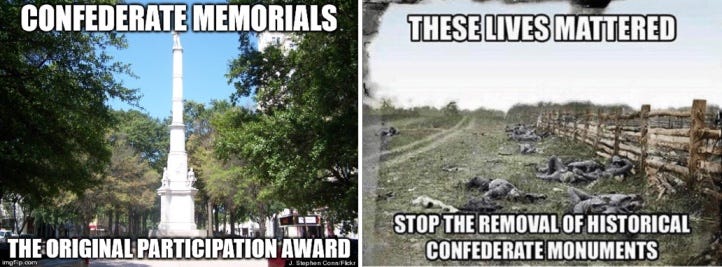
Often overlooked in media coverage of the debates and demagoguery are the monuments themselves. Sweeping pronouncements about their cultural significance are rarely accompanied by even a cursory description of their appearance. Likewise, it has been my experience that, when challenged, few people can summon even the vaguest impression of what Confederate monuments actually look like, though they may cherish them as their heritage. But in a debate about monuments, the monuments themselves matter. We cannot defend, oppose, or claim to understand them without first looking at their symbols, reading their inscriptions, learning their history, and walking in their shadows. What can monuments actually tell us about the past? You don’t hear this often, but archaeology may have an answer.
Some skepticism is warranted. Archaeology is widely considered an esoteric pursuit, a discipline more concerned with trivial debates about ancient garbage than the serious issues of the modern world. I feel this way fairly often myself, particularly on long summer afternoons spent alone in a storage facility 5,000 miles from home measuring broken pieces of pottery. But archaeology, as the study of the past through its material remains, has long grappled with the complexity of monuments and offers valuable frameworks for interrogating our own commemorative landscapes. Archaeologists develop interpretations by considering ancient artifacts in their local contexts and situating them within broader cultural trends. This dispassionate approach is harder to maintain for the Confederate monuments in our own communities. Without historical distance, their impact is more immediate, and the stakes much higher. Nevertheless, archaeological inquiry may prove fruitful. By looking closely at Confederate monuments themselves, we may hope to see their significance in clearer terms and perhaps foster a more productive conversation at the impasse between “heritage” and “hate.” To illustrate this approach, I’ll look specifically at the Confederate Soldiers Monument standing three blocks from my apartment in Durham, North Carolina.
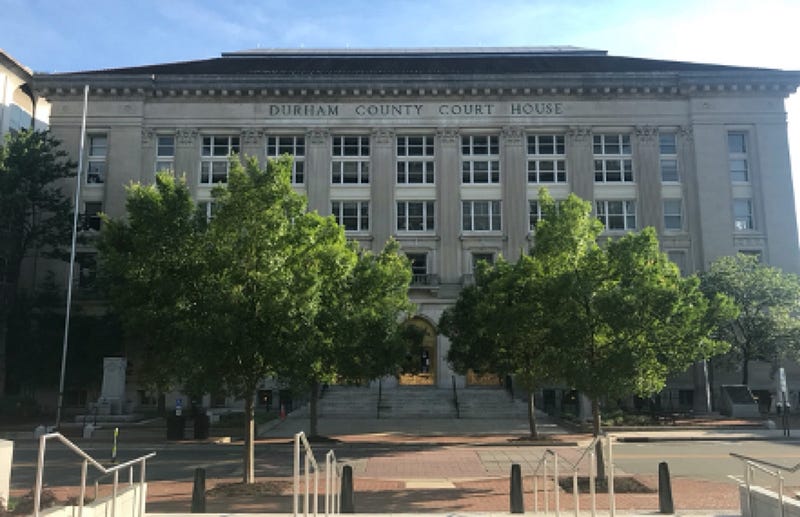
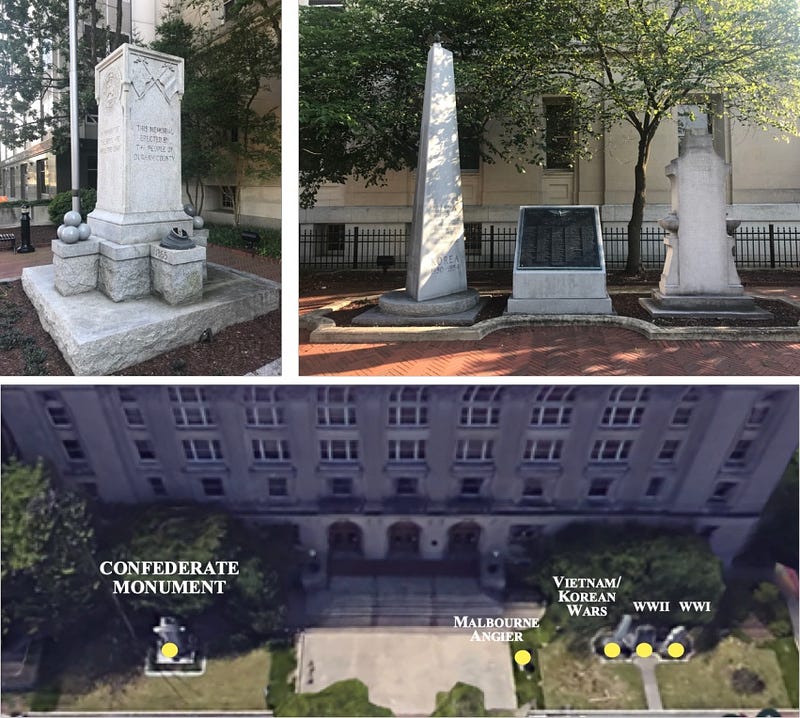
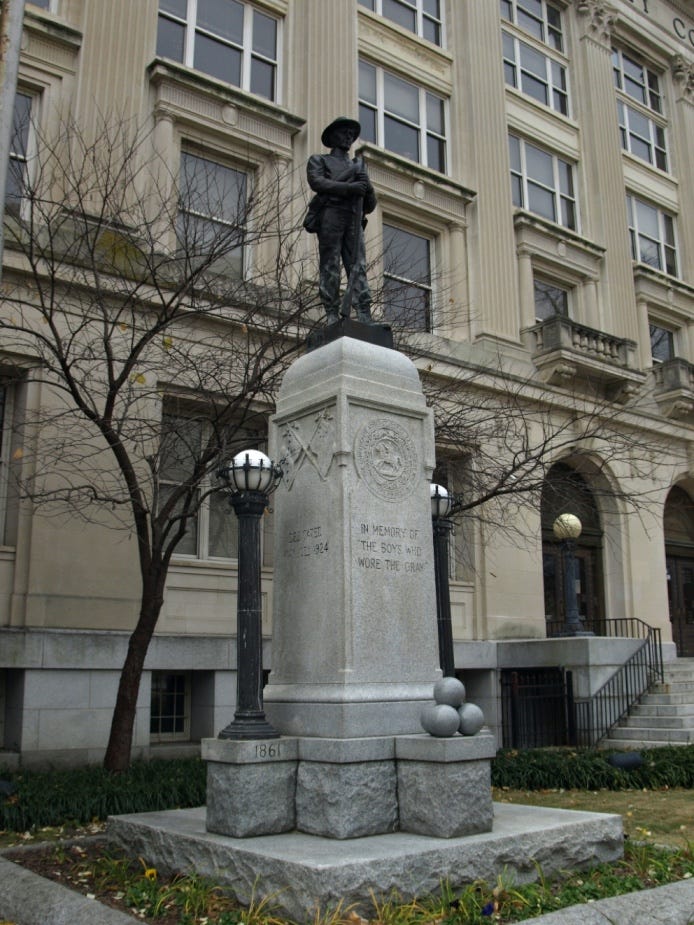
The Confederate Soldiers Monument is located on Main Street in downtown Durham, where it stands in the open plaza fronting the old Durham County Courthouse (fig. 2). While memorials to World War I, World War II, the Korean and Vietnam Wars, and local politician Malbourne Angier crowd the west side of the square, the Confederate monument commands the east side by itself (fig. 3). Its cruciform base of roughly hewn granite supports a plinth serving as the pedestal for a bronze statue of a Confederate soldier (fig. 4). It is the tallest monument in the plaza, but it was once even taller. In 2017, protestors in Durham toppled the bronze statue, and brass lampposts on either side were dislodged shortly thereafter. The base and plinth remain in place today.
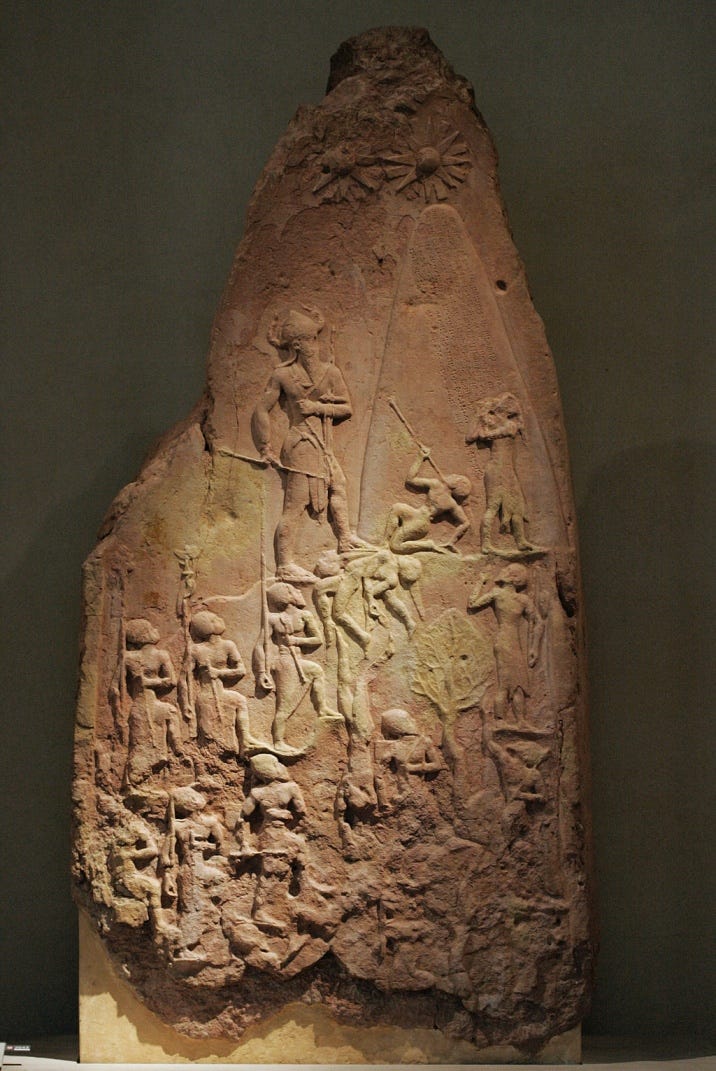
These details are tedious but crucial. A monument’s immediate surroundings, what archaeologists call its context, influence how we understand it. For example, around 2200 B.C., Naram-Sin, a powerful king in the area of modern-day Iraq, erected a monument in the city of Sippar to commemorate a military conquest (fig. 5). A thousand years later, it was plundered by a different conqueror and displayed in Susa, hundreds of miles away. It now resides at the Louvre in Paris. Each move changed the monument. A victory celebration became a war trophy became Bronze Age art.¹
It is instructive, then, to imagine how in another location, the Confederate monument might speak to us differently. In a cemetery, the statue could invite solemn reflection, a curious cenotaph among tombstones. A museum would strip away this sentimentality, presenting the statue as a didactic artifact in an educational gallery. In its current location, the Confederate monument occupies a position of power. It stands in a heavily trafficked area of downtown Durham, highly visible to cars on Main Street and pedestrians passing on the sidewalk. Because the monument resides on public ground, we can infer that its presence is officially sanctioned by the city. With the courthouse as its backdrop, the Confederate statue carries with it the full authority of Durham’s judicial and civic institutions. The west face of the plinth even reads, “THIS MEMORIAL / ERECTED BY / THE PEOPLE OF / DURHAM COUNTY” (fig. 6).
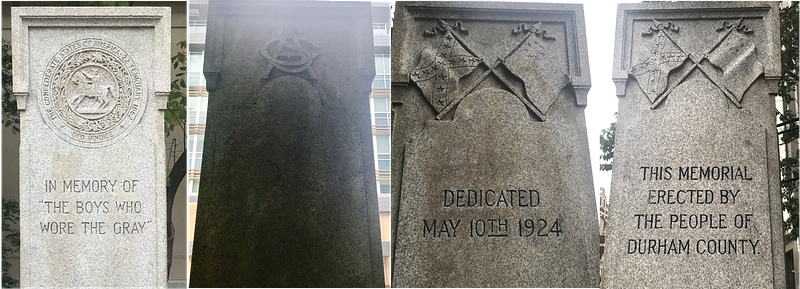
By “people of Durham county” the monument really means the Durham County Board of Commissioners, a governing body of locally elected officials responsible for, among other things, approving public monuments. Ideally, the council’s decisions should represent the will of the voters. So, who were the voters? The inscription on the east side offers a clue: “DEDICATED / MAY 10TH 1924” (fig. 6). At the time of the memorial’s unveiling in 1924, North Carolina was not exactly known as a staunch defender of voting rights. In 1900, the state approved a constitutional amendment requiring a poll tax and literacy test for voters, though a “grandfather clause” effectively exempted poor, illiterate whites. The intended consequences were clear: “The unlettered and unlearned colored man will then cease to be a voter and a disturbing element in the political life of this state” (Durham Morning Herald, August 1900). In local elections, too, specific provisions were enacted to curtail Black representation on the council.² Disenfranchised at all levels of government, the Black community was voiceless when the board of commissioners approved the Confederate monument. Furthermore, when private fundraising efforts for the monument fell short, the state legislature subsidized the cost by raising taxes. In 1924, then, Black residents of Durham paid a mandatory tax to fund a monument they did not commission and could not formally oppose. By declaring the full endorsement of the public in its inscription, the monument silenced dissent and continues to mythologize its support.
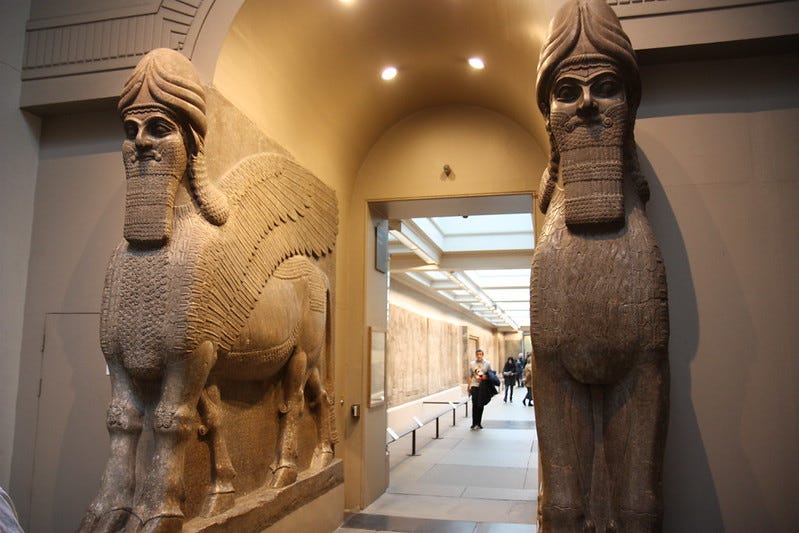
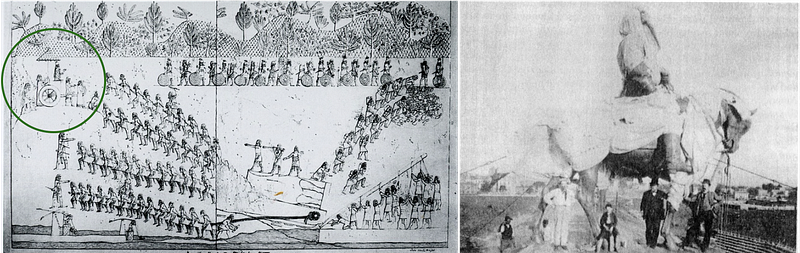
In this way, the very process of making a monument can articulate and perpetuate power structures. When Assyrian king Sennacherib built his great palace at Nineveh in the seventh century B.C., it was not enough to frame each major doorway with massive sculptures of protective deities (fig. 7). He also had to show off exactly how these monuments were made, from the extraction of natural resources to their installation in his palace (fig. 8). Wall carvings show the king at the top of a hill, shaded under a parasol in his chariot, while below him teams of laborers drag the sculpture across the landscape. He built a monument to commemorate the building of his monument. Likewise, a photograph taken during the erection of the Robert E. Lee statue in Richmond, Virginia, captures a group of well-dressed white men posing proudly in front of the monument as Black workers hoist it up behind them.
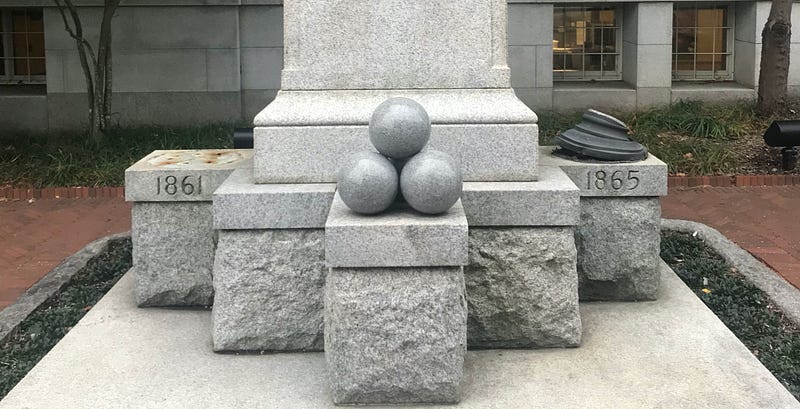
The timing of the Confederate monument’s construction is curious. While the east face notes its dedication in 1924, the north side supplies the dates of the Civil War (1861–1865) (fig. 9). We learn that the Confederate monument was erected 59 years after the fall of the Confederacy. By contrast, the World War I memorial at the other end of the plaza was built in 1921, only two years after the war it commemorates. Why did a Civil War monument suddenly appear in 1924?
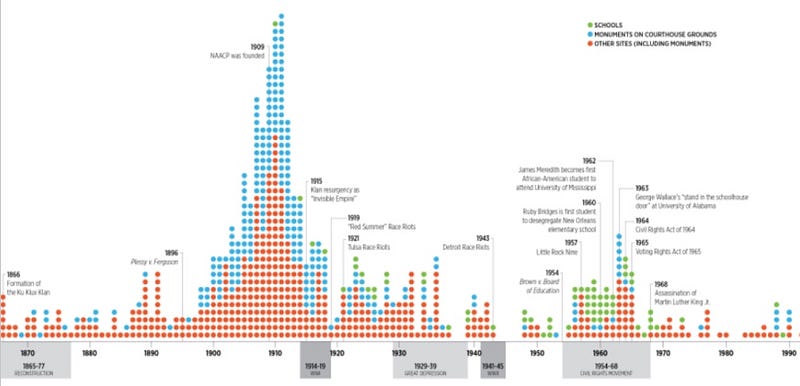
Most Confederate statues were not built in an outpouring of national grief immediately after the Civil War, but many decades later in the 20th century.
It is telling that, at the time, Durham was home to one of the country’s most prosperous Black communities. The historic district of Hayti and Black Wall Street downtown boasted hundreds of businesses by the early 20th century, including the North Carolina Mutual Life Insurance Company, the largest and most successful Black-owned company in the United States. In 1910, Booker T. Washington visited Durham and deemed it “a city of Negro enterprises.”
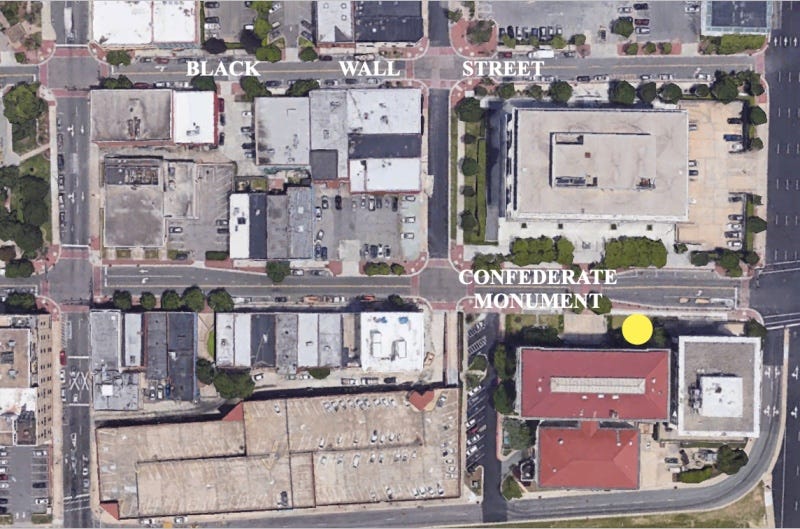
Black Wall Street stretches across Parrish Street, half a block from the courthouse, or about a 45-second walk (fig. 10). This proximity is alarming. When Durham’s Black community built a home downtown, the Confederate monument moved in next door. In 1924, its presence was a menacing reminder from Durham officials that Black success in American business bought them no power under American law. By considering the historical circumstances and spatial context of the monument’s construction, we can detect in the white community’s effort to project power an underlying fear of its Black neighbors.
This phenomenon was not confined to Durham. Most Confederate statues were not built in an outpouring of national grief immediately after the Civil War, but many decades later in the 20th century. It is frequently noted that their construction surged at two points: the early 1900s and the 1960s, coinciding first with the passage of Jim Crow laws and rise of racial terror under the KKK and later with the civil rights movement (fig. 11).
Viewed in this context, Confederate monuments are less shrines to the war dead than instruments of targeted intimidation. Whereas Durham’s World War I and World War II memorials both feature olive branches in gestures of peace, the Confederate monument prominently displays weaponry (fig. 12).
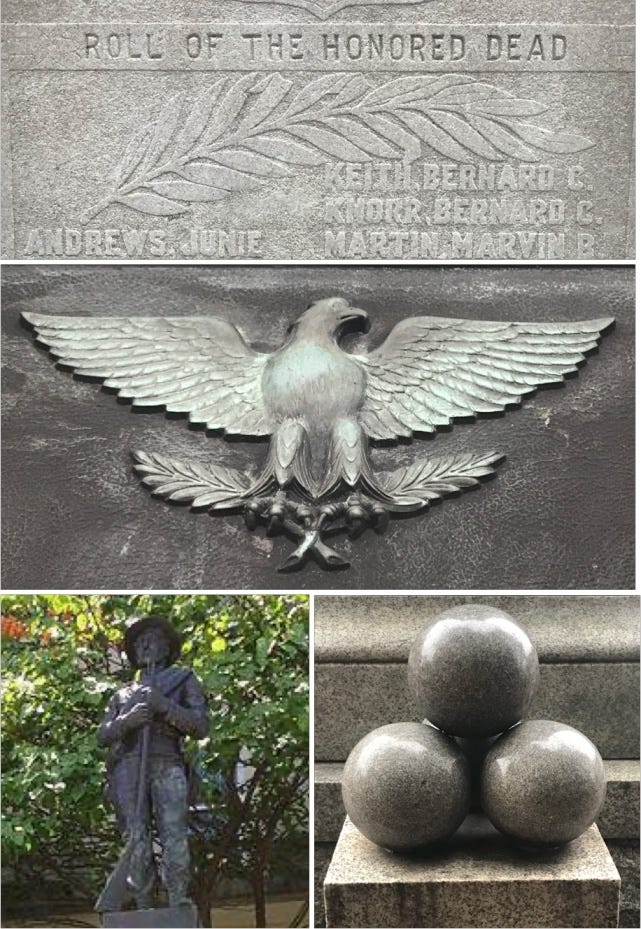
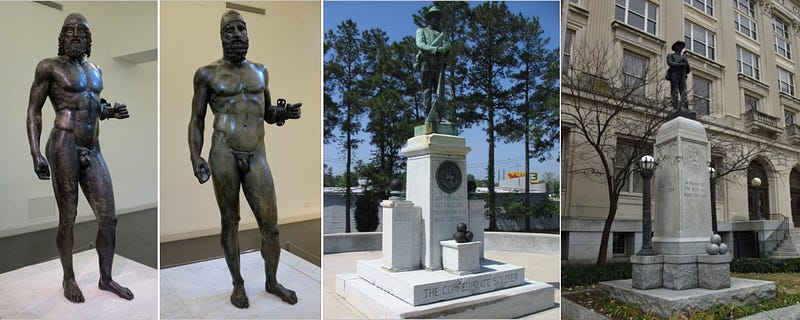
The north and south sides of the base support stacks of cannonballs, and the uniformed Confederate soldier on the pedestal faces Black Wall Street and brandishes a rifle, gripping the barrel with both hands and resting the butt at his feet. Footage of the 2017 protest shows that this statue crumpled on impact when it was pulled to the ground. It turns out that Durham’s tax dollars had bought the city not a unique artistic production, but a frail sheet of molded bronze. Classical archaeologists have spent too much time with mold-made sculptures to let this slide. We’ve puzzled through descriptions of the lost wax technique, compared countless bronze limbs and torsos, and catalogued too many identical terrra-cotta figurines (fig. 13).
Molds facilitated the mass production of Confederate soldier statues, allowing companies to fabricate them cheaply, quickly, and on a vast scale, the same way plastic action figures are made today. These legions of indistinguishable bronzes were rapidly deployed in cities across the South, garrisoned in courthouses, parks, and boulevards. Durham ordered its monument from the McNeel Marble Company. A nearly identical memorial was dedicated in Kinston, North Carolina, on the very same day, May 10, 1924 (fig. 13).
If monuments remind us of our past, what does the Confederate monument want us to remember? The inscription on the north face makes it clear: “IN MEMORY OF / ‘THE BOYS WHO / WORE THE GRAY’” (fig. 14). The tone is sentimental and nostalgic, conjuring visions of uniformed adolescents marching to battles already lost. What were these anonymous boys fighting for?
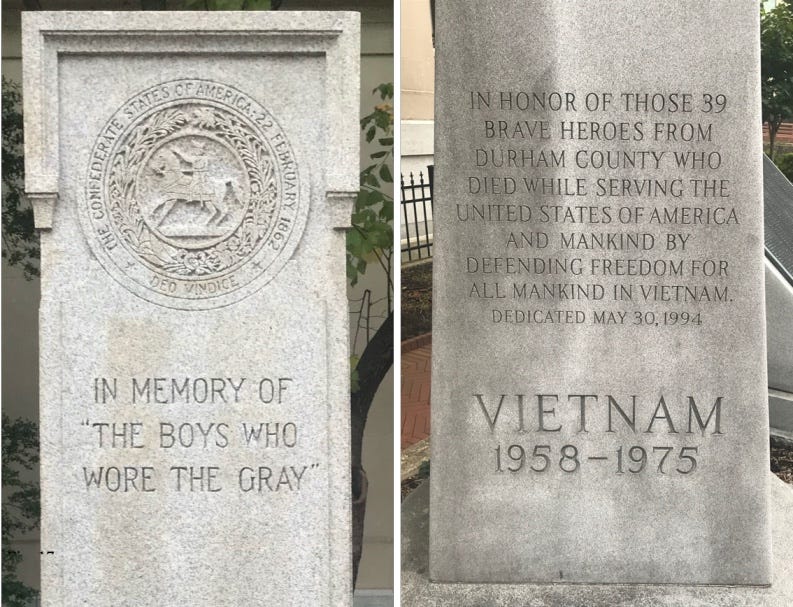
The monument to the Vietnam and Korean wars claims that their soldiers “DIED WHILE SERVING / THE UNITED STATES OF AMERICA / AND MANKIND BY / DEFENDING FREEDOM” (fig. 14). By contrast, the Confederate Soldiers Monument offers no reason for their sacrifice.³ However, there are clues. The seal of the Confederate States carved just above the “boys in gray” inscription features a representation of George Washington on horseback (fig. 15).
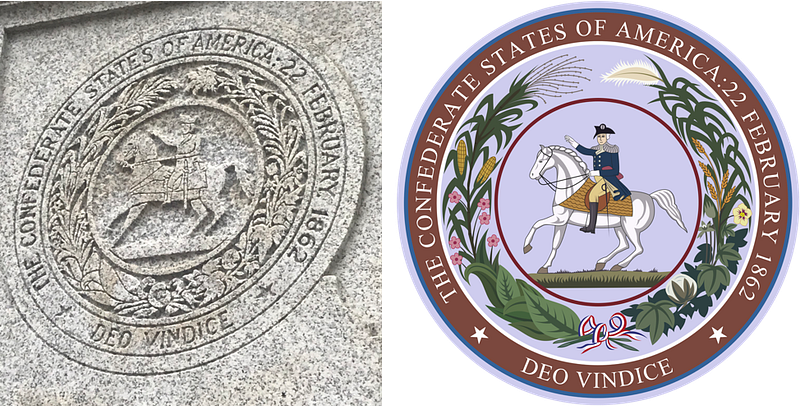
Washington, of course, served as the Union’s first president and died in 1799. He has no historical connection to the Confederacy. The use of his image, then, serves an ideological purpose. It links the Civil and Revolutionary wars, aligning the Confederate cause with the birth of the nation. The Civil War is cast as yet another rebellion against tyranny, the South’s war of independence. Archaeologists should recognize this strategy. Repressive regimes have always cloaked their reforms in symbols of tradition, couching radical changes in familiar patriotic terms.
The Confederate monument not only hides the cause of the war, it lies about the outcome.
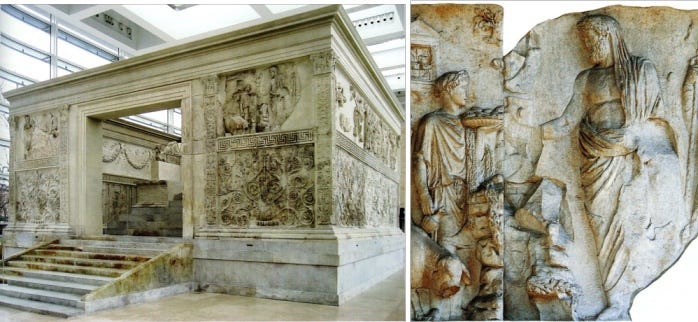
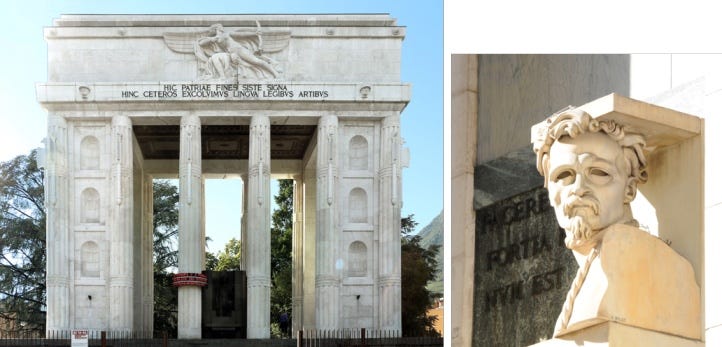
This is why Augustus blanketed Rome with images of Aeneas, the city’s legendary founder, while simultaneously dismantling its republican institutions (fig. 16). Two thousands years later, Mussolini decorated his explicitly fascist Monument to Victory in Bolzano, Italy, with the faces of heroes from the First World War, making them martyrs for a cause they never championed (fig. 17).⁴ What the Confederate monument doesn’t tell us is that, in his will, Washington ultimately freed his slaves. The boys in gray fought to keep theirs.
The Confederate monument not only hides the cause of the war, it lies about the outcome. On the west side of the square, the World War I memorial features a shield of stars and stripes, and the World War II memorial displays a bald eagle (fig. 18).
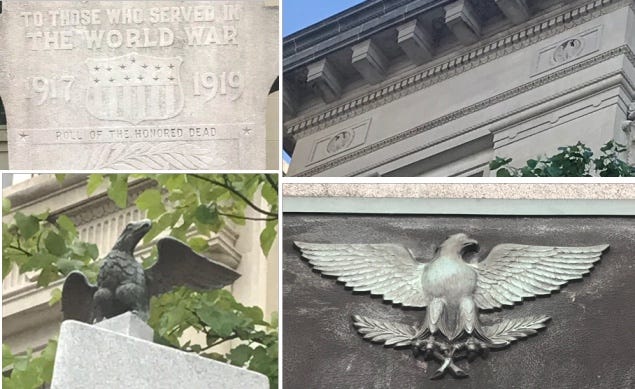
Another bald eagle is perched atop the memorial to the Vietnam and Korean wars, and still others guard the architrave of the courthouse. Although built at different times, these monuments work in concert to promote a unified program of patriotic American iconography. But in another telling contrast, there is not a single symbol of the United States on the Confederate monument.
Toppling the statue did not erase history; the monument has been erasing history all on its own for nearly 100 years.
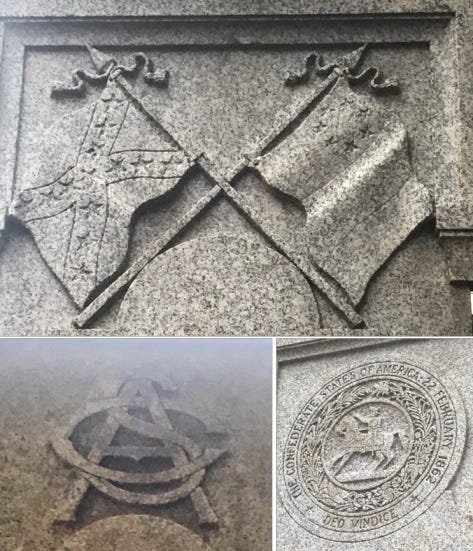
The north side of the plinth shows the seal of the Confederacy, the east and west faces both display the Confederate national and battle flags, and the south face is marked with the CSA monogram, Confederate States of America (fig. 19). Confederate symbols are visible at every angle. To modern eyes, this iconography might suggest that the monument was raised during the period of secession. But we already know that it was built in 1924. The monument offers no indication that the Confederacy had been defeated in the previous century. There are no gestures toward reconciliation or unity, only signs of defiance. Sixty years after the war, a powerful circle in Durham either believed they were still living in a Confederate state or tried hard to make it look like one.
So, does the Confederate monument honor soldiers who died in the Civil War? Of course it does, it says so right on the front. But a monument of this size, in this place, built at that time, by those people, with these symbols, does so much more. It is a project “erected by the people” that excluded the Black community, a memory of 1865 “dedicated in 1924,” an American monument with no American symbols, a statue that honors the “boys in gray” with no mention of their Black slaves, a war memorial that can’t remember the reason for the war, a victory monument for the Lost Cause. Toppling the statue, then, did not erase history. The monument has been erasing history all on its own for nearly 100 years: the history of slavery’s role in the Civil War, of the Confederacy’s defeat, of Black commercial success and political disenfranchisement. Like all monuments, it reveals more about its makers than the people it commemorates. It teaches us nothing of the Civil War, but speaks volumes about Durham, North Carolina, in 1924. Monuments gesture to the past, but they stand firmly in the present and never fully shake the trappings of their time. Archaeology lays bare these contradictions. It teaches us to be skeptical of our monuments, to notice that what they say is often not the same as what they actually do. It is easy to understand what monuments want us to remember; we must look harder to see what they want us to forget.
It would be naive to charge archaeology with resolving our culture wars. There are many ways to look at monuments, and our understandings will always be somewhat personal. But if you find yourself in a debate with friends or family, try steering the conversation toward an actual monument. Invite them to look at pictures, or better yet visit the site together. Without doing any research, see if you can figure out who or what it commemorates, what it is made of, when it was built, and what else was around at the time. People enjoy this kind of problem-solving. Think about the audience. What type of space is it in? What buildings surround it? Has the area changed over time? Look at its symbols. What ideas or institutions are represented, where else do you see the same images, what feelings do they evoke? Read the inscriptions. How much information does the monument actually give you, and how much is left unsaid? Try imagining if it were shorter, or made of fancier materials, or placed in a different neighborhood; how would your understanding change? Most of all, think about whose story it elevates, and whose it hides. You may not reach a consensus, but at least you would be asking the right questions.
What should we do about Confederate monuments? There is always a reflex toward preservation. We tend to value monuments for their permanence, authentic witnesses of bygone eras. But in truth monuments are rarely as stable as they appear. Stonehenge was in a state of flux for thousands of years before it settled into the form we recognize today. If Neolithic farmers were compelled to rearrange their sarsen rocks and bluestones every few decades, we should feel comfortable remaking our own megaliths to reflect contemporary values. Monuments should perhaps be respected, but they do not need to be revered. Some decry the radical vandalism of protestors, but it is clear that letting Confederate monuments stand unchanged promotes a much more radical agenda. There have been numerous proposals, from destroying them completely to exhibiting them in museums. But by simply removing these monuments, we risk forgetting how visible they once were. I suggest that Confederate monuments be buried exactly where they stand, sealed under a pavement inscribed with the statue’s name, height, date of construction, and date of interment. Archaeologists of the future will decipher these words, excavate the soil, uncover the statues, and understand that in this stratigraphic sequence, a community confronted the truth of its past and strived for something better. I don’t know what statues will rise in their place. I suspect that the very process of designing and debating will help us articulate the values of a new American age. We should not be surprised when even these monuments fail to satisfy the next generation.
Notes
- For more details about how the Victory Stele of Naram-Sin changed over time, see Crawford, Catherine Lyon. 2007. “Collecting, Defacing, Reinscribing (and Otherwise Performing) Memory in the Ancient World.” In Negotiating the Past in the Past: Identity, Memory, and Landscape in Archaeological Research, edited by Norman Yoffee, 10–42. Tucson: University of Arizona Press.
- For a comprehensive treatment of Durham’s history see: Anderson, Jean Bradley. 2011. Durham County: A History of Durham County, North Carolina. 2nd ed., rev. expanded. Durham: Duke University Press.
- These observations about the monument’s silence concerning the cause of the Civil War are inspired by the work of Kirk Savage, who has called attention to how Confederate and Union monuments alike fail to grapple with the legacy of slavery: Savage, Kirk. 1994. “The Politics of Memory: Black Emancipation and the Civil War Monument.” In Commemorations: the politics of national identity, edited by John R. Gillis, 127–149. Princeton, N.J: Princeton University Press.
- For the history and modern re-contextualization of the Monument to Victory in Bolzano see: Hökerberg, Håkan. 2017. “The Monument to Victory in Bolzano: desacralisation of a fascist relic.” International Journal of Heritage Studies 23 8: 759–774.
Sources for fig. 8:
- Barnett, R. D., Bleibtreu, E., Turner, G., & Collon, D. 1998. Sculptures from the Southwest Palace of Sennacherib at Nineveh. London: British Museum Press.
- Savage, Kirk. 1994. “The Politics of Memory: Black Emancipation and the Civil War Monument.” In Commemorations: the politics of national identity, edited by John R. Gillis, 127–149. Princeton, New Jersey: Princeton University Press.


