
About The Writing Cooperative
The Writing Cooperative Submission Requirements and Style Guide
Updated December 9, 2023

The Writing Cooperative is one of Medium’s largest publications. We strive to publish high-quality stories that support and encourage writers of all types. Being selected for publication ensures a global audience will read your work and increases the chance of broader distribution and boosting through Medium’s network.
This guide is designed to maintain our high standards and provide guidance as you write, edit, and submit a draft. This document is frequently updated. Please refer to the Change Log at the end for a list of changes.
We prefer all submitted drafts are submitted behind Medium’s Partner Program paywall (see Rule 2b) and do not provide direct payments or financial compensation.

- What We Publish
- Submission Rules
- Style Guide
- Request to Contribute
- Submit a Draft
- Disclosures
- Questions?
- Change Log

We publish unique, high-quality articles that focus on creativity, writing, editing, publishing, and everything in between. We’re looking for original stories based on personal experience that help writers improve their craft. All submissions should provide unique, experience-based, and well-researched information that offers a creative perspective our readers can apply themselves.
Your personal experience is invaluable and should be featured extensively in your writing. However, your experience should be the frame for what readers can learn and apply in their writing. Remember that you’re writing for a global audience and not yourself.
All submissions should help writers grow. Our audience is made up of writers like you who are looking for advice, tips, and encouragement. Use your experience to help the reader learn from your choices, tips, and education. Each submission should clearly explain why you are the perfect person to provide the advice presented.
While we have a wide breadth of articles that we accept, there are multiple types of submissions we are not interested in publishing. Avoid submitting anything that doesn’t consider the reader and what they will learn or take away from your article.
Here are a few types of articles we are not interested in publishing:
- Anything that could be called content.
- Shortform content or anything under a three-minute read.
- Standard or common advice, like writing daily or breaking grammatical rules.
- Listicles of any kind.
- Articles presenting takeaways based on quotes from other authors.
- Articles focusing on overused sources like Stephen King’s On Writing or Neil Gaiman’s MasterClass. Yes, these are excellent sources of inspiration, but plenty of other options exist. Present sources that are unique, new, or otherwise compelling.
- Content solely focused on Medium — our publication provides advice and inspiration to writers of all types, not just those using this platform (see Rule 5c).
- Reviews of writing tools, services, or platforms that do not consider alternatives or offer comparisons. While well-intended, single-item reviews are spammy (see Rule 6).
- Stories about how you made $x in x-months. We’re not interested.
- Stories written or that could have been written using generative AI (see Rule 5f).

Opinions presented in the publication are those of the author credited on each story, who also holds the copyright to the content. Only stories authored by Justin Cox contain official statements and positions of The Writing Cooperative.
Writers may remove stories from the publication at their discretion. However, writers who habitually pull stories without notice may lose the ability to submit in the future.
By submitting to the Writing Cooperative, you agree to comply with ALL of the rules and requirements outlined below.
Writers whose submissions are repeatedly rejected for violating our rules will lose the ability to submit to The Writing Cooperative without notice or explanation.
Rule 1: Medium’s Rules
Submissions must comply with Medium’s Rules, Plagiarism Guidelines, Duplicate Content Policy, Ad-Free Policy, and Distribution Standards. Stories violating Medium’s rules will be reported.
Rule 2: Distribution
2a: Unpublished
Submissions must be unpublished on Medium. This ensures stories gain the most exposure possible. Your submissions may be republished to or from your blog or another publication outside Medium when following Medium’s republishing guidelines.
2b: Paywalled
We prefer articles behind Medium’s paywall. Placing stories behind Medium’s paywall allows writers to receive compensation through Medium’s Partner Program. The Medium Partner Program is the only form of payment offered to writers of The Writing Cooperative.
Rule 3: Nonfiction
Submissions must be nonfiction. We do not publish fiction or poetry.
Rule 4: Family-Friendly
Submissions must be family-friendly. We reserve the right to reject offensive or inappropriate articles.
Rule 5: Content
5a: Quality
Submissions must be unique, well-organized, and of high quality. Anything derivative, too abstract, unclear, meandering, lacking a clear purpose or takeaway, or not focusing on creativity or writing will be rejected. Personal takes and opinions are welcome, but diary-like blog posts are not.
5b: Clickbait-free
Titles and subtitles must not be anything considered clickbait. This includes any title that withholds context, over-promises, exploits, is overly hyperbolic, misleads, or relies on gimmicks. Clickbaity titles and subtitles may be changed, or the submission may be rejected.
5c: Not Medium-centric
Anything solely focused on Medium is rejected. We want to help all writers improve their craft everywhere they write and publish. Passing mentions of Medium are permissible.
5d: Cite all sources
Every reference, claim, quote, or acknowledgment must be backed with evidence and links to a primary source. Secondary sources are acceptable only when primary sources are unavailable. Submissions making claims without citing or linking to sources will be rejected. When citing sources with references or end notes instead of inline links, please follow the formatting provided in 8d.6.
Sources must be cited using inline links or with an identifiable footnote. Submissions with a vague list of sources at the end of the article will be rejected.
5e: Absolute free
While we seek to aid writers of all backgrounds, we acknowledge that everyone is different. What works for one person may not work for another. As such, any submission based on an absolute claim will be rejected. For example, submissions titled “Why You Can’t Live Without X” or “Writers Should Never Do Y” are rejected. Subsequently, these titles typically are too hyperbolic and fall under Rule 5b above.
5f: Generative AI
While generative AI tools can benefit idea generation, they should not be used to create entire works. These pieces do not draw upon your experience and are often soulless and uninteresting. Do not submit anything written solely using a generative AI tool.
Furhter, any submission that could have been written by generative AI will be rejected. If the article lacks any personal experience or depth, we don’t want to publish it.
When using a generative AI tool to create any portion of your submission, you must cite it like any other source. Include a disclaimer at the end of the submission indicating an AI tool was used to write a portion of the article. Submissions suspected of using generative AI without citation will be rejected.
Images using generative AI tools are acceptable and must be cited following the image rules in section 8b below.
Rule 6: Spam
Submissions must not be spammy. We do not publish stories solely intending to sell or promote a book, blog, service, tool, or anything we deem a product. Honest product reviews and comparisons that help our community make informed decisions are acceptable; ads or press releases are not.
Writers may promote their book, blog, service, tool, or other product with a short text link at the bottom of the story according to Rule 7 and Medium’s recommendations for a call to action.
6a: Affiliate disclosures
Affiliate links and product endorsements must be appropriately disclosed in an obvious and unavoidable way. Failure to disclose affiliate links or products provided for promotional review may violate the law.
Affiliate links must be disclosed by adding (affiliate link) next to the link in question or by providing an affiliate declaration in the submission. Anything containing undisclosed affiliate links may be rejected.
Stories using a link-shortening service like Bit.ly to obfuscate affiliate links will be rejected.
Requests to join Medium using an affiliate link are not permissible and the affiliate program was depreciated in September 2023.
6b: Inline links
Please link to other content in your story, especially other Writing Cooperative articles. This helps enhance your story’s Search Engine Optimization (SEO) through discoverability. Links should be inline, like this one here, and relevant to your point. An overabundance of self-promotional links or anything that feels “spammy” is not permissible.
6c: Embedded links
Stories may contain a maximum of three self-promotional links using Medium’s embedded card-style links. See the example of an embedded card-style link below.
6d: Tagging writers
Tagging other Medium members is only acceptable when the reference is relevant. For example, when quoting another Medium author, link to the story and tag the author. Stories overusing tags are rejected as spam.
Rule 7: Call to Action
Submissions must be free of most calls to action (CTA).
A CTA is something requesting the reader do something. Any request should follow Medium’s best practices, be a reasonable request, include less than three lines of text, not capture user information, not be entirely in bold, and must follow the standard formatting rules (see Rule 8d). CTAs using section headings or quote formatting of any kind will be removed.
Each CTA must be discreet and in the reader’s best interest. Requests to join Medium with an affiliate link, clap, read slowly, or provide support through a payment platform (including Venmo, Square Cash, etc.) will be removed. Additionally, keep social media follow requests to a minimum. Additionally, any list of links, either embedded or inline, suggesting a list of articles to read next will be removed.
CTAs must appear at the very end of a submission. Anything considered an “author’s biography” must also comply with these rules and are not permissible in addition to a CTA. Please optimize your Medium profile to contain any biographical information.
We will remove CTAs that do not comply with these rules from submissions that are otherwise compliant and ready to publish.
Rule 8: Publication Ready
Submission must be ready to publish. Our Style Guide, included below, is an extension of this rule. All submissions must be appropriately formatted, contain unique and correctly cited images, and have engaging and descriptive titles. Writers are expected to fully edit and vet all pieces before submitting them for publication.
8.1 Error-free
Stories must be written in fluent English and free of spelling, grammatical, and language issues.
👀 The Writing Cooperative recommends ProWritingAid (affiliate link) for catching obvious spelling and grammatical issues before submission. Want a discount? Become a supporter on my website!8.2 Paragraph format
Submissions containing improperly written paragraphs and overusing one- or two-sentence paragraphs are rejected.

Submissions must follow our Style Guide in its entirety. This ensures readers encounter a consistent reading experience throughout our publication.
All writers are encouraged to read our guide, So, You’re New To Medium…, to learn about Medium’s formatting tools before submitting.
8a: Titles and Subtitles
8a.1: Clarity
Submissions must have a clear and descriptive title and subtitle at the very top of the story. The title and subtitle should be the first thing a user sees.
8a.2: Title case
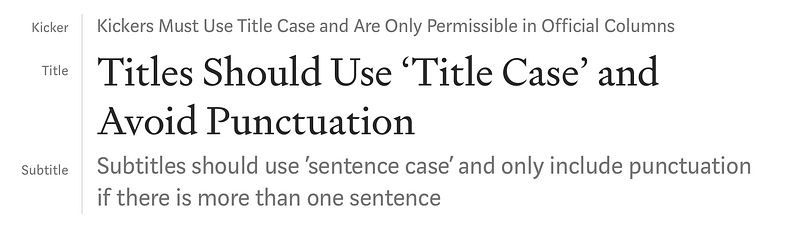
Titles must be written in title case. Subtitles must be written in sentence case.
8a.3: Quotes
Quotes in titles should use single quotes (‘ and ’).
8a.4: Standard formatting
Submissions should use Medium’s built-in title and subtitle formatting. Adding a kicker above the title is permissible only in official series or columns managed and approved by The Writing Cooperative.
Submissions with a link in the title or subtitle, written in all capital letters, or containing profanity of any kind are rejected.
Here is an example of a properly formatted title:
8a.5: Search engine optimization
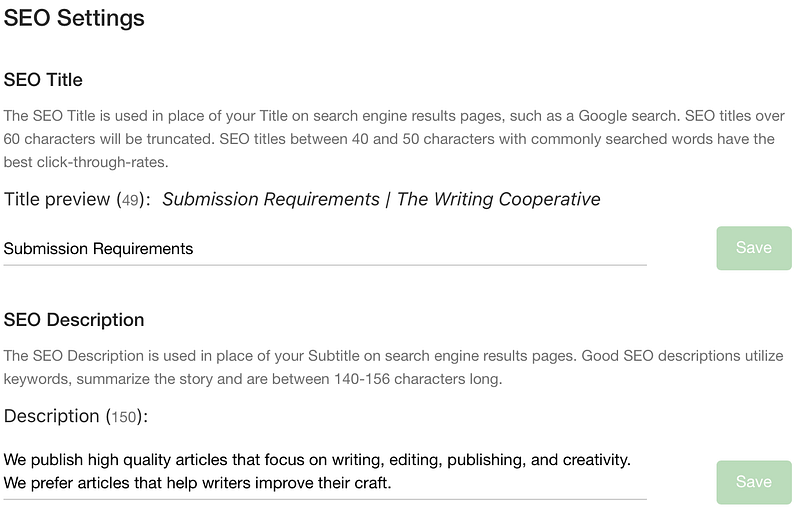
Please update the SEO title and description when changing a submission’s title or subtitle. Medium doesn’t always update these automatically. To change the SEO title and subtitle, click the “…” button in the editor, select “More settings,” and then scroll to “SEO Settings.”
8a.6: Examples of acceptable titles
- Acceptable Title: How to Write Articles That Sell: A Beginner’s Guide to Freelance Writing
- Unacceptable Title: 3 Ways To Become A Freelancer Writer In 3 Minutes
- Acceptable Subtitle: Treat writing like a 9-to-5 job, and other practical lessons from Salman Rushdie
- Unacceptable Subtitle: #3 will blow your mind!
8b: Images
All submissions must include a unique featured image right BELOW the title and subtitle.
8b.1: Choosing images
All images must be something the author has a legal right to publish. Medium is partnered with Unsplash to add pictures with proper citations to every submission. While this integration makes adding images easy, please do not use the same overused writing-centric images. Be creative with your searches and find pictures that align with your content.
Featured images should be eye-catching, unique, related to the article, and largely text-free.
When using an image containing text, all words must be legible when cropped to center-square format as presented in the publication feed.
Stories containing an overabundance of images will be rejected or have pictures removed without notice. Images should enhance the story, not distract from it.
8b.2: Inline
Featured and additional images must use Medium’s “inline” image format.
8b.3: Gifs
Gifs, while permissible, should only be used when they add value to a submission. A gif may be used as the featured image if it complies with the rules governing featured images above. Gifs are capped at three per submission.
8b.4: Image citation
All images must include a caption citing the source and usage rights, even if it is a photo taken or created by the author. The citation should convey the image's usage rights when not using the automatically generated citations from Unsplash.
When an image is provided by the author or permission has been granted individually, the citation should read Photo Courtesy of Person Who Provided the Image or Photo Credit: Person Who Took The Photo. When none of the above apply, Source: Studio or Provider may be used ONLY if the image falls under fair use.
Submissions containing images with unclear or improperly cited credits will be rejected. We reserve the right to remove questionable images from otherwise acceptable submissions.
8c: Section Headings
Section headings help break up large blocks of text and benefit the article’s search engine optimization. All submissions should be split into well-organized sections using correctly formatted section headings.
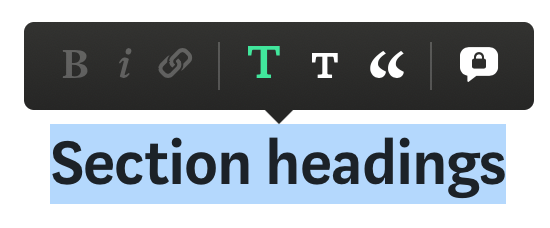
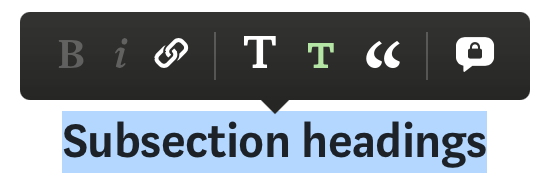
There are two types of section headings: section headings and subsection headings. Section headings are larger (H2), and subsection headings are smaller (H3).
Bold text is never acceptable as a main section or subsection header.
8c.1: Main section headings (H2)
Main section headings (H2) can be written in title case or sentence case without trailing punctuation. The choice between title case and sentence case should be consistent throughout the submission. Main section headings should be one sentence long at maximum.
Main section headings should use Medium’s big-T title option. This is available using a keyboard shortcut (Mac: Cmd+Opt+1; Win: Ctrl+Alt+1) or highlighting the text and selecting the larger “T” icon.
The only exception is when section headings denote questions in an interview, as in the Write Now series. In this case, the smaller subsection headings option should be used, and the sentence case heading should end with a question mark.
If you import a story to Medium previously published on WordPress, all section headings will be the little-T option. You must reformat each header to the proper format.
8c.2: Subsection headings (H3)
Breaking main sections into subsections, like the one above, is encouraged, and should use Medium’s little-T title option. This is available using a keyboard shortcut (Mac: Cmd+Opt+2; Win: Ctrl+Alt+2) or highlighting the text and selecting the smaller “T” icon. Subsections should be written in sentence case. Subsection headings should not be more than one sentence long.
Additionally, subsections should have at least one paragraph and, ideally, multiple paragraphs. The subsection heading should not be longer than the paragraph.
8d: General formatting
All submissions should include proper formatting to use Medium’s standard tools.
8d.1: Text formatting
Use Medium’s tools for formatting text.
8d.2: Importing
When importing a story from another source, ensure the formatting is correct before submitting it for publication.
8d.3: Drop caps
Drop caps are not permissible.

8d.4: Lists
Ensure lists trigger Medium’s automatic list formatting. Lists activate when a paragraph begins with an asterisk (*) or a dash (-). Imported stories often must be reformated.
8d.5: Quotes
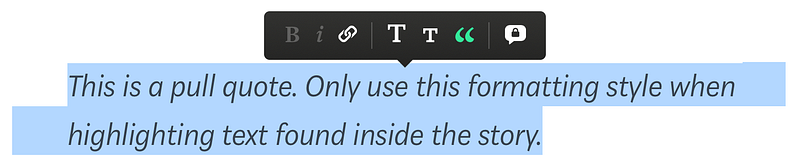
Pull quotes and block quotes must be appropriately used and not used as section headings or as a way to emphasize text. Pull quotes should only draw attention to the text found elsewhere within a story’s content. Pull quotes cannot be used to quote someone else; that’s what block quotes are for. Neither may be used as a method of formatting text.
Inline quotes should use proper punctuation where closing quotes are found outside of enclosing punctuation. For example, “this is a correct quote.” “This, however, is an incorrect quote”.
Inline quotes should use two quotation marks (") for first-level quotes and single quotation marks (') for second-level quotes. For example, “I heard you say ‘let’s go for it’” is a properly formatted sentence.
8d.6: References and endnotes
Adding references and citations throughout a story is encouraged when references do not make sense in the body of the article. When considering citations, use Medium’s inline superscript formatting. To output a number, such as 6⁷ or title⁸, type in 6^7 or title^8.¹
At the end of the submission, include the reference notes referring back to the numbered items. Use a large section header or regular body text in bold to title your references. See an example below:
References: ¹ Medium Help Center: Using the story editor.
8d.7: Code
Should a submission require describing keystrokes like the ones described in the above section, consider using Medium’s built-in code formatting. Type ` in the middle of a sentence for inline code like this. End the inline code with another `. To include an entire block of code, use ``` at the start of a new paragraph. (Ironically, you can’t capture an ` in the code format.)
8d.8: Tags
All submissions should include five tags.
Medium only shows the first tag used in the feed, and writing is redundant to our publication. Everything we publish is about writing, so this tag provides the reader with no additional insight.
Use the first three tags to be hyper-specific about your article. For example, if the article is about marketing a book, consider using the tags marketing, books, and book marketing. If the submission is about why writers create self-limiting beliefs, consider psychology, self-limiting beliefs, and self-improvement as your three tags. Try to be as specific as possible, and don’t chase popular tags.
General tags like writing and creativity may be used as the final two.
8c.3: Dividers
Section dividers break up a thought or create a visual pause for the reader. As shown in the example below, these should never precede a main heading, as Medium automatically provides proper spacing.

New writers must request to contribute by filling out our Writer Request Form. Filling out the form does not guarantee addition as a writer, nor does acceptance as a writer guarantee publication of submissions. Requests to contribute via email, private note, social media message, or any process other than the request form below are ignored.
Each new request is handled manually and only processed once or twice a month. Please be patient and wait for a confirmation email to arrive.
👀 Request to write for The Writing Cooperative.
Anyone listed as a writer for our publication may follow Medium’s process for submitting a draft to a publication. All submissions must be made using this process. Emails containing pitches, submission requests, links, or attachments are ignored and possibly considered spam.
We receive dozens of weekly submissions, and manually evaluating each takes time. Submissions are only reviewed on weekends, so processing your request may take a week or more. Select subscribers on my website receive an expedited review of their articles.
If a submission is not fit for publication, it will be rejected. In most cases, we’ll leave a private note explaining the issue. Stories are occasionally rejected without a private message if the author has disabled the feature or the violations are far too egregious to innumerate. In most cases, submissions can be reworked and resubmitted. Do not resubmit stories without correcting the indicated issues.
We reserve the right to make minor changes to your submission without notice. Possible changes include rewriting a title or subtitle, reformatting section headings and paragraphs, changing a featured image, removing undisclosed affiliate links, deleting CTAs, and more. We may make these minor changes instead of rejecting an otherwise acceptable submission.
If a submission is ready for publication, we schedule it in our next available publishing slot. We focus on quality over quantity. Publishing on our schedule ensures maximum exposure for each story. Because of this schedule, articles are often scheduled a week or more from the day it is processed. Select subscribers on my website receive an expedited review of their articles.

Privacy Policy
The Writing Cooperative is a publication hosted by Medium.com. Our publication falls under Medium’s Privacy Policy (see their Privacy Policy).
Additionally, we utilize services from select third-party companies. These include, but are not limited to, Flodesk (see their Privacy Policy), Ghost (Privacy Policy), Patreon (see their Privacy Policy), Instagram (see their Privacy Policy), Discord (see their Privacy Policy), and Mastodon (see their Privacy Policy).
Affiliate Disclosure
We include affiliate marketing links from trusted partners on select articles by Justin Cox. These affiliate links pay referral fees when new users sign up for a service or purchase a product. Any affiliate links found in articles authored by anyone other than Justin Cox benefit the individual author and not The Writing Cooperative.

Reach out to Justin. Questions asked as responses or private notes to this story may go unseen for quite some time.

This list updates when the document updates.
December 9, 2023
- Updated What We Publish
- Updated Rule 2b to reflect Medium’s use of “Paywalled” instead of “Metered.”
- Updated Rule 5d: Cite All Sources to require inline links or identifiable footnotes.
- Upated Rule 5f: Generative AI to also exclude any submission that could have been written by generative AI.
- Updated Rule 6a to acknowledge the end of Medium’s affiliate program.
- Updated Rule 8b.2 to require that featured images use the inline formating option.
July 20, 2023
- Updated Rule 7: CTAs to include lists of links.
- Updated subscription link.
- Updated contributor request link.
June 19, 2023
- Updated contributor request link.
April 22, 2023
- Changed priority submission subscription links from Substack to Justin’s website.
March 10, 2023
- Updated language in the preamble.
- General language and grammatical updates throughout.
December 3, 2022
- Expanded “what we’re looking for” to highlight experience.
- Expanded “what we’re not looking for” to include generative AI.
- Created Rule 5f: Generative AI.
- Expanded Rule 8d.5 to include proper punctuation for quotes.
- Fixed grammatical and spelling fixes throughout.
November 5, 2022
- Swapped out Patreon for Substack and added Substack to the list of third-party privacy policies. Editor’s Note: The Writing Cooperative is not moving to Substack, but the weekly newsletter, This Week In Writing, is hosted on that platform. Encouraging those who wish to support the publication to do so on Substack instead of Patreon reduces the number of platforms Justin needs to maintain.
October 23, 2022
- Updated the timeline for draft review and publishing.
July 26, 2022
- Added inter-document links to make navigation easier (not supported by the Medium mobile app).
- Updated section heading graphics.
- Added the Preamble.
- Expanded What We Publish to include how to frame articles and highlight what types of submissions we don’t accept.
- Updated Rule 1 (Medium’s rules) with new links to Medium’s rules and guidelines.
- Updated Rule 2a (unpublished) to include Medium’s guidelines for republishing content.
- Updated Rule 2b (metered) to reiterate that the Medium Partner Program is the only payment offered to writers.
- Expanded Rule 6 (spam) to include a link to Medium’s guidelines for a call to action.
- Clarified how to disclose affiliate links in Rule 6a (affiliate links).
- Updated Rule 6d (tagging writers) to provide an example of when to tag writers.
- Updated Rule 7 (CTA) to include a link to Medium’s guidelines for a call to action.
- Updated Rule 8a.4 (standard formatting) to include a better screenshot highlighting Medium’s title formatting options.
- Updated Rule 8b.1 (choosing images) with guidelines for selecting unique images and when to use text on images.
- Updated Rule 8c (section headings) to clarify the distinction between main section headings and subsection headings.
- Updated Rule 8c.1(main section headings) to allow for title and sentence case in section headings.
- Combined Rule 8c.1 (main section headings) and Rule 8c.2 (formatting) to clarify that formatting pertains to main section headings.
- Moved Rule 8c.4 (subsection headings) to the new Rule 8c.2 to highlight the distinction from main section headings.
- Moved Rule 8c.3 (dividers) to Rule 8d.9.
- Changed Rule 8d from text formatting to general formatting.
- Rewrote Rule 8d.8 (tags) to clarify tag usage and provide detailed guidelines inspired by Terrie Schweitzer at Better Humans. Poorly used tags is the biggest issue with accepted stories.
- Clarified the timeline in Request to Contribute.
- Updated Submitting a Draft to explain why a story may be rejected without a private note and clarify the review timeline.
- Changed the link in Questions to Justin’s contact form to reduce spam.
- Updated spelling and grammar throughout the document.
June 18, 2022
- Stories may be scheduled a week or more in advance.
May 5, 2022
- Modified Rule 6a to disallow Medium affiliate links.
- Modified Rule 7 to clarify and reduce the amount of content permissible in a Call to Action.
- Removed the requirement for U.S. English in 8a.2 and 8.1.
- Enhanced 8c.2 to highlight formatting issues when importing from WordPress.
April 7, 2022
- Removed the note about former rules nine and ten.
- Increased the number of permissible card links in 6c.
- Shortened 8a.2.
- Added Disclosures.
- Added 8d.8 to encourage better tags.
February 9, 2022
- Modified 8b.2 since Medium no longer provides image formatting choices.
November 19, 2021
- Fixed a typo in section 2b.
October 22, 2021
- Clarified the unpublished rule in section 2a.
- Clarified the metered rule in section 2b.
- Added a preference for primary sources in section 5d.
- Clarified the SEO preferences in section 8a.5.
- Clarified featured image requirements in section 8b.1, removing a preference for horizontally aligned images.
- Clarified image formatting procedures in section 8b.2.
- Revised the submission process for new drafts.
March 30, 2021
- Added subsections 5d and 5e to Rule 5 to clarify the requirement for citing sources and preventing absolute statements.
- Clarified the affiliate disclosure requirements in 6a.
- Added subsections 8.1 and 8.2 to Rule 8 for added clarity when rejecting submissions.
January 4, 2021
- Added subsection references for more clarity when there are issues with a submission.
- Added formatting suggestions for references and inline code.
- Opened contribution requests.
December 1, 2020
- Added sub-sections to Rules 2, 5, and 6 for added clarity.
- Expanded Rule 6 to encourage inline linking and Search Engine Optimization.
- Moved Affiliate Links and CTA style descriptions from the Style Guide to their appropriate Rules for clarity.
- Added Search Engine Optimization to the Titles and Subtitles section of the Style Guide.
- Added clarification on Featured Images and gifs.
- Added a description of subsection headings to the Style Guide.
- Expanded what changes editors can make instead of rejecting a story.
- Closed contribution requests for the holiday season.
August 1, 2020
Opened contribution requests.
July 4, 2020
Added a new Style Guide section defining acceptable formatting for calls to action. Updated Rule 7 to acknowledge this new section. Closed contribution requests.
June 14, 2020
Updated Rule 2 to ensure submissions to The Writing Cooperative are unpublished anywhere and clarified kicker usage.
April 26, 2020
Added a note about making minor changes to submissions.
April 15, 2020
Added clarity to the Image rules in the Style Guide.
April 10, 2020
Added an example of Medium’s embedded links to clarify Rule 6 and clarified grammar throughout the entire document.
March 4, 2020
This was an extensive change to our rules and style guide. Most rules were rewritten to make everything a little more clear. Here are the major changes:
- What We Publish: Updated to focus on unique and creative stories.
- Rules Preamble: Removed the description about locked content and added it to Rule 2.
- Rules: Reformatted the section for easier reading.
- Rule 2: Added locked content requirement.
- Rule 5: Clarified the wording.
- Rule 6: Clarified the wording and added more details about what promotion is acceptable and what is not.
- Rule 7: Clarified what CTAs are acceptable and what are not.
- Rule 8: Redefined to focus on all elements of publication, not just grammar and language. Added the Style Guide to this rule.
- Rule 9: Removed and added to the Rules preamble.
- Rule 10: Removed and added to Rule 8.
- Style Guide: Clarified Title and Section Headings. Added details on how images should be formatted.
- Change Log: Reformatted the section for easier reading.
January 2, 2020
Expanded Rule 2 to include Medium’s ban on duplicate content.
December 21, 2019
New writer requests are open again. :) Request away!
November 15, 2019
Closed new writer requests for the remainder of 2019. New requests can be made in 2020.
October 30, 2019
- Expanded Rule 8.
- Expanded explanation of our submission process.
- Added the Change Log.
October 7, 2019
Clarified pull quote and block quote formatting in the style guide.


