
How I Use Robert Greene’s Notecard System
I adopted the master researcher’s notecard system to transform great ideas into actionable steps
I kept hearing about Robert Greene’s note card system from Ryan Holiday as he described his own personal method he created while apprenticing under Greene.
The more I heard about the system, the more I became obsessed with it.
The reason is that I am a master at collecting information. I can gather resources and stack the materials necessary to complete projects of unimaginable magnitude. The problem that I often encounter is synthesizing that giant pile of stuff into any form of content.
I would often ask myself, “How do I transform the information and data into a meaningful and actionable script?”
The more I read about the notecard system, the more I realize that it could work for me. At its most basic premise, it was a form of marginalia and contained bits of things I was already doing. For example, I like to physically write things down. I use Evernote like most people, but if it really matters to me, I put it on paper.
It makes it matter more for me and Holiday will say in multiple different articles that it is the difference-maker for him and the system.
Here is his response to the question of a digital system being easier: “Yes. But I don’t want this to be easy. Writing them down by hand forces me to take my time and to go over everything again (taking notes on a Kindle is too easy and that’s the problem). Also being able to physically arrange stuff is crucial for getting the structure of your book or project right. I can move cards from one category to another. As I shuffle through the cards, I bump into stuff I had forgotten about, etc.”
And when questioned about using Evernote: “Maybe for you but not for me. If that’s what you want to use then go for it. But I think there is something irreplaceable about the physical aspect. Physical books, physical notecards, that’s the best in my opinion.” — Ryan Holiday in an article on Thought Catalog
How Does it Work?
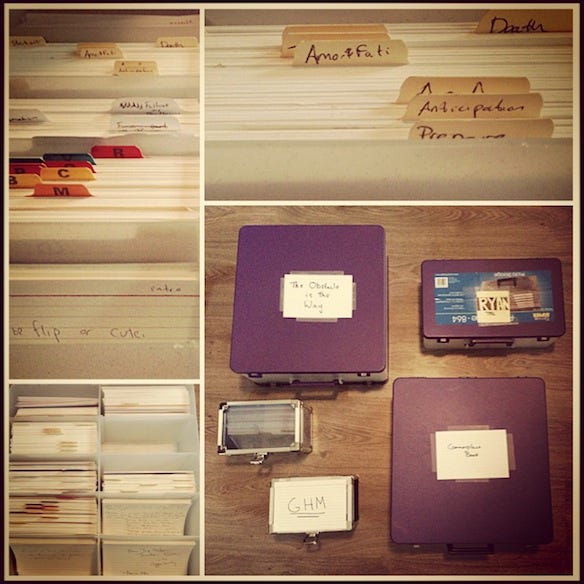
When Greene sets out to write a book, he would end up with hundreds of note cards, each containing bits of information necessary to piece together the puzzle of a finished product. The key is to ensure that the notecard is properly referenced so that it can be organized into similar themes (often becoming book chapters). Overall, The premise is very simple but its execution takes discipline.
- When you read something you like or hear something or think of something, write it down on a notecard.
- File the notecard according to an overarching theme or within a section of a bigger project (like a book).
- When you aggregate the cards under a theme, it will formulate the foundation for a bigger idea.
- Make the system a ritual and do it for everything that you find or like. The value in the system is that it builds upon itself. More note cards create more ideas which leads to more ideas. Each note card contributes to a bigger theme.
- Go back through the cards often as it will help to generate new ideas or reignite old ones.
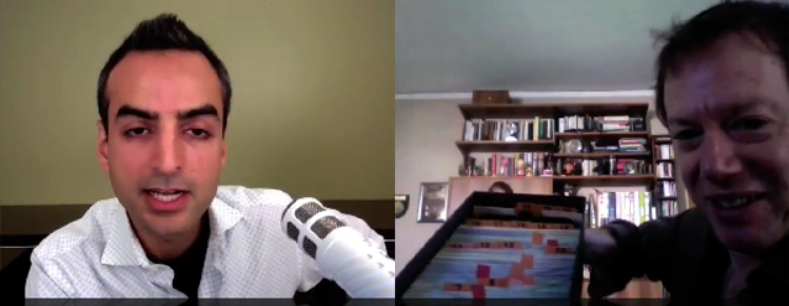
When Greene was interviewed on Mixergy, he was able to fully describe the process: “Well, basically, I read a book and I take, as I’m reading it, I underline it and put notes on the side and then I go back and put them on notecards. And I can gauge a good book will generate 20 to 31 notecards. A bad book will generate two or three notecards and I will find themes in this book and I will take a book that’s maybe no organized very well and I will do the organizing. On page 30 you talk about this and you talk about it on page 180, you should have put those two together but I’m going to put those two together. And I find the themes in there and I break the book down into the gist of it, the heart of it. And, I categorize it later as I move into the process, I see these themes and patterns that you were talking about that an apprenticeship, creativity, working with a mentor, social intelligence. Slowly the chapters come to life and I’m now able to organize it in various chapters. Each part has the title of the book on it and is color-coded, have different colors of cards, depending on the kind of subject that I’m dealing with. If it’s the arts, science, politics, etc. It’s elaborate. You don’t want to know everything about it, but with this there now, if I’ve done all that work and I sit down to write, I have at my fingertips, all of this. If I want to do Leonardo da Vinci, I have 50 notecards that break him down from every possible angle. I can now, with that, write in a much fuller, deeper, dimensional way because I’ve taken all this information and I’ve organized it.” — Robert Greene
Here are some additional thoughts from Greene on his Reddit AMA: “I read a book, very carefully, writing on the margins with all kinds of notes. A few weeks later I return to the book, and transfer my scribbles on to note cards each card representing an important theme in the book. For instance, in Mastery, the theme of mirror neurons. After going through several dozen books, I might have three hundred cards, and from those cards, I see patterns and themes that coalesce into hardcore chapters. I can then thumb through the cards and move them around at will. For many reasons I find this an incredible way to shape a book.”
Like I said earlier, it is not a very complex system, yet Greene has used it to assemble a list of multiple best-selling books. He admits that his brain is built for distilling large ideas and huge amounts of information; he says that he is built to write books. But it can work for anyone that is willing to be diligent in the process, to constantly revisit the notecards and the ideas that they contain. Despite Greene’s massive success as perhaps the most notable non-fiction writer of our generation, he created the system after an unsuccessful stint in journalism and being told that he would never amount to anything as a writer.
A System for Personal Success
The value of the system is that it can be used to help archive large amounts of information. Ryan Holiday began his career by filing note cards into categories that were useful for his own personal success. He is now a recognized authority in many of those same categories:
- Stoicism (served as the premise for his most noteworthy book, The Obstacle is the Way)
- Life (mostly advice for himself)
- Strategy (examples of strategic genius or wisdom)
- Post Ideas (ideas for articles to write)
- Trust Me, I’m Lying (a book he wrote on media manipulation)
- Writing (wisdom about the craft)
- Education (ideas about learning)
I adopted the system with a slight twist. Before transferring the key ideas onto notecards, I take all of my markups on the margins, notes, and ideas and put them onto a Google word document. This allows me to further refine all of the big ideas while being selective with what I choose to transfer onto the notecards.
The notecards are still the core of the system because I still revisit them the most and organize them according to the topic, book idea, or project.
The value in a system like this is organizing large amounts of information into “piles.” If you read a lot, you need a way to organize and capture the most valuable pieces of information. My main goal with personal development and self-improvement was to use it as a stepping stone to reach new heights.
If you don’t use the information to improve in some way, reading is nothing more than a leisure activity. It can even become a pointless exercise in self-manipulation if you think you are getting better by simply reading more books.
“Nothing changes if nothing changes.” — Courtney C. Stevens
Nothing will change unless you change and reading is a powerful catalyst only if it drives you to action.
One of the most important things I learned in college was to not accept things at face value. You have to look deeper than what you first observe, see, and feel. College may not have been that useful (Holiday never returned after his apprenticeship with Greene), but if you learn that one important lesson, it is still worth the time.
The same principle applies to reading a book or consuming a piece of content. You have to look deeper and allow the core message to seep below the surface of your conscious mind. A book or idea can change your life, if only you have a system in place that moves you to action.
This story contains affiliate links which means I get a portion of what you pay at no extra cost to you. If you are new to Medium, you can join using my referral link below. For just $5, you will get full access to my stories, book reviews, and publication on living a high-performance lifestyle.


