
I’m a Black Trans Woman. All Parts of My Life Matter.
Society focuses on one thing, but I see all the intersections
I’m a radio producer. I’m a stand-up comic. I’m an aunt, sister, and friend. But lately, it feels as though my identity as a Black transgender woman is all anyone can think about.
I knew coming out as a Black trans woman wouldn’t be easy. Three years ago, the world had to say goodbye to the child my parents raised. I was named after my dad, and Sherm was the shorthand version, which I kept. I chose a new first name, Morgan, because it is beautiful and bold. Selecting a name, however, was one of the easier parts of my journey. And though it is difficult to talk about the lowest moments, I want more people to see me for who I am. I’m a Black trans woman and all parts of my life matter.
I tried to mentally prepare for the pain that comes with this journey. But that’s impossible. After building a career as a radio producer, I was terminated from one of the most respected stations in Washington, D.C. I wanted to push for trans-inclusive feminism, and I wasn’t supported. This type of situation happens to trans women often, a myopic understanding of feminism with no inclusion of trans women. So in 2018, my workplace shifted from the radio station to my home long before the coronavirus pandemic forced us all to quarantine. I’m rebuilding my career because transness requires resilience. It’s an uphill battle, but it can be done.
I’m not as sure that I’ll win the battle with family though. Will they ever accept Morgan? I’ll never forget the day my mother came to visit me in a psych ward. I love my mother, but on this day — the day after an unsuccessful suicide attempt — her words were far from comforting.
“The love and acceptance you want from me you’re not gonna get,” my mother told me. She was crying when she said it. I was numb at first, but her words stung. The woman I admired the most unequivocally denied my existence.
Part of getting to know me meant unpacking my own isms.
As a child, I learned that my job was to make mama proud, but as an adult, this edict grew complicated as I embraced Morgan and grieved my familial losses. My self embrace was followed by faded friendships and a pre-Covid version of social distance as people explained their absences with phrases like “I don’t agree with your lifestyle.” None of them wanted to get to know Morgan. They were married to Sherm. But the truth is this: I became more than they could imagine.
Part of getting to know me meant unpacking my own isms. For 30 years, I was given the benefit of the doubt as a Black (assumed) male with light skin. In the last three years, I experienced unimaginable loss while blossoming into the Black transgender woman that was always here. I had to unlearn the things society taught me. I had to unpack my misogyny and transphobia. I had put a lot of effort into fitting in without thinking about who I was oppressing by doing so. I stayed silent when I saw queer kids getting picked on in school. I crept through the night to sleep with trans women and then abandoned them once I got what I wanted. I had to change, but initially, I was intimidated by that internal process and by people powerful enough to be themselves. I didn’t think I was strong enough to handle how people would react to the real me. But the real me is here.
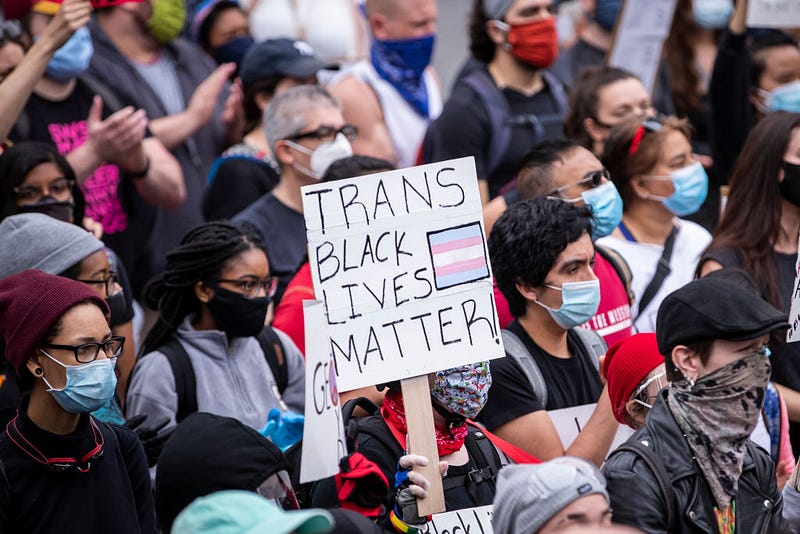
My understanding of how the systems of sexism, racism, colorism, and transphobia intersect is a large reason why I speak out. There have been at least 22 killings of transgender or gender nonconforming persons in the U.S. thus far in 2020, via the Human Rights Campaign. One of those deaths happened in Marquette Park in Chicago, Illinois, where I grew up. Selena Reyes-Hernandez was a Latina trans woman whose life ended at the age of 37. A man killed her after coming to her home, reportedly because she was transgender. He left her home, was still apparently pissed, and came back and shot her. I listened to my best friend cry over the phone about Selena’s death. She was crying because she too is a Latina trans woman, and she’s 36 years old. While my best friend and I are committed to protecting each other, we know that our lives could be stolen from us at any moment.
The real me reached out to Selena’s friends on Facebook to get a proper image sent to news outlets. Selena was deadnamed in the articles, and her photo was not posted on any of the stories about her death. I wanted to make sure her photo reached the news outlets so it could replace the image of the monster who killed her. This is doubly important because as a trans person, our photos in death become one of the few times we’re actually celebrated. People now reach out to me whenever a trans person is murdered. Black men do this often. They are afraid to express these sentiments publicly because of how they’ll be judged. Even the slightest acknowledgment of concern about trans lives puts their masculinity in jeopardy.
The real me understands the dichotomy of skin tone even within my transness. It’s been my experience that White people see me as Black while Black people see me as trans. Colorism adds yet another layer to this cake. This crystallized for me when I shifted into the hospitality industry. Earlier this year, as racial and political tensions exploded in this country, I logged into my email to find a thread where a White trans manager weaponized my transness against a Black female manager who is dark-skinned. This moment brought back the twisted memories of my childhood and of favoritism. My complexion is light and normally read as something other than Black. I got the benefit of the doubt to a point. For example, I was accepted into advanced media programs I did not qualify for. I was forgiven for mistakes that my darker peers were not.
In this work email, I saw the same dichotomy happening again, except this time the weapon wasn’t solely skin color. I handled the issue with grace. No weapons needed, but it angered me that a manager attempted to get Black women to turn on each other, and that is violent. My transness is important, and I am glad they support it, but my Blackness is important as well. I cannot be the trans employee on your website but Black when it’s time to cut payroll.
I’m so much more. I take care of my grandmother, who is immunocompromised, during these unusual times. This includes getting her jellybeans before her trips to dialysis. I serve on a diversity committee for the restaurant group I am furloughed from. I still make time to tell jokes.
Through all of this, I hope people can see me for who I really am. I’m a survivor. I’m a leader. I’m an advocate. I’m resilient. I like sports. I love music. I’m not cookie-cutter, and no trans person is. I’m a fully formed human being. I’m powerful enough to keep my nickname of Sherm. And as a Black trans woman, I finally embrace that my Black trans womanhood will necessarily underline everything I do.