
Why The Apparent Motion We See in Film and Video Has No Scientific Explanation
The Ability to Create Motion From Coherent Still Images Has No Natural Cause — Illustrating The Paradigm Of Responsive Naturing
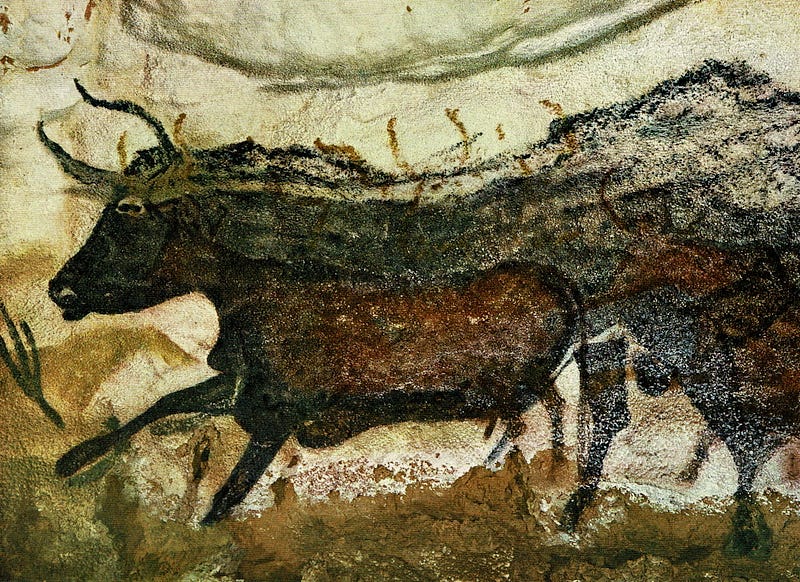

My study of the prehistoric paintings in the Lascaux cave in Southwest France, as well as other local caves in the area, has been one of increasing respect for the early human artist-shamans that created these artworks. It has been humbling as well to see how little we have added to their understanding of human perceptual abilities. Even the destruction of the original paintings in Lascaux has served to open my eyes to how little we can do to mitigate the extreme climate changes that we have caused. Not because these changes are inevitable, but because we lack comprehension of what we have done and how to undo it without making matters much worse.
What I did not expect to come out of this interest was that it would lead me to the precious insight that the apparent motion that we experience every time we watch a video or film, or use an electronic device with a screen, is positive evidence of what I have presented in my work on the novel paradigm of Responsive Naturing. To explain this, I need to recap a bit of what I have explained at length elsewhere.
The primary difficulty in describing a nondual reality is that both ‘consciousness’ and ‘awareness’ are defined dualistically in our current paradigm. Because of this, they are difficult to fit into a nondual understanding without ignoring certain problems in doing so. I have explained why neither is veridical as defined, because there are no individual perceivers, nor any independent things that are perceived, so to say that one has an awareness of something is wrong. But I go further because just arguing against that one view is not sufficient.
Some traditions speak of “pure awareness” to denote simple cognitive presence, but then extend that to be the nondual source of all things, without acknowledging that it is no longer pure if it is the source of all things as it is no longer simple aware presence.
Some other traditions say that it is not the source of all things, but simply is all things, without accounting for how ‘awareness’ accommodates things. If it is all things, then calling it awareness is misleading because they have done nothing to change the existing understanding of what “awareness” means. Using it ‘as is’ obfuscates what the structure actually is.
And yet, no matter how we describe “awareness,” we experience a life filled with things, events, and emotions. How is this possible? I have moved away from using abstractions, such as “awareness” and “consciousness,” in the paradigm of responsive naturing. Instead, I focus on how things ‘show up’, given that they appear regardless of what we think is happening. My goal has been to arrive at an understanding that makes apparent what is otherwise hidden by our abstract concepts.
I first show that if we put aside our concept of Time by accepting what science is now asserting — that Time is just a formalism that has no veridicality — then the visceral presence of duration in all of our experiences must be other than time. I emphasize that each response is recognized as it is natured. This is the indivisible first stage of the action of naturing, which occurs with no entity or agent doing the naturing, and this naturing is cognitive, yet impersonal. The latter results from the nondual nature of the new paradigm — there are no entities, so there can be no ‘personal’ knowledge.
This first stage, which is inseparable from the naturing, is the veridical event in every perception because it is nondual — so there is no actual, nor imputed, perceiver, perceived, or entity involved. But note that this understanding means also that there must be a slight offset between the response and the immediate recognition of it. One cannot recognize what is not yet present. The neuroscientist Benjamin Libet has written about this delay in his book “Mind Time.”
Note that this is not an idealist stance because there is no mind-entity. ‘Mind’ is simply the collection of all the things presenting now. This is also not a materialist view since there is a cognitive aspect to the naturing of every thing. It is something other than those two theories.
I argue that ‘awareness’ without duration is empty of meaning, and that ‘duration’ without awareness is also bereft of meaning. The former is easy to contemplate, but the latter normally creates a reaction of insistent pushback. This is because time is seen as a dimension of reality — but remember, science says it is only a formalism to make their theories work. It is important to realize that there is no delta between these two aspects of our experience — awareness is duration with no residual meaning, and duration is awareness with no residual meaning.
This does not make duration a kind of psychological time that distorts our perception, because there are no entities to which such an assertion can be applied. So the pushback to the assertion that duration without awareness is empty of meaning results from having two abstract ideas which are assumed to have completely different meanings, as in our current paradigm. We are unfamiliar with a paradigm in which the naturing of all natural things is accompanied by an impersonal recognition of what is natured, rather than, as in the current paradigm, having a hypostatized ‘consciousness’ of something, in a dualistic interpretation of what is happening.
This cognition of what is natured is very much like how a fluid dancer, for example, recognizes the quality of their performance — it is a flowing performance that is present within the dancer who is inseparable from their unfolding performance. It is not something ‘objectively’ perceived.
Then I go deeper: what is recognized in each response is specifically the coherent continuity of the thing recognized. This is possible because each response is a vignette which includes the ‘backstory’ of the conditions that played a role in the response. It is not a memory in the normal sense. And it is not a calculation of differences between two states, because there is no longer a previous state present — the vignette only has the conditions that made the actual response possible. The recognition of the vignette encompasses both, because a response is both — what is done and why it is done. William James commented on something similar to this when he spoke of the ‘specious present’, which is a good starting point towards understanding this paradigm.
This is not the whole paradigm of responsive naturing, but I want to present this part because I see its applicability to an explanation for the apparent motion that occurs when we view videos and films, which is still not explainable in any conclusive, non-speculative, scientific way. This illusion is often claimed to be caused by the ‘persistence of vision’, even though there is no such ‘persistence’ in the illusion of apparent motion. This is readily discernible in the motion’s clarity, which would not be the case if one image bled into the next image because it persisted.
To put my point bluntly: Every moment you spend watching apparent motion in video or film of any kind, you are watching Responsive Naturing at work in your experience. Each response to a visual perception of a still image projected onto a screen is initiated because of the coherent continuity evident in the visual perception. This results in the apparent motion that is presented when all that is there is a stream of still images — but images that are continuously coherent in their content (until an editing cut occurs in the film or video). If the images are not continuously coherent, then fluid motion is not substituted for the still image.
As an example, the video below is a 24 frames-per-second video in which there is no coherent continuity at all — each frame is a random picture. It is enlightening to see how it actually appears to us, when the difference is in the content of the images, not the medium. But heed my warning: watching this could give you a headache or even a seizure if you are prone to having seizures caused by strobing lights. The reason for presenting this to you is so that you see exactly what occurs in all video and films that you watch, yet when there is a coherent continuity present within the images, you see only apparent smooth motion. There are no currently identified neurological correlates in the brain for the recognition of the coherent continuity that makes this possible, which is why there are still no conclusive, non-speculative, scientific theories to explain it in physical terms, nor will there be.
That the recognition of coherent continuity has nothing specifically to do with perception, but with the general naturing of all things, explains why even prehistoric early humans could understand visual illusions, as evidenced by their use of the techniques used in modern videos, films, illustrations, and paintings in order to create illusions of motion in their own paintings. And other animals can view the apparent motion of video and film — perhaps all sentient beings with vision can. For example, this video is evidence that parrots see the apparent motion in video displays:
The reason this recognition of coherent continuity is the constraint within which naturing must operate in the new paradigm is because there is no actual change or motion, as it is presently conceived. Each response is a non-durational reconfiguration. Reality, as responsive naturing, depends on the impersonal recognition of coherent continuity as a condition for each response. But if each response was a durational event, a paradox would present: as the granularity of each equal unit of change or motion becomes smaller, the count of the number of discrete changes becomes larger, until the change is perfectly continuous, so that the number of changes is infinite, as well as the duration of the event. This paradox is present in today’s paradigm, but is ‘fixed’ by postulating a smallest possible unit of change and a shortest possible unit of time so that infinity is never reached . In the new paradigm of responsive naturing in which each response is a vignette, which ‘flashes’ like the sudden presentation of a still image, it is the coherent continuity recognized in each vignette that creates the fluid motion — and this is how we experience change and motion, without which there would be no point to life. Instead, our lives would be more like that portrayed in the French film L’Année dernière à Marienbad (1961).
If I am correct, as I believe I am, that this phenomenon of apparent motion that we experience while watching films and videos results from the recognition of responsive naturing, then I suggest to you that this is irrefutable evidence that the novel paradigm that I have presented is veridical, and the current materialist paradigm is terminally defective for being an incomplete description of reality, because it does not incorporate cognition into all activity.
This explanation is irrefutable because our vision sees motion directly without the need to construct an illusion of motion — in the real world. In fact, it is the opposite case that is clearly present: the illusion of stillness that keeps the scene around us steady as our bodies and eyes are in motion. When our eyes move, these saccades, as they are called, inhibit the perception of movement. You can experience this yourself if you put your face as close as possible, while still being able to focus, to a mirror, and flash your eyes quickly and repeatedly to the left and right. You can see that the eyes in your reflection do not move. This results from inhibitory signals that block the transfer of visual information to the brain during these saccades. Since this is how our vision works, the response of apparent motion makes no sense, given the energy expenditure and computational load on our brains that creating motion from still images created from blocking motion in order to have still images, would entail. Surely, our brains would overheat and melt from the effort.
Seeing that motion is indispensable to survival — for finding prey, and noticing predators — the time delay caused by blocking motion vision during our own movements is a necessary danger, but to have to create apparent motion from still images endangers survival with no offsetting benefit. There is no obvious evolutionary explanation for our ability to construct motion from still images.
I also note that there are no natural still images in the world, except those that we purposely create as art and advertising. This is most obvious during the prehistoric period during which our ancestors painted the walls of caves, already knowing how to create the illusion of motion in their art.
Finally, I point to the elephant in the room: our time sense is simply this same process of the impersonal recognition of coherent continuity that constrains each response — time is the illusion of motion of all things along their developmental potential. While clock-time is just a comparison between a certain phenomenon, such as the decay of a radioactive isotope and the apparent motion of change in our own development as human beings. The naturing of our human ontogenetic form, which is our developmental potential, and similarly for all other natural beings, informs what is known as the ‘arrow of time’ which logically only ‘flows’ in one direction, because the ‘direction’ is a formalism only. This formalism is grounded in our naturing, which ‘flows’ from response to response. It is the on-going recognition of the coherent continuity of this naturing, conflated with the ‘arrow of time’, which are compared to that of other phenomena, which we call our ‘sense of time’.


